Ovarian Cancer Back Pain vs. IBS: Symptom Comparison

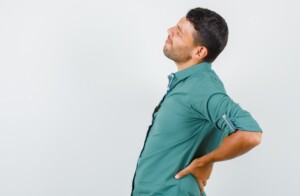
Here is a comparison between the back pain of ovarian cancer and that of irritable bowel syndrome.
Though this article should not be used to make a home-based diagnosis, it does have the purpose to help guide women and encourage them to have their ovaries checked if they’re having concerning symptoms.
Even if you suspect only IBS, these symptoms should be evaluated by a physician, since serious diseases other than ovarian cancer can mimic IBS.
“Ovarian cancer related back pain is usually localized to the lower back area,” begins Teresa P. Diaz-Montes, MD, of the Gynecologic Oncology Center at Mercy Medical Center, Baltimore, MD.
“The pain could be more localized to one side (right or left) of the back depending on the size and location of the ovarian mass,” continues Dr. Diaz-Montes.
”The pain is usually constant and not aggravated by movement. Rarely, there is any irradiation of the pain to the legs or any loss of sensation in the legs.”
By “irradiation,” Dr. Diaz-Montes means pain extending from the back and into the legs.
She continues: “It can be associated with a sensation of pressure in the pelvis. A women may complain of a new onset of constipation or urinary frequency.
“This is due to the compression of the pelvic mass on the adjacent organs. The intensity of the pain is very variable.
“If the mass is small, the pain is duller. When the mass increases in size, the pain is more intense, requiring the use of pain medications.”
As you can see, back pain that does not require painkillers does not rule out ovarian cancer. But how does back pain from IBS usually present itself?
Back pain is not a very common complaint among IBS patients, says Nnenna C. Okpara, MD, gastroenterologist and director of endoscopy at the Center for Women’s Gastrointestinal Health, Women & Infants Hospital in Providence, RI.
But she explains, “IBS patients may describe back discomfort as a cramping sensation, similar to menstrual cramps, which may be secondary to generalized pain or fibromyalgia, or linked to referred pain from abnormal bowel motility.
“It is mostly localized to the lower back, and some patients describe it as worse at night. It also appears to worsen with menses.
“NSAIDs, exercise and muscle relaxation therapies do play a role in the management.”
If you’re experiencing suspicious symptoms, have your ovaries checked before you see the gastroenterologist.
Dr. Diaz-Montes is associate director of The Lya Segall Ovarian Cancer Institute at Mercy Medical Center. Board certified in gynecologic oncology, she has conducted various clinical trials to advance the care of gynecologic cancer. Gynecologic Oncology Center
 Dr. Okpara’s clinical interests include colorectal cancer screening, gastrointestinal disease in pregnancy, and management of functional bowel disorders, including IBS and constipation.
 Lorra Garrick has been covering medical, fitness and cybersecurity topics for many years, having written thousands of articles for print magazines and websites, including as a ghostwriter. She’s also a former ACE-certified personal trainer. .
Top image: Freepik/azerbaijan_stockers

Empower a Teen Bullying Victim with THIS Exercise

A teen who’s a victim of bullying will gain empowerment with a particular type of exercise — regardless of his or her weight or height.
Are you a teen who continuously gets bullied and sees no end in sight?
Or, are you the parent of a bullied teenager, and you’ve “tried everything” to stop this problem, but it only seems to be getting worse?
Teenagers who keep getting bullied develop a sense of helplessness or powerlessness.
Dealing with this situation should be done in a constructive, rather than destructive, way.
Try THIS to Empower the Victim of Bullying
A type of exercise will go a long way at giving the victim of bullies back some of his or her power. It’s powerlifting.
Powerlifting doesn’t have to be competition. Anyone who performs the three powerlifting moves — whether in their school’s gym, home basement or at the local rec center — is a powerlifter.
“The art and sport of powerlifting is all about putting seemingly unclimbable obstacles in front of you, getting really comfortable with feeling uncomfortable, deciding that your current limitations are unacceptable, and working your rear end off till you summit,” says Jarrett Arthur, one of the highest ranking female Krav Maga (Israeli self-defense) black belt instructors in the U.S., who instructs children and adults in self-defense. And she also powerlifts as part of her training.
I have martial arts training. I’m also a powerlifter. Even though I’m an adult who doesn’t get bullied, vs. a teenager who does…I can still vouch for the effectiveness of powerlifting.

Shutterstock/Vladimir Sukhachev
There’s a reason I don’t get bullied, and it’s not because I’m an adult.
In fact, victims of bullies come in all ages, and the adult version of “schoolyard bullying” is workplace harassment, neighbor-to-neighbor harrassment, abusive marriages and abusive relationships.
Being an adult, in and of itself, does not deter adult perpetrators.
I know I can deadlift a heck of a lot more weight than the average man walking on the street.
This knowledge does something to the vibes that transmit from my body as I’m walking down a street past seedy-looking men.
They receive these vibes. They know I’m not prey.
This doesn’t mean that powerlifting has turned me into a bully. And it won’t turn a victimized teenager into a mean-spirited person, either.

Depositphotos.com
Teen victims of bullying feel powerless enough as it is. They feel helpless and this is downright frightening, because they know that the worst has yet to come: being out on their own as an adult in a dog-eat-dog world.
Powerlifting will empower them. Even if your child is only 13 years old and female…GET HER INTO POWERLIFTING.
It will not stunt her growth. Smoking and poor nutrition will, but not strength training.
Growth is determined by nutrition, what goes into the body, and the parents’ genes!
Ignoring the bullying won’t make it going away, but I’m banking that just a few months of powerlifting most certainly will — or at least, dial it down a few good notches.
 Jarrett Arthur is a leader and innovator in the self-defense space, motivating and inspiring with tools and techniques that work to keep you safer and show up more powerfully in every area of your life.
 Lorra Garrick has been covering medical, fitness and cybersecurity topics for many years, having written thousands of articles for print magazines and websites, including as a ghostwriter. She’s also a former ACE-certified personal trainer.
.
Top image: Shutterstock/fizkes

Do Child Karate Experts Ever Get Bullied?

I guess the question isn’t so much do kids with black belts ever get bullied, but rather, do they ever get bullied a second time by the same person?
I’ve trained for years in the martial arts, but I’ve never run a martial arts school, so I decided for this article to consult with someone who does, to get the master instructor’s take on bully-proofing children via martial arts training to the black belt level.
“Everybody has the potential to be bullied, even martial arts black belts, since bullies typically do not respect titles or accomplishments,” says Jarrett Arthur, one of the highest ranking female Krav Maga (Israeli self-defense) black belt instructors in the U.S., who instructs children and adults in self-defense.
Certainly, a bully might decide to pick on the new kid in school who happens to be small in stature or humble in disposition, traits that create the illusion that this individual can easily be preyed upon by bullies.
But this same kid can be prolific in a martial art such as Krav Maga, karate or taekwondo.
The question then becomes: Will the bully likely continue picking on the child who has truly earned a black belt?
And the “picking” here isn’t necessarily physical. Most bullying is non-physical.
Arthur explains that “black belts tend to be kept off of the victim list because they very often possess characteristics that are unappealing to bullies: confidence, self-esteem, verbal and body-language boundary-setting skills, and the know-how to fight back if need be.”
I have witnessed precisely what Arthur has described in the various martial arts schools that I have attended.
I will admit, however, that a few of the schools handed out black belts too prematurely, to kids who exhibited intermediate skills at best.
This is why it’s important that when shopping around for a high quality martial arts school, the parent must be very judicious and discriminant, and not be swayed by slick sales talks or pressure to “sign up now for the great deal” or “get a black belt in 90 days.”
Avoid schools that put the heat on you to sign a long-term contract. And no child or adult can attain a black belt level in only 90 days, no matter what the instructor says. That’s like saying your child can master golf in 90 days.
A child, adolescent or teenager who has truly earned a black belt would be able to make a spectator say, “Dang she’s good!” or “Holy cow!” after seeing a performance of a kata or form.
“Bullies most often look for victims they deem weak, meek and insecure (not adjectives assigned to black belts), so that they have the best chances of successfully putting their targets down in order to pick themselves up,” says Arthur.
Jarrett Arthur is a leader and innovator in the self-defense space, motivating and inspiring with tools and techniques that work to keep you safer and show up more powerfully in every area of your life.
Lorra Garrick has been covering medical, fitness and cybersecurity topics for many years, having written thousands of articles for print magazines and websites, including as a ghostwriter. She’s also a former ACE-certified personal trainer.
.
Top image: Freepik.com

Can Karate Prevent Bullied Kids from Suicide Attempts?

Ever wonder why whenever you read of a bullied youth who has died by suicide, the boy or girl was not accomplished in the martial arts?
Though there’s no magic pill that will automatically turn a bullied child away from the idea of attempting suicide, there IS a potent experience that can give a victim enough hope to want to stick around for a while longer.
Bullying, Suicide and Martial Arts
“What we typically see in bullied children who have taken their own life are victims who have reached the lowest level of hopelessness and helplessness,” says Jarrett Arthur, one of the highest ranking female Krav Maga (Israeli self-defense) black belt instructors in the U.S., who teaches children and adults self-defense.
“Oftentimes, those two states of being work hand-in-hand with powerlessness.”
Though dying by suicide is actually very rare in young people, the number of attempts is alarming.
Every year in the U.S., about two million attempts are made—by adolescents.
Nearly 700,000 require medical attention for the attempt. This information comes from the American Academy of Child and Adolescent Psychiatry.
To my knowledge, there’ve been no studies on the effect of martial arts training on the mind of the young bully victim who has been thinking about suicide.
This lack of research doesn’t mean that martial arts would not have a profoundly positive effect.
But why don’t you sit in on a martial arts class for teens and adolescents and see for yourself what it does for self-value, self-esteem and self-discipline?
Sit in on an advanced class, because these kids would have been in the arts long enough for it to have established a powerful effect on their minds.
Sometimes, just belonging to a judgment-free zone is enough to keep the bullied, depressed teen or adolescent from making an attempt at their life.
A high quality martial arts school will often provide a calendar of judgment-free social activities where everyone accepts everyone else, no matter what they look like or where they come from.
I once belonged to a school that had an assortment of activities: bowling nights, movie nights, pizza nights, etc.
Often, bullied kids who think about suicide come from dysfunctional families.
At school they suffer; at home they suffer. There is no escape. But the martial arts school can provide that escape.
Plus, training for tournaments ignites the goal-setting process. Who wants to take a lethal amount of sleeping pills or hang themselves when there’s a growing collection of tournament trophies in their bedroom?
I swear, kids LIVE for trophies! I have seen what being handed a big shiny trophy does to them.
And I’m not talking just about seven-year-olds; I’m also talking about tweens! You’d think they were handed a wad of $100 bills!
Even if the martial arts practitioner doesn’t think he or she will place in that big tournament, the experience alone will keep their spirit hopping!
Martial arts is based upon reaching for one goal after another, and major goals are divided into smaller, bite-sized goals.
This will help detract the young mind of a bully victim from wanting to put an end to it all via suicide.
Jarrett Arthur is a leader and innovator in the self-defense space, motivating and inspiring with tools and techniques that work to keep you safer and show up more powerfully in every area of your life.
Lorra Garrick has been covering medical, fitness and cybersecurity topics for many years, having written thousands of articles for print magazines and websites, including as a ghostwriter. She’s also a former ACE-certified personal trainer.
.
Top image: Shutterstock/Kaderov Andrii
Source: nami.org/Content/ContentGroups/Illnesses/Suicide_Teens.htm

Can Childhood Karate Prevent Adult Abusive Relationships?

Seems that a little girl who takes martial arts lessons will never end up staying in an abusive relationship as a helpless powerless victim.
It’s not always about the ability to knock out a strapping six-foot man.
It’s the ability to feel good enough about yourself, and self-confident enough, NOT to be drawn to violent men in the first place.
Or, to put it another way, feeling secure enough with your place in the world that you’d never STAY with such a man after the first time he exhibits violence.
“Yes, students learn how to physically defend themselves in martial arts classes, but it goes beyond that,” begins Jarrett Arthur, one of the highest ranking female Krav Maga (Israeli self-defense) black belt instructors in America, who teaches children and adults self-defense.

Shutterstock/Fotokvadrat
“The particular life skills taught in martial arts classes can give your child an incomparable boost in their ability to maintain healthy and safe relationships as teens and beyond to adulthood.”
It stands to reason that childhood martial arts training would be a powerful preventive agent in getting involved with an abusive man.
Not that it’s never happened, but let’s take off our blinders and see the logic behind this premise.
“A lack of confidence and self-esteem is one of the biggest factors in young adults and adults engaging in abusive relationships,” explains Arthur.
“Parents have a huge opportunity to build a child’s confidence and subsequently, set them up to be a confident adult.
“Enrolling your child in a martial arts class is one of the best ways to boost their confidence.
“Martial arts curriculums are built to consistently challenge students with difficult but attainable goals, and are quick to highlight achievements through positive praise and celebration both privately (direct praise from a Sensei) and publicly (being awarded with a new belt or stripe in front of the entire class).”
Women Who Stay in Abusive Relationships Lack Self-Advocacy
“Self-advocacy, or an individual’s ability to effectively communicate, convey, negotiate or assert his or her own interests, desires or needs, is a skill often overlooked, partly because it’s mistakenly confused with back-talk or disrespect,” Arthur explains.
“Back-talk is very different from self-advocacy and can be differentiated by tone of voice, body language and subject.
“Your child whining about not wanting to do homework is very different from a child using clear, concise words to tell a bully that what he/she is doing is not okay.
“Martial arts programs tackle this life skill head-on by encouraging respect, while teaching kids how to effectively communicate using their words and body language (like eye contact).
Reputable schools will have students participate in role-playing scenarios so that students can get hands-on practice standing up for what they want and need in appropriate situations (like bullying) in a confident and effective, but respectful way.”
Parents should do their homework when hunting for a high quality martial arts school and not be pressured into signing long-term contracts with so-called black belt factories or “McDojos.”
Arthur continues, “It’s often hard to recognize an abusive relationship, especially one in which no physical abuse takes place.
“While most martial arts schools will leave explicit discussions of abuse off the table, many will lead lessons plans geared towards recognizing situations and relationships that don’t feel good, or ones that are not mutually positive and beneficial.
“I teach kids as young as five the difference between a joke and bullying because it helps them begin to learn what behavior by their peers and partners is ok, and what is not.”
Jarrett Arthur is a leader and innovator in the self-defense space, motivating and inspiring with tools and techniques that work to keep you safer and show up more powerfully in every area of your life.
Lorra Garrick has been covering medical, fitness and cybersecurity topics for many years, having written thousands of articles for print magazines and websites, including as a ghostwriter. She’s also a former ACE-certified personal trainer.
Best Type of Exercise for Improving Ejection Fraction
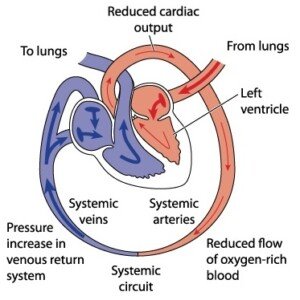
Not all exercise is the same when it comes to improving ejection fraction in heart failure patients.
There is a certain type of exercise that research has shown to improve one’s ejection fraction remarkably well, even if it’s very low. It’s called interval training.
The first report is titled “Superior Cardiovascular Effect of Aerobic Interval Training Vs. Moderate Continuous Training in Heart Failure Patients” (journal Circulation).
“Continuous training” refers to a fixed pace, or a pace-based session, such as 20 minutes of nonstop level (non-incline) walking at 2.5 mph (give or take very minor fluctuations in speed).
This nonstop speed, though slow from the viewpoint of fit people, can be quite fatiguing to many heart failure patients.
To convert 20 minutes to an interval training session, the patient might go just one minute at 3.2 mph and then three minutes at 1.8 mph, and keep alternating this way till 20 minutes are up. This second approach is superior to the first approach.
For this Norwegian study (Wisløff et al), 27 people with an ejection fraction of 29 percent were assigned to one of three groups.
The first group was continuous training (also known as “steady state”) at 70 percent of highest heart rate.
The second group did interval training (95 percent of highest heart rate).
The third group was the control. The aerobic sessions were done for 12 weeks, 3x/week.
For only the interval training group, the interval training report states: LV ejection fraction increased 35%.
The conclusion says that intensity of exercise was an “important factor” for improving aerobic capacity and reversing left ventricular (LV) remodeling.
The second study (Meyer et al) pits HIIE against MICE.
- HIIE stands for high intensity interval exercise
- MICE stands for moderate intensity continuous exercise.
This report is heavily detailed, but the conclusion states: HIIE is more effective than MICE to improve VO2peak in patients with heart failure and reduced left ventricular ejection fraction.
Studies of aerobic exercise on people with congestive heart failure (who of course, have the compromised ejection fraction) have the patients either walking or pedaling a stationary bike.
Why don’t more cardiologists push the idea of interval walking for their chronic heart failure patients?
“It’s important to know that it’s overall a very small sample size of only 27 total patients,” says Sendhil Krishnan, MD, referring to the first study.
“I think the obvious reason that this is very difficult to implement in the general population is really that time involved and commitment necessary to get patients on a scheduled aerobic interval training that is required,” explains Dr. Krishnan, a board-certified adult general cardiologist with advanced subspecialty training in interventional cardiology.
“Remember, these patients were trained at 95 percent of the target heart rate, three times a week for 12 weeks.
“That level of exercise program can only be achieved with a dedicated trainer or at a dedicated cardiac rehabilitation facility.
“Patients are also at different functional levels. Some may have limiting arthritis, back or hip or joint pain that limits their mobility, and obviously the older they get the less functional they’re going to be.
“So while in theory I certainly would recommend interval training to all my patients (regardless of having CHF), the reality may be that only a very few patients are able to maintain this degree of exercise training.”
Keep in mind that the very person who goes on to develop chronic heart failure that impairs quality of life is also the very person who – in his or her younger days – never felt a need to permanently commit to a serious exercise regimen.
It’s thus no surprise that committing to one (even if it’s non-strenuous) later in life would be an unrealistic expectation.
What about the patient who actually commits to a plan?
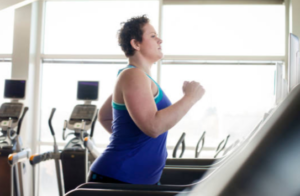
The treadmill is ideal because speed and time lapse can be easily observed.

Holding onto a treadmill is wrong other than for a momentary balance check. Look how it warps this man’s posture and creates a false sense of accomplishment. This is not how we walk once we’re off the treadmill. Heart failure is no excuse for holding on.
Intensity can also be introduced with an incline for those whose knees don’t like brisk walking.
• Do not hold onto the treadmill. This negatively alters gait and posture.
• It also mimics using a walker.
• Holding on teaches your body that it needs external support for walking.
• A natural arm swing encourages good posture and activates the body’s balancing mechanism.
• Start out at a slow speed to get used to walking on a tread without holding on.
• Hold on only for brief, momentary balance checks such as when you’re drinking water.
If you prefer a stationary bike, that’s fine too, as interval training can be done with any piece of cardio equipment.
In summary, interval training simply means brief periods of exertion alternating with brief periods of casual pacing.
 Dr. Krishnan is with Pacific Heart & Vascular, where you can view his videos on heart disease and healthy living. He has numerous publications and often speaks at local and regional events.
 Lorra Garrick is a former personal trainer certified through the American Council on Exercise. At Bally Total Fitness she trained women and men of all ages for fat loss, muscle building, fitness and improved health.
.
Top image: Shutterstock/Blamb
Sources:
circ.ahajournals.org/content/115/24/3086.short
fondationepic.org/site/images/stories/2013_Meyer_P_HIIT_in_CHF_REVIEW.pdf

WHY Does Acid Reflux (LPR) Cause Throat Lump Feeling?

You already know that the “lump in the throat” can be caused by LPR or acid reflux, but here’s WHY this occurs.
LPR is actually acid reflux that makes it up to the throat.
A well-established symptom or result of LPR is the sensation of a lump in the throat.
But what is it about LPR that makes the patient experience this “feeling”?
“One can feel like they have a mass in the throat, and it is hard to swallow and food is getting stuck,” begins Dr. Stacey Silvers, MD, of Madison ENT & Facial Plastic Surgery in NYC, who is board certified in otolaryngology—the specialty of the ears, nose and throat. ENT physicians deal a lot with LPR (laryngeal pharyngeal reflux).
“That feeling of a lump in the throat is a physical swelling from irritating-stomach acid reaching up into the throat.
“If all patients with acid reflux presented with heartburn and indigestion, the diagnosis would be easy.
“As a result patients would take over the counter reflux medication for their uncomfortable ‘classic’ reflux symptoms.”
But not all patients have the classic symptom of heartburn from their acid reflux.
The symptoms can bypass the stomach and chest area and be felt only in the throat.
LPR Scares Many Patients
“The fear in most is that this lump is a tumor,” says Dr. Silvers.
“The area in the throat that is inflamed and swollen is at the opening of the esophagus which sits behind the vocal cords at the level of the thyroid cartilage in the neck.
“As a result of this swelling, other associated symptoms like hoarseness, shortness of breath, post-nasal drip, cough and throat-clearing are also common symptoms.”
Dr. Silvers adds that this area requires examination with a fiberoptic scope.
Typically a patient will come into the doctor’s office and be diagnosed with allergies or asthma, especially if they complain of shortness of breath or a sensation that not enough air is getting through when they inhale.
“But allergy medications and asthma inhalers are not working,” says Dr. Silvers.
“In most cases the diagnosis is not correct, and the underlying cause of all of the symptoms is missed.”
LPR is also known as “silent reflux” because, as mentioned, it bypasses the classic symptoms that millions of people feel in their chest and upper stomach, and presents as various throat symptoms, including that lump feeling.
Here are Dr. Silvers’ recommended natural and drug treatments for LPR relief.
 An NYC expert in ear, nose and throat care, Dr. Silvers has been named among America’s Top Physicians and Surgeons in facial plastic surgery and otolaryngology numerous times since 2003. Dr. Silvers is an expert in the field of minimally invasive rhinology, resolving patients’ breathing and sinus problems with simple in-office procedures.
Lorra Garrick has been covering medical, fitness and cybersecurity topics for many years, having written thousands of articles for print magazines and websites, including as a ghostwriter. She’s also a former ACE-certified personal trainer.
.
Top image: ©Lorra Garrick

LPR: Natural + Drug Treatment Guidelines from ENT Doctor

Here is what an ear, nose and throat doctor recommends for the relief of LPR symptoms.
LPR causes an assortment of symptoms, and in some patients, this condition can be chronic, frequent, sporadic or something that has happened just a few times—as was the case with me.
LPR Treatments for Relief
For those with the ongoing or frequent symptoms (such as the lump in the throat feeling, difficulty inhaling and constant coughing), “You can start by cutting out acidic foods in your diet, elevating the head of bed when you sleep at night and avoiding eating three hours before bedtime,” explains Dr. Stacey Silvers, MD, of Madison ENT & Facial Plastic Surgery in NYC.
Dr. Silvers is board certified in otolaryngology—the specialty of the ears, nose and throat. ENT physicians work a lot with patients who have LPR (laryngeal pharyngeal reflux).
Acidic foods include:
Corn, blueberries, bread and any other white-flour-based food like pasta, oatmeal, rice, wheat, beans (black, pinto, red), butter, cheese, cashews, peanuts, walnuts, beef, pork, salmon, cod, tuna, turkey, lamb, canola oil, olive oil, sunflower oil, sugar, soda, wine, cocoa, pepper, coffee and vinegar.
Alkalizing foods include:
Green beans, cruciferous vegetables, carrots, onions, tomatoes, mushrooms, apples, bananas, grapes, lemons, oranges, peaches, grapefruit, strawberries, watermelon, almonds, whey protein powder and millet.
As you can see, cutting back on acidic foods won’t be easy, but try it for 30 days and see if it provides relief of your LPR symptoms.
What if cutting down or out on acidic foods, and not eating three hours prior to sleep, don’t help with LPR symptoms?
“If this alone does not manage your symptoms then a trial of an OTC reflux medication may help, taken first thing when you wake up,” says Dr. Silvers.
“Follow up with your doctor if symptoms persist or you become dependent on medication for symptom resolution.
“When you have these symptoms and you are frustrated with misdiagnosis, ask your ENT if you have ‘silent’ reflux.
“The proper diagnosis and treatment can be very helpful and life changing for many.”
An NYC expert in ear, nose and throat care, Dr. Silvers has been named among America’s Top Physicians and Surgeons in facial plastic surgery and otolaryngology numerous times since 2003. Dr. Silvers is an expert in the field of minimally invasive rhinology, resolving patients’ breathing and sinus problems with simple in-office procedures.
Lorra Garrick has been covering medical, fitness and cybersecurity topics for many years, having written thousands of articles for print magazines and websites, including as a ghostwriter. She’s also a former ACE-certified personal trainer.
Top image: Shutterstock/Josep Suria
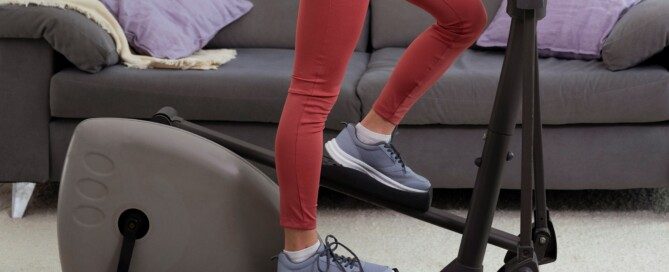
HIIT on the Elliptical Machine for Killer Fat Burn
Here’s how to do HIIT with the elliptical machine for a killer fat burning workout.
Don’t let the smooth pedaling motion of this machine fool you into thinking that this device can’t crush a lot of fat via high intensity interval training.
The elliptical machine for HIIT is useful for people who are not able to run full force, either due to poor physical condition, overweight, or knee problems.
Such individuals can still put forth a gigantic HIIT workout on the elliptical machine and thus burn much fat.
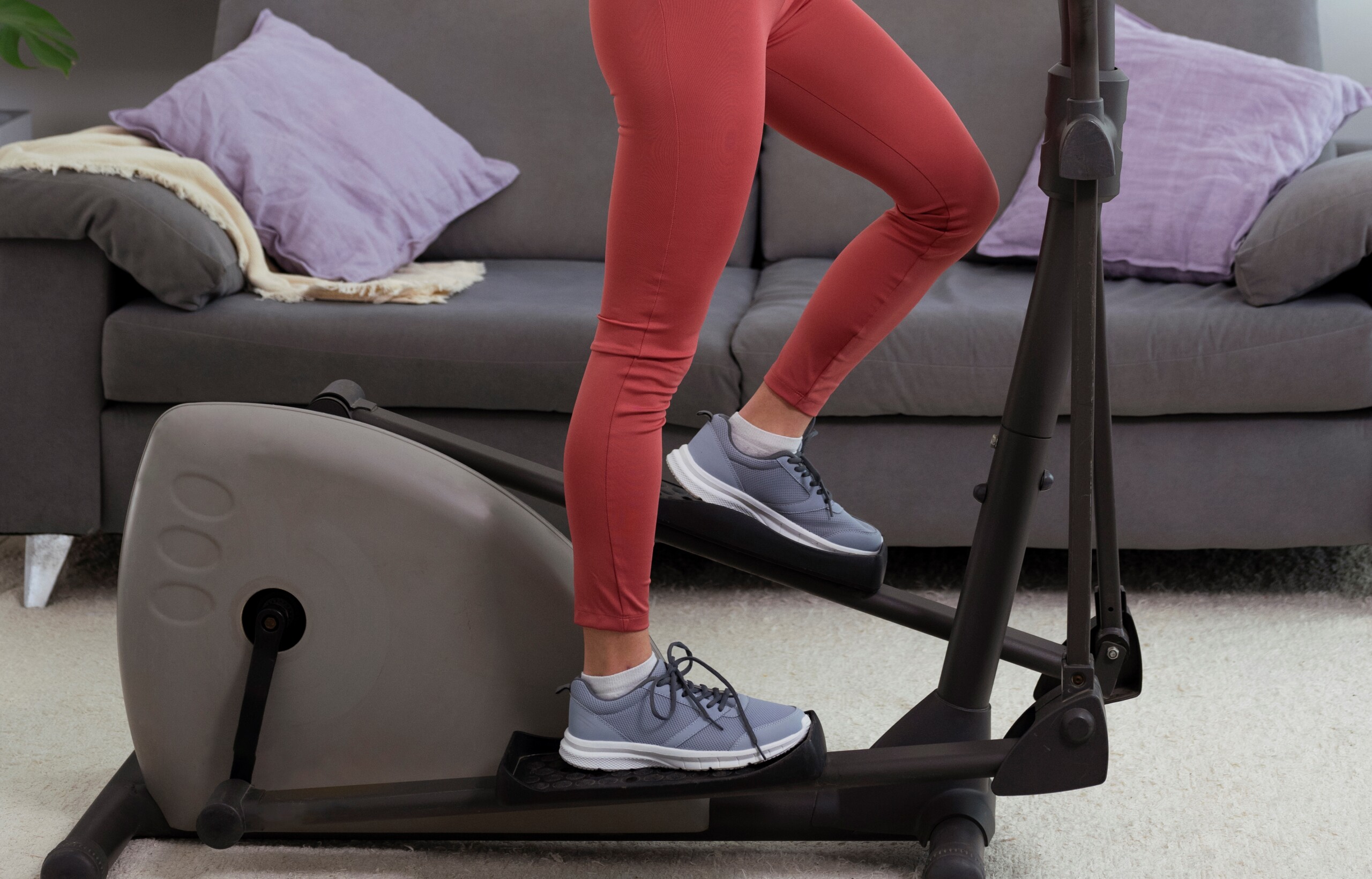
The most effective way to do HIIT on the elliptical trainer is to choose a model that does not have the arm bars — which are shown below.

Freepik.com/jcomp
For significant fat burn, you want your legs and buttocks to do all the work, since these are the body’s largest muscle groups.
Forget the arm bars and instead just move arms in a synchronized fashion at your sides, as your legs pedal away on the machine.
These just get in the way and create a distraction. You will NOT burn more calories or fat with this particular model. Your legs make the arm bars move, not your arms or shoulders.
The arm bar mechanism and the pedals are one and the same, and do NOT move independently of each other.
I do not endorse holding onto the elliptical aside from just a very light, minimal contact with the fingertips to the machine to keep posture in check.
I’ve seen people gripping the elliptical console and rails, which creates poor posture and may lead to back strain.
Keep your body straight and in correct posture as you pedal, and place fingertips lightly on the rails ONLY if you feel like you are going to fall off.
For optimal fat-burning using the elliptical machine, keep your hands off the equipment entirely — unless it’s time for that balance check.
As with any HIIT session, warm up first on the elliptical.

Freepik.com/jcomp
HIIT segments should be 30 seconds, and can be done in a variety of ways, such as light pedal tension and very high RPMs, as fast as you possibly can, forwards or backwards.
Or, you can use heavy pedal tension and still try to go as fast as possible, with the understanding that you will not be able to pedal nearly as fast as with a light tension.
Whichever combination you choose, your HIIT interval should be so fierce, that it should take 90 seconds to two minutes before you are ready to perform another one — 90-120 seconds of gentle, relaxed pedaling at a light tension for heart rate recovery.
An example would be level 7 at 300 RPM for the high intensity component; and level 7 again at 80 or so RPM for the recovery.
Another example of a work interval would be level 12 at 150-200 RPM. You can also vary the pedal angle.
Don’t blow off the elliptical as an effective HIIT tool for burning fat. When you really pump your hardest on this equipment, you will get a significant fat-burning effect.
A good HIIT session with the elliptical machine should last 25-30 minutes, excluding warm-up and cool-down.
Lorra Garrick is a former personal trainer certified through the American Council on Exercise. At Bally Total Fitness she trained women and men of all ages for fat loss, muscle building, fitness and improved health.
.
Top image: Freepik.com

Can Aortic Aneurysm Growth Be Slowed with Losartan?

If you have Marfan syndrome and a thoracic aortic aneurysm, you’ll be very interested in Losartan, which may potentially slow the expansion of the diseased area.
Marfan syndrome is a connective tissue disease, typically treated with beta blocker drugs which lower blood pressure.
Lowered blood pressure is very desirable in the Marfan patient, to reduce stress on the inner wall of the aorta.
In Marfan, the aorta becomes enlarged and can dissect, causing instant death.
A study report (Braverman et al) from 2014 hails Losartan as a possible alternative to beta blockers for slowing the growth of an aneurysm.
Even if you don’t have Marfan syndrome but nevertheless have a thoracic aortic aneurysm, the study’s findings will interest you.
• The study (published in The New England Journal of Medicine) involved 608 people with Marfan syndrome from six months of age to 25.
• All the subjects had enlarged aortas.
• Half the subjects were given the beta blocker Atenolol while others were given Losartan.
• The Atenolol was given in higher than usual doses.
• The subjects were followed for three years.
The patients were followed for three years, and the results in both groups were the same as far as aortic growth rate, tear rate of the aorta, number of surgeries to repair torn aortas and number of deaths.
Losartan may be considered in patients who experience adverse side effects from beta blockers which can include nausea.
Losartan Today
As of 2019, we must wonder where Losartan fits in with the management of thoracic aortic aneurysm. So I asked Michael Fiocco, MD.
“For decades we have used lower blood pressure to theoretically reduce aneurysm growth,” says Dr. Fiocco, Chief of Open Heart Surgery at Union Memorial Hospital in Baltimore, Maryland, one of the nation’s top 50 heart hospitals.
“Although Losartan is used to lower blood pressure (classified as ARB or angiotensin receptor blocker), in this case it is thought to modify the cellular matrix of the aortic wall and inhibit expansion.
“This is in the experimental stage and I am not aware of any human clinical studies.
“Also, the studies to date relate to Marfan aneurysm but not the host of other types.
“This work continues with other ARBs, anti-inflammatory agents and even statin drugs in hopes of modifying the walls of these diseased aortas to inhibit expansion.”

Dr. Fiocco specializes in treating artery disease, valvular disease and aortic aneurysm. His heart care expertise has earned him recognition by Baltimore Magazine as a Top Doctor in 2010, 2011, 2013, 2016 and 2017.
Lorra Garrick has been covering medical, fitness and cybersecurity topics for many years, having written thousands of articles for print magazines and websites, including as a ghostwriter. She’s also a former ACE-certified personal trainer.
.