

Can a Headache Be a TIA’s ONLY Symptom?

Is it possible that a headache can be the only symptom of a transient ischemic attack (TIA, mini-stroke)?
Let’s say the headache even lasts just a few minutes.
What are the odds that this could have been a TIA (transient ischemic attack), especially if you have risk factors for one of these mini-strokes?
Headaches and TIAs
“Approximately 25% of all TIAs present with headache as a prominent complaint, and yes, it can be the only symptom of a TIA,” begins Rob Lapporte, MD, who is board certified in emergency medicine.
“However, this is rare. Usually there is a speech deficit or a motor deficit, such as weakness or facial droop.”
So for instance, a sudden-onset headache that comes at the same time as double vision, in a person who has risks for a transient ischemic attack, are very worrisome symptoms.
This individual should go to the ER as soon as possible, even if the headache and visual disturbance last for only 10 seconds!
Very short duration of TIA symptoms is NOT related to the seriousness of the underlying cause.
So whether that headache, coupled with some other neurological symptom such as one-sided heaviness, lasts only 10 seconds or 30 minutes, the urgency to get to an ER is the same.
A sudden headache that’s full force, like a thunderclap, is a warning to get to the ER as soon as possible—and by ambulance.
This is far more likely to be the immediately life-threatening burst blood vessel in the brain (ruptured aneurysm or hemorrhagic stroke), than a transient ischemic attack or ischemic stroke.
Risk factors and ways to reduce the possibility of having a TIA are the same as that for a stroke, such as controlling blood pressure, structured exercise and not smoking.
And remember, headaches can have many causes.
 Dr. Lapporte has been practicing evidence-based clinical medicine in emergency rooms and urgent care centers for 25+ years. His experience includes that of medical director for Legacy ER and Urgent Care.
 Lorra Garrick has been covering medical, fitness and cybersecurity topics for many years, having written thousands of articles for print magazines and websites, including as a ghostwriter. She’s also a former ACE-certified personal trainer.
Top image: Shutterstock/Ruslan Huzau
Can Strength Training Prevent Sciatica?

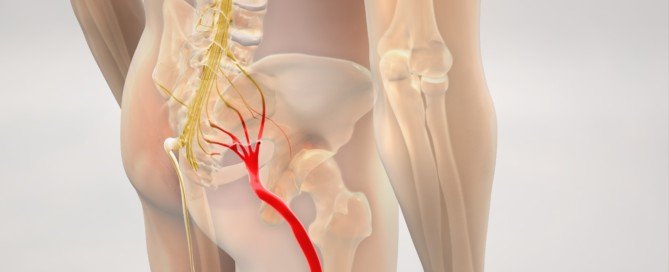
If you’re worried about developing the painful condition of sciatica, and you haven’t been strength training — it’s time to hit the gym and lift those weights.
It’s yet one more benefit to weight workouts: lowering the risk of ever ending up with a nerve problem.
“Some ways to prevent sciatic pain definitely includes strength training of core muscles to help increase stability,” explains Dr. Jeff Langmaid, DC, founder/owner of The Evidence Based Chiropractor, LLC, in Tampa, FLA, a research-based marketing and practice growth company that serves thousands of chiropractors across the globe.
Dr. Langmaid continues, “It’s also important to incorporate flexibility exercises into your routine.
“Strengthening your core muscles can help support your lumbar spine. Core stability and support can decrease the likelihood of an episode of sciatic pain.
“Strength training and core muscles are extremely important, but don’t forget also to temper that with flexibility.
“Our body functions at its optimal potential when we are able to have proper strength and flexibility.”
Strength Training Recommendations for Sciatica Pain Prevention
“Regarding weightlifting and sciatic pain, I recommend a focus more on repetition rather than excessive load,” says Dr. Langmaid.
This means 25 reps with a medium-weight kettlebell, for example, instead of eight reps with a super heavy giant kettlebell.
“You don’t want to perform max load exercise – rather, perform strength training exercises with light weights and more repetitions.”
Another example is a 15 rep deadlift routine. Fifteen reps would be done with a medium or light load of weight.
As with the kettlebell swing, proper form is very important with the deadlift.

Shutterstock/Maridav
Dr. Langmaid continues, “Increasing repetition of strength training exercises goes hand-in-hand with core stability.
“This can help prevent sciatic pain. Strength training with maximum load can increase the likelihood of sciatic injury.”
Among the best strength training exercises for preventing sciatica pain are the following: deadlift, bent-over dumbbell row, seated row, kettlebell swing, corner row, pushup, pushup-row and squat.

Freepik.com/fxquadro
Though these are classic weight training moves, every one of them strengthens the core. Your sciatic nerve will thank you!
 Jeff Langmaid, DC
Lorra Garrick has been covering medical, fitness and cybersecurity topics for many years, having written thousands of articles for print magazines and websites, including as a ghostwriter. She’s also a former ACE-certified personal trainer.
.
Top image: Shutterstock/Zennis Se/Pexels

Can Stabbing Sciatica Pain Come on Suddenly?
You can be simply bending over to tie a shoe when suddenly a sharp pain rips down your leg and takes your breath away. Sciatica can be the cause of this.
“Yes, stabbing sciatic pain can come on suddenly, most commonly due to injury,” says Dr. Jeff Langmaid, DC, founder/owner of The Evidence Based Chiropractor, LLC, in Tampa, FLA, a research-based marketing and practice growth company that serves thousands of chiropractors across the globe.
“Many patients will report bending over to tie shoes or pick up a newspaper and feel the pain,” adds Dr. Langmaid.
Other Passive Actions that Can Bring on Sudden Stabbing Pain Due to Sciatic Nerve Irritation
- Leaning over to put something in or take something out of the dishwasher
- Bending over to fill the dog bowl with food
- Bending over to pet the dog
- Leaning over to shave the lower leg
In fact, any similar motion of trunk/spinal flexion, in which the lower back is bending so that you can reach for something, can induce a sudden stabbing pain — thanks to sciatica.
Yet these are such seemingly very innocuous activities.
Imagine what a more taxing movement might do, such as bowling, picking up a toddler, loading groceries into the trunk of a car, and heavier work such as pulling a sofa closer to the edge of a wall or picking up a box of books.
How can a small, light movement trigger intense sciatica pain?
Dr. Langmaid explains, “Often, decades of repetitive micro-trauma can leave a lumbar disc on the verge of herniating.
“Then, a simple, benign motion such as tying your shoes can cause the disc to herniate [bulge out] and put pressure on the sciatic nerve.
“But don’t forget, sciatic pain can come on acutely or build slowly throughout time.”
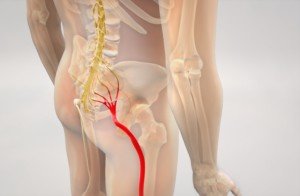
The sciatic nerve runs the length of the leg. Shutterstock/Nathan Devery
If you’ve been plagued by periodic bouts of sudden stabs of pain down your leg or in your butt due to sciatica — it’s time to revisit the concept of aggressive conservative treatment and management of the condition.
This includes sticking to a physical therapy and stretching regimen that a physiotherapist can prescribe for you.
Jeff Langmaid, DC
Lorra Garrick has been covering medical, fitness and cybersecurity topics for many years, having written thousands of articles for print magazines and websites, including as a ghostwriter. She’s also a former ACE-certified personal trainer.
.
Top image: Freepik.com/8photo

Can Stabbing Sciatica Pain Affect only the Butt?

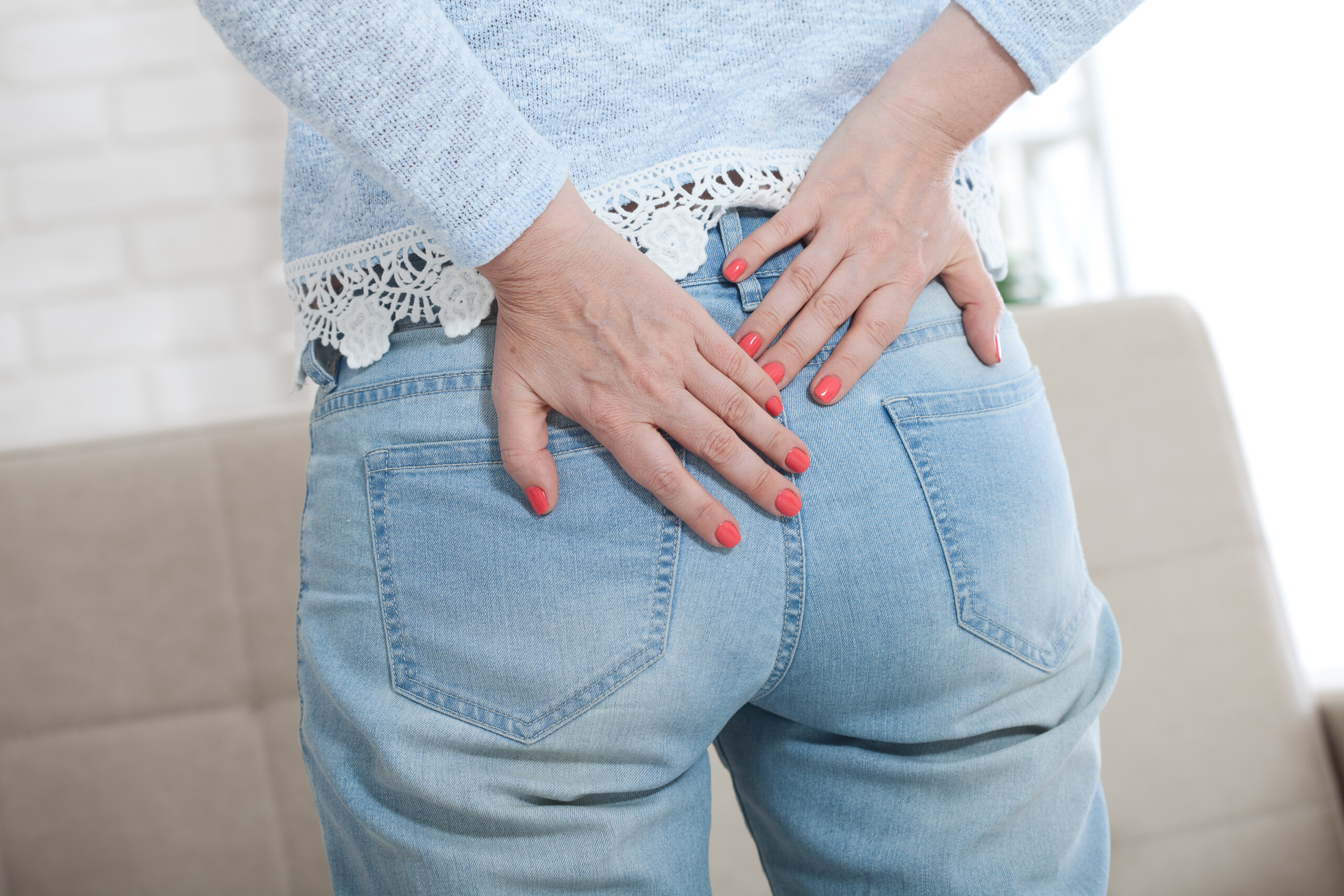
If you have a stabbing butt pain only, can this be caused by sciatic nerve problems?
Imagine walking around in the house or at a store, or standing in line, when suddenly a stabbing pain surges through your rear-end.
This happens from time to time, and there are no other symptoms. The pain occurs only in your buttocks.
“Stabbing-type sciatic pain indicates the sciatic nerve has been pinched, which can be caused by acute injury or repetitive micro-trauma,” says Dr. Jeff Langmaid, DC, founder/owner of The Evidence Based Chiropractor, LLC, in Tampa, FLA, a research-based marketing and practice growth company that serves thousands of chiropractors across the world.
“It doesn’t have to be limited to the buttocks,” continues Dr. Langmaid.
“It can carry down to the leg, then calf and down to the foot. Sciatic pain can run across through the entire sciatic nerve, although some patients only feel it in one or two places.
“It doesn’t have to just be pain, but can include burning, tingling and the electric leg shock. Sciatic nerve pain is often felt as a result of a lumbar disc herniation.”
A stabbing type of pain that comes on suddenly, whether it is only in your behind, only down a leg and especially both in the butt and leg, is highly suspicious for a pinched or compressed nerve.
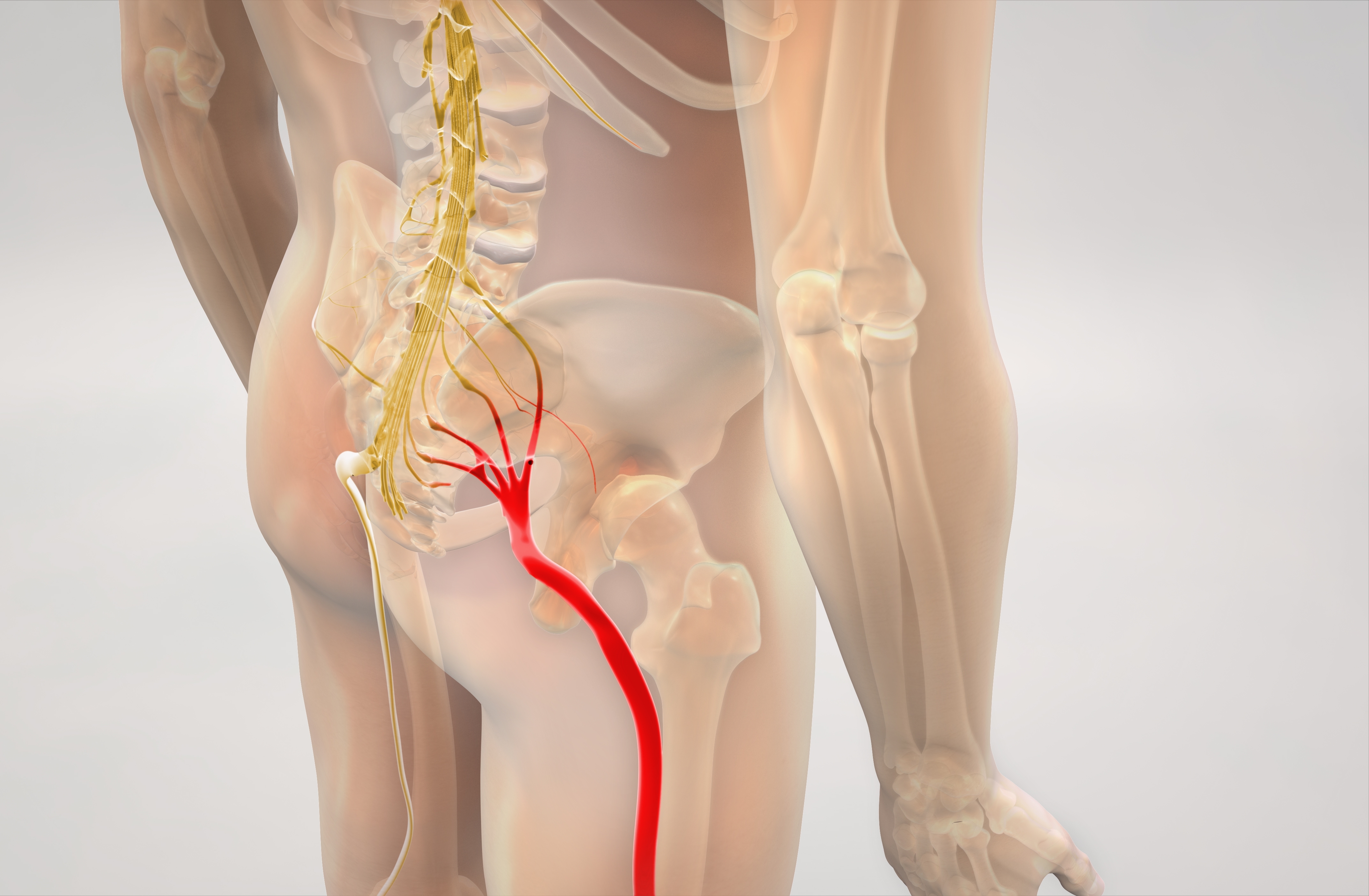
This includes the sciatic nerve — a major nerve that runs down the butt and leg, all the way to the foot.
As mentioned, a lumbar disc herniation is the usual cause. The disc bulges out and compresses or “pinches” a nerve that comes out of the spine. The affected nerve is not necessarily the sciatic one.
As for sciatic nerve compression, this can also be caused a little further down in the buttocks by a tight piriformis muscle.
If this muscle presses upon the nerve, it can induce pain, tingling or numbness.
Stretching and strengthening exercises (see below) can help relieve the condition.

Hip extension for the butt.

Stretch for the piriformis muscle. Shutterstock/Maridav
Jeff Langmaid, DC
Lorra Garrick has been covering medical, fitness and cybersecurity topics for many years, having written thousands of articles for print magazines and websites, including as a ghostwriter. She’s also a former ACE-certified personal trainer.
.
Top image: Shutterstock/Miss Ty
Can Specific Exercises Increase the Risk of a Herniated Disc?
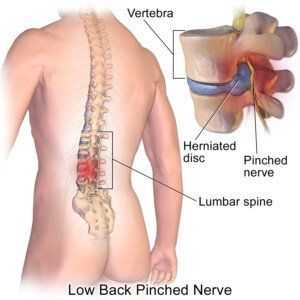
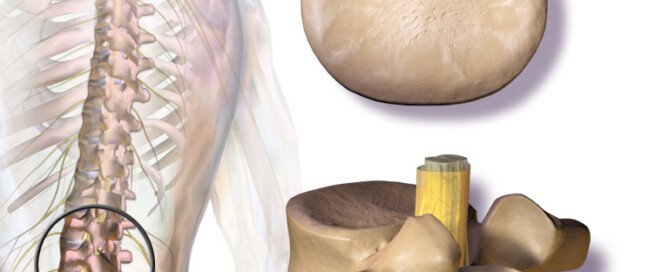
If a spinal disc might easily tear in some people, could certain exercises raise the risk of a herniation?
A herniated disc is when disc material bulges (herniates) out from the spinal column. This puts pressure on nerves.
“At times, our discs can withstand tremendous load and at other times, they can tear like tissue paper,” says Dr. Jeff Langmaid, DC, founder/owner of The Evidence Based Chiropractor, LLC, in Florida, a research-based marketing and practice growth company that serves thousands of chiropractors across the globe.
“They are very strong in some planes of motion and very weak in other planes of motion.
“Exercises that have both twisting and loading are very challenging to a disc and can increase the likelihood of an injury to the disc.
“Some of these exercises may include straight leg raises, deep knee bends or the wood chop, to name a few.”
Exercises that Simultaneously Involve Some Degree of Twisting plus Loading
- Walking lunge while holding a weight and twisting to one side with each step.
- Renegade row (pushups alternating with a dumbbell row)
- Bent-over dumbbell row (most people do twist somewhat when doing this).
- Any oblique-twisting exercise against resistance
- Some yoga routines
If you’re doing something at the gym that involves simultaneously twisting and loading, you may want to rethink your perceived need to do this particular exercise if you’re concerned about a disc herniation.
There actually is no need to simultaneously bare heavy loads and twist, whether your goal is to lose weight, gain muscle or achieve a certain appearance to your physique.
Unless you’re training for a wood chopping competition (and yes, “timber sports” have wood chopping events), do not combine twisting with load bearing.
Also be mindful of what seems to be linear movements that are heavily loaded, such as the leg press.
I knew a fitness director at a gym who “blew out a disc” (herniated it) when he went down very deep in the leg press apparatus, causing his lumbar area to leave contact with the apparatus, while attempting to press up a very heavy load.
Jeff Langmaid, DC
Lorra Garrick has been covering medical, fitness and cybersecurity topics for many years, having written thousands of articles for print magazines and websites, including as a ghostwriter. She’s also a former ACE-certified personal trainer.
.
Top image: BruceBlaus/CreativeCommons

Can Cardio Exercise Prevent Sciatica?

Sciatica is a cause of sudden attacks of severe pain that can shoot down the leg, often starting in the butt.
Cardio exercise is something that you should strongly consider if you’re determined to knock down your chances of ever developing sciatica.
This disorder is very common and involves pressure at some point along the higher portion of the sciatic nerve.
This major nerve extends down the buttocks, continuing down the upper leg and then lower leg.
Cardio Exercise and Sciatica
“Cardio exercise has the potential to indirectly limit or prevent sciatica,” says Dr. Jeff Langmaid, DC, founder/owner of The Evidence Based Chiropractor, LLC, in Tampa, FLA, a research-based marketing and practice growth company that serves thousands of chiropractors all over the world.
He continues: “If you have good cardiovascular fitness, chances are you are maintaining a healthy weight and are staying active.
“Both of those are key contributors to not only preventing sciatica, but overall health and wellness.”
Sciatica does not just happen.
The key is consistent, structured exercise, not irregular or inconsistent bouts of physical activity.
- This means that the periodic pickup basketball games do not count.
- Neither does housework.
Dr. Langmaid continues, “Additionally, many cardiovascular exercises can contribute to core strength and stability.
“For instance, a seated rowing machine is a cardiovascular activity, but provides a strength training component with it that can go a long way towards preventing sciatic pain.
“There are also certain cardio exercises and activities that can increase our flexibility, and the combination of core strength, flexibility and cardiovascular endurance is best together for preventing or limiting sciatica.”
Proper Use of a Treadmill
Walking is a form of aerobic exercise — when done with enough intensity to get the heart rate elevated.
If you use a treadmill, do not hold on. This interferes with natural spinal alignment when walking.

Shutterstock/Khakimullin Aleksandr
When the spine is concerned, you do not want anything less than correct biomechanics when conducting cardiovascular exercise.
If you feel you’re going to fall off unless you hold on, then slow the speed or lower the incline.
Swing your arms so that your upper and lower body move the way nature intended.
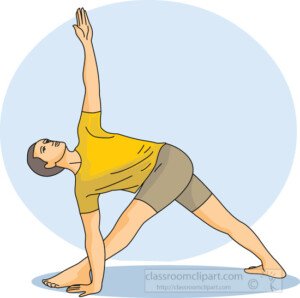
In addition to doing consistent cardio activity to help prevent sciatica, you should employ the exercises depicted below.

Freepik.com/yanalya

Jeff Langmaid, DC
Lorra Garrick has been covering medical, fitness and cybersecurity topics for many years, having written thousands of articles for print magazines and websites, including as a ghostwriter. She’s also a former ACE-certified personal trainer.

Does Slow Walking on a Treadmill Desk Stiffen Your Back?

Have you found that walking even just one mph on your treadmill desk after 30 minutes leaves your low back feeling oddly stiff? What’s going on here?
A chiropractor explains why slow walking on a treadmill desk can cause lower back stiffness.
“Our bodies are built for motion and perform at their best when we have adequate movement throughout the day,” says Dr. Jeff Langmaid, DC, founder/owner of The Evidence Based Chiropractor, LLC, in Florida, a research-based marketing and practice growth company that serves thousands of chiropractors all over the world.
“The intensity or duration of motion is going to depend on the individual.
“If you have health challenges such as a cardio-pulmonary disorder, you may be recommended a low-impact activity that is consistently done throughout the day.
“Other patients might be more apt to do some brisk, high-impact exercises five-to-seven days per week.
Of course the gold standard is to be active each day. Elevating your heart rate is important for cardiovascular fitness.
In terms of low back pain, I advocate for continual motion each day.
Whether it is high-impact or low-impact will depend on the physical condition and health history of each patient.
It is always best to consult with your trusted health care provider before beginning an exercise routine.
Even the highest level of athlete has a threshold of activity where tissues are pushed too far and injury can occur.
In short, both high-impact and low-impact activity can be beneficial.
It depends on the specific individual and if they’re experiencing any other challenges or pain. Both are certainly better than no exercise at all.
Jeff Langmaid, DC
Lorra Garrick has been covering medical, fitness and cybersecurity topics for many years, having written thousands of articles for print magazines and websites, including as a ghostwriter. She’s also a former ACE-certified personal trainer.
.
Top image: Freepik/stefamerpik

Can Sciatica Cause ONLY Pain?

How is it possible that sciatica can cause only pain and no other symptoms like numbness or tingling?
“Symptoms of sciatica can vary,” begins Dr. Jeff Langmaid, DC, founder/owner of The Evidence Based Chiropractor, LLC, in Florida, a research-based marketing and practice growth company that serves thousands of chiropractors across the globe.
. Patients can experience burning and pain, numbness and tingling. Symptoms can vary by person depending on where the nerve is injured or affected.
“There are different points along the sciatic nerve where they can be affected. Even within the spine, there are different tissues or structures that can affect the nerve roots which become the sciatic nerve.
“Your symptoms will be based upon the place of compromise and structure causing compression or injury. So that is why different patients may have different symptoms.”
Sciatica Can Affect Even the Foot
Compression of the sciatic nerve at the spinal cord level can actually cause symptoms in the foot on that same side.
A condition called “foot drop” can result. The foot drops when a person walks. There is difficulty flexing the ankle joint, as you would when putting on a pair of socks.
There’s nothing wrong with the foot itself. The problem originates near the spinal cord where the sciatic nerve is irritated.
This is an issue of foot weakness rather than pain. If a person has pain in only one area of the body — the foot — then sciatica probably is not the cause.
Sciatic pain typically presents in the low back, buttocks and/or upper leg.
Sciatica Treatments
Rarely is surgery needed. There’s a host of conservative treatments that have proven very effective, sometimes resolving the issue in a matter of only several weeks.
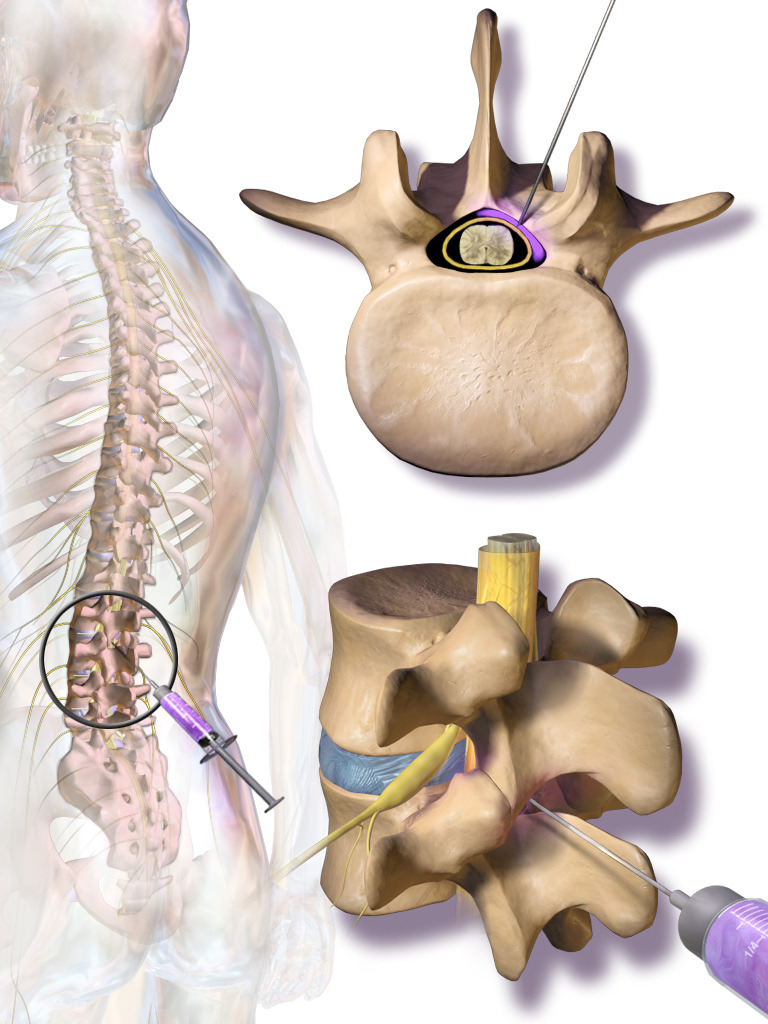
These consist of medications, physical therapy exercises, stretches and epidural injections in the low back.
In summary, don’t ever say, “This pain can’t possibly be from sciatica because there’s no tingling or numbness.”
Jeff Langmaid, DC
Lorra Garrick has been covering medical, fitness and cybersecurity topics for many years, having written thousands of articles for print magazines and websites, including as a ghostwriter. She’s also a former ACE-certified personal trainer.
.
Top image: Shutterstock/aceshot1

Here’s WHY an Energy Drink May Cause a Heart Attack

WHY are energy drinks suspected as a cause for heart attacks in some people?
Don’t assume it’s the caffeine. How often do you hear of people dropping from heart attacks because they drink five cups of coffee a day?
But something else is going on when it comes to energy drinks and a heart attack.
The QT Interval
There is something called a QT interval on an EKG (the test that prints out your heart rhythm).
The QT interval is corrected by a formula to correspond to the heart rate at the time of the EKG. This is called the QTc.
There is a normal range for the QTc, and it’s calculated in milliseconds.
A QTc longer than this millisecond range will get a doctor’s attention — depending on the patient’s medical history, symptoms and medication usage — because QT prolongation can mean a higher risk of sudden cardiac arrest.
But a QTc outside the normal range can also mean operator error (the nurse putting on the EKG leads) and computer miscalculation from the EKG.
Other factors must be considered when noting a prolonged QT interval, such as personal history of fainting episodes.
Energy Drinks May Prolong the QT Interval
A prolonged QT interval means a highter QTc value. For some people this means a higher risk of sudden cardiac death, which may appear as a heart attack.
Why Energy Drinks Cause Apparent Heart Attacks
In one investigation (Shah et al), researchers took a look at the QT interval of 93 healthy people after they drank one to three cans of an energy drink.
An EKG showed that their QT intervals were 10 milliseconds longer than the limit for the normal range.
Now you may be thinking, “Only 10 milliseconds? How can that make a difference?”
Well, it does. Milliseconds count when it comes to how well the heart recharges for its next beat.
If it takes too long (again, measured in milliseconds), this heightens a person’s risk of ventricular fibrillation leading to cardiac arrest.
This isn’t a heart attack per se, but rather, the quivering instead of beating of cardiac muscle, making it impossible to pump blood throughout the body.
In general, a cardiologist becomes concerned when there’s an extra 30 milliseconds to the QT interval from baseline.
The Shah et al study showed that energy drinks can prolong QT interval.
There is a genetic form of this condition, called genetic long QT syndrome.
But even if the prolonged QT interval is caused by an extraneous agent, such as an energy drink, this anomaly is just as serious a concern and has the potential to cause heart problems.
The study also notes that energy drinks increase blood pressure, which certainly isn’t good for the heart.
Stay Away from Energy Drinks
A beverage with carbohydrates will provide you with energy. If you’re growing fatigued during sport or training, drink some regular juice or have a banana, peach or apple.
A so-called “energy” boosting drink is not necessary, even though these are marketed to athletes.
“Certain energy drinks can increase the heart rate significantly because they are stimulants,” says Yaser Elnahar, MD, a cardiologist with Hunterdon Cardiovascular Associates in NJ.
“If you have an excessive amount of stimulants, they can cause rapid heartbeat or even arrhythmias.
“There have been case reports of excessive energy drinks and heart attack — in which the researchers felt the excess intake led to low blood flow and clotting that led to a heart attack.
“There aren’t trials showing energy drinks cause heart attacks directly.”
 Dr. Elnahar has publications in the Journal of Atrial Fibrillation, the Journal of Clinical Medicine and Research, Reports in Medical Imaging, and more.
 Lorra Garrick has been covering medical, fitness and cybersecurity topics for many years, having written thousands of articles for print magazines and websites, including as a ghostwriter. She’s also a former ACE-certified personal trainer.
.
Top image: Shutterstock/Yuttana Jaowattana
Source: sciencedaily.com/releases/2013/03/130321205524.htm





Can’t Rid Belly Fat Despite Cardio 7 Days a Week?

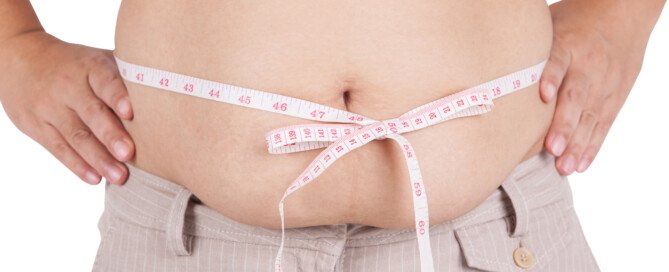
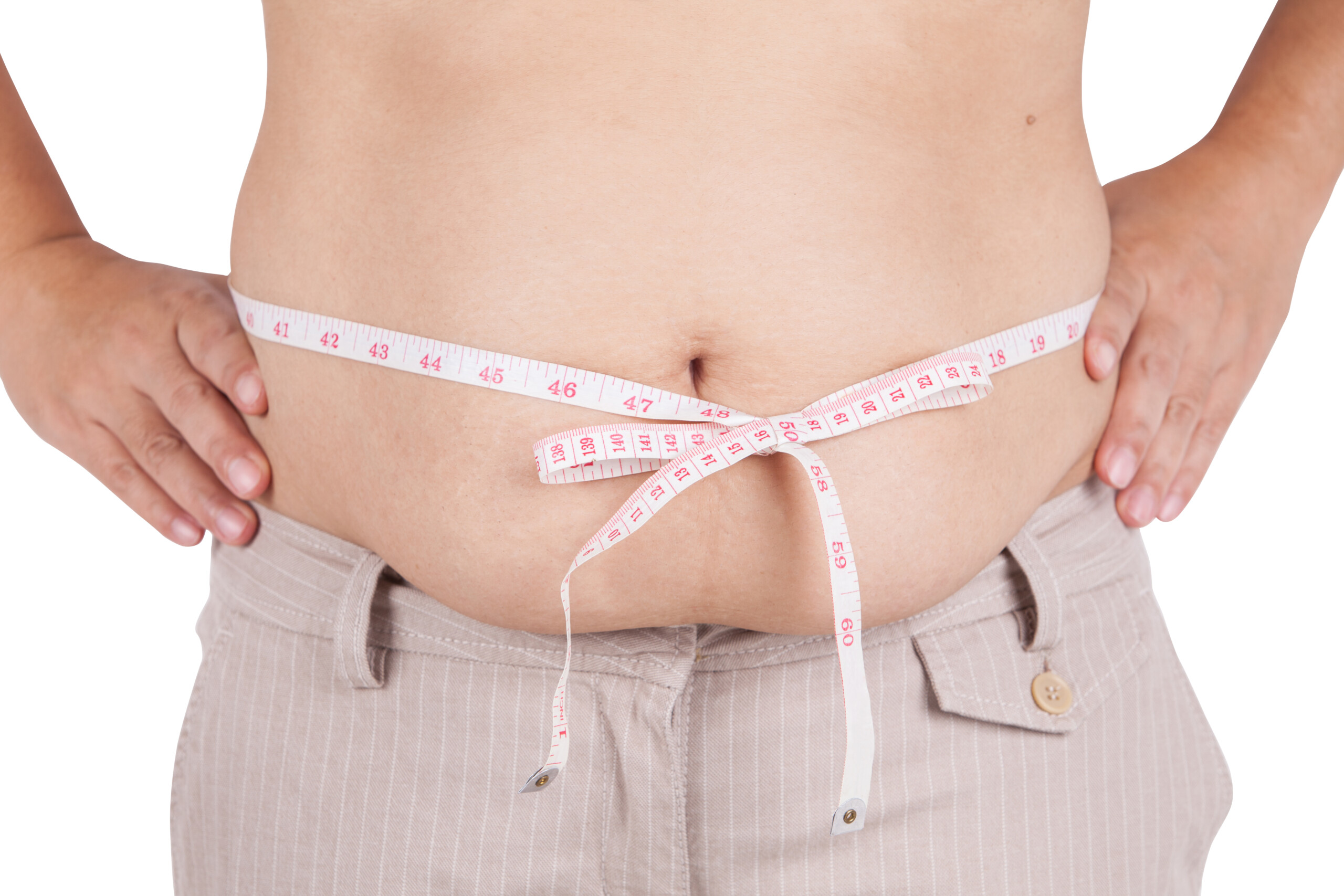
What’s REALLY going on when you can’t get rid of your belly fat despite doing cardio exercise seven days a week, week after week?
There’s a reason why the fat won’t budge.
And the stomach fat won’t budge even though your cardio exercise could be jogging, “power” walking, cycling or an aerobics class — and you’re even sweating and huffing hard.
But the excess belly fat just doesn’t want to depart from your body.
Something Interesting About Great Abs
Lots of cardio is not the best thing for ripping off belly fat.
Which type of athlete has the most buff body and tightest, trimmest waist? One such athlete is the sprinter.
Not that everyone should want to look like a competitive sprinter, but it’s the point I’m driving at:
It only makes sense that if you want to strip off belly fat, you must do some derivative of what these athletes do in their training.
The core of their training is that of alternating short bursts of output with a slower movement.
Sprinters will sprint hard, then walk around for several minutes before sprinting again.
Soccer players will run hard, and then there’s always that loll in the game or practice.
Rid Belly Fat without Cardio Every Day — but Only 2x/Week
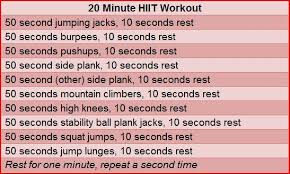
As a former fitness trainer, I recommend high intensity interval training.
This is a form of cardio, though technically, it’s an “anaerobic” type of exercise.
It creates hormonal changes in the body that accelerate the fat burning process.
An example is dashing up several flights of stairs, then slowly walking back down thenm, maybe pacing around in the landing for another minute or two, then dashing back up the steps as fast as you can.
You only need to do this for six to eight cycles to create a significant belly fat-burning effect.
Twice a week will do, and you should strength train three times a week.
If you don’t add strength training to the mix, you’re shorting your body of optimal fat burning.
Stop doing cardio seven days a week, day after day, week after week–even hour-long sessions of “steady state” aerobics won’t do much for stubborn belly fat.
Do high intensity interval training (“HIIT”), and for best results add strength training.
Lorra Garrick is a former personal trainer certified through the American Council on Exercise. At Bally Total Fitness she trained women and men of all ages for fat loss, muscle building, fitness and improved health.
.