

Why a Primary Melanoma Sometimes Can’t Be Found?
A person is diagnosed with metastatic melanoma but the original “bad mole” cannot be found; why IS this?
It’s crucial to find that primary melanoma tumor so that it can be surgically excised. (more…)
Is a Malignant Melanoma Different than just “Melanoma”?
“Malignant melanoma” vs. “melanoma.”
Is there actually a difference in meaning when someone says malignant melanoma as opposed to just “melanoma”? (more…)
How Fast Can a Seborrheic Keratosis Grow?
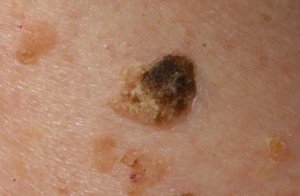
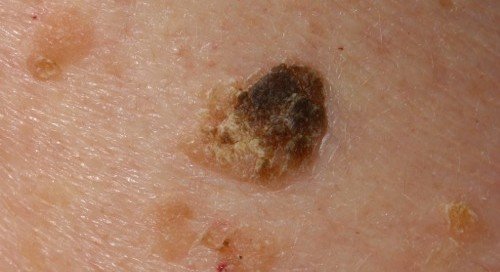
The sometimes rapidly changing growth of a seborrheic keratosis can fool people into thinking they have a melanoma.
But not all seborrheic keratoses grow quickly. (more…)
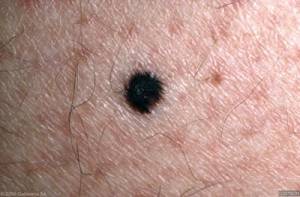
Can Melanoma Be Perfectly Round, Symmetrical, One Color?
Okay, we all know that “black and ugly” describes melanoma, and online images show melanoma to be evil-looking, dark, jagged, bumpy, the whole works.
But we must also consider that often, by the time a melanoma is photographed by a dermatologist, it’s at a later stage of development.
Who spots a tiny innocent-looking dot, says to their doctor, “I’ve never seen this before,” and the doctor decides to take a photo of it before excising it?
What more likely happens is that when what obviously appears to be a melanoma, with classic features, is presented to a dermatologist, the doctor THEN takes the photo. And it ends up online—looking mighty nasty.
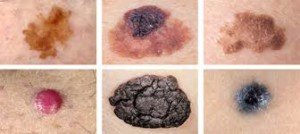
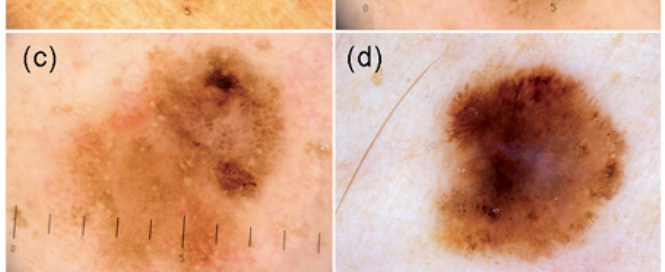
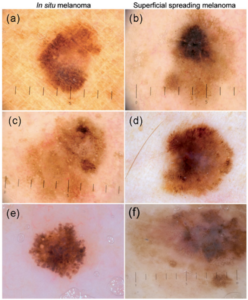
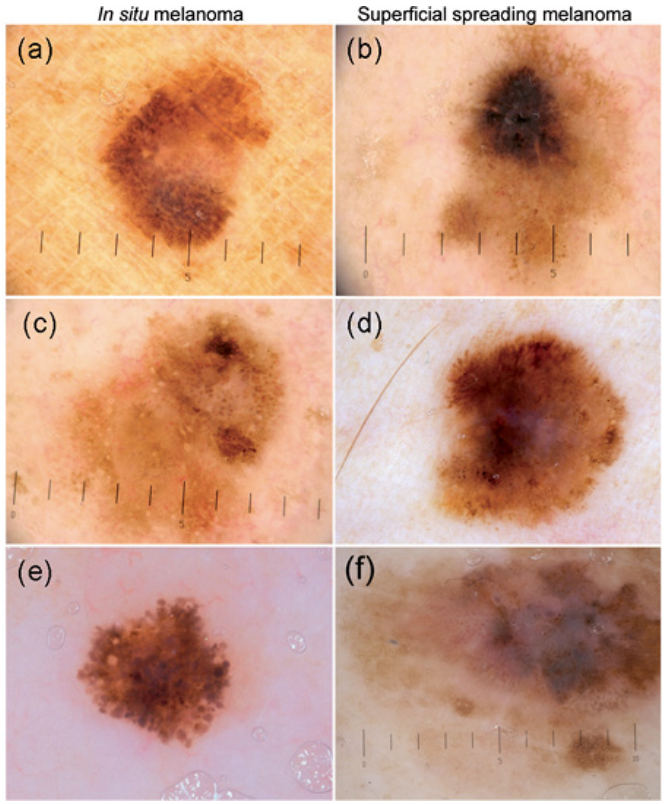
Note that the dark pink melanoma in the lower left is quite round, symmetrical and all the same color.
In actuality, not all melanomas—by the time they’re diagnosed—are scary looking or have any of the classic features such as jagged edges and bumpy portions.
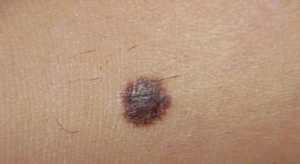
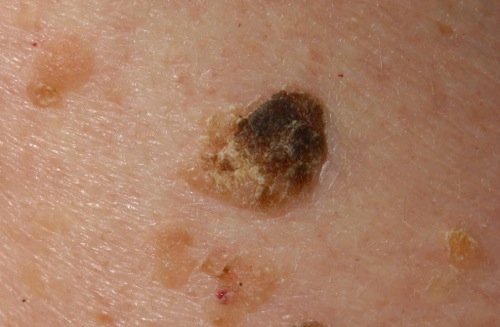
This one here below is relatively symmetrical, and keep in mind that it’s magnified — which accentuates asymmetry in any lesion.
Melanoma Has to Start Somewhere
And it can start as a tiny sane-looking dot. A melanoma doesn’t go from nothing to a pencil-eraser-sized purple and black cobbled spot overnight.
“Not all melanomas begin as the typical funny looking or sinister lesion,” says Sharyn Laughlin, MD, board certified dermatologist and co-founder of the DermaEnvy Skincare ™ line of sun protection products and medical director of Laserderm, a pioneering laser skin surgery clinic in Ottawa, Ontario, Canada.
“Some start out as a very small, innocent looking, pale, pink or black spot or nodule that will over time change in size — a vertical growth rather than the typical spreading lesion.
“Some resemble a skin tag or a seborrheic keratosis. If the patient says this is new – take them at their word regardless of what it looks like and follow it with photographs or biopsy it immediately.
“This is where the experienced dermatologist exercises intuition – call it a ‘gut feeling’ and usually does the right thing.
“My philosophy is simply to biopsy it if any uncertainty persists after looking at the lesion and using my dermatoscope to see it under magnification.
“Then neither you nor the patient need lose sleep or worry. The pathologist gives you the definitive diagnosis.
“The downside — the patient ends up with a small scar, which in my hands using my CO2 laser to deal with the excision base, is practically invisible.”
A melanoma’s only distinguishing feature may simply be an increase in size over several months, even though the color, symmetry and border remain the same. When it doubt, have it checked out.
 In practice for 30+ years, Dr. Laughlin has been lead or co-investigator in many research trials and an innovator in developing new laser technology. dermaenvy.com.
 Lorra Garrick has been covering medical, fitness and cybersecurity topics for many years, having written thousands of articles for print magazines and websites, including as a ghostwriter. She’s also a former ACE-certified personal trainer.
.
Top image: pcds.org.uk/clinical-guidance/melanoma-an-overview1
Can a New Melanoma Start Out Looking Like a Blackhead?

Unfortunately, among all those blackheads on your nose, chin or cheeks could be a very early melanoma slyly blending in and going unnoticed.
If the new “blackhead” begins developing in an isolated area on your face, away from other blackheads, it’s more likely to be noticed and then surveilled.
Melanoma “can start as a small black dot that to an untrained eye could resemble a blackhead,” says Sharyn Laughlin, MD, board certified dermatologist and co-founder of the DermaEnvy Skincare ™ line of sun protection products and medical director of Laserderm, a pioneering laser skin surgery clinic in Ottawa, Ontario, Canada.
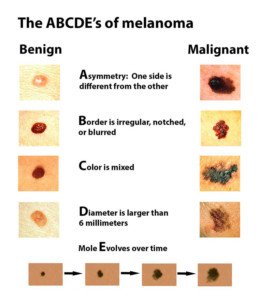
“It will not yield to squeezing — since most people cannot resist squeezing. This black dot will evolve and change along the ABCDE rules on melanoma.”
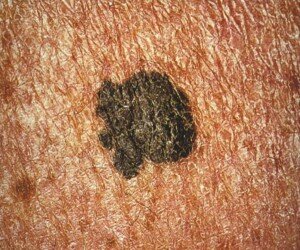
Melanoma. CDC, Carl Washington, MD, Emory Univ. School of Medicine, Mona Saraiya, MD, MPH
Blackheads, as you surely already know, don’t visibly progress beyond the appearance of a tiny black dot.
A melanoma in their midst will, over time, begin to stand out as it grows.
This doesn’t mean you should obsessively inspect every blackhead on your face.
But keep an eye on any that stand out, such as a new tiny dot that’s not part of your usual cluster of blackheads.
ABCDE Melanoma Rules
The new little black dot isn’t necessarily melanoma if it’s not a blackhead.
It could be the beginning of an age spot or lentigo, a seborrheic keratosis, a clogged pore or a new benign mole – even if you’re middle aged or older.
New spots or “blackheads” that look like moles, however, should be examined by a dermatologist.
Chances are they’re benign, but a new spot in middle age is more likely to be a melanoma when compared to new moles in young adulthood.
In practice for 30+ years, Dr. Laughlin has been lead or co-investigator in many research trials and an innovator in developing new laser technology. dermaenvy.com.
Lorra Garrick has been covering medical, fitness and cybersecurity topics for many years, having written thousands of articles for print magazines and websites, including as a ghostwriter. She’s also a former ACE-certified personal trainer.
.
Top image: Shutterstock/Motortion Films
Can a Melanoma Biopsy Spread Cancer Cells?
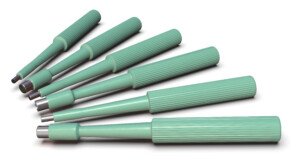
If you’re scared that an upcoming biopsy of what you think is a melanoma might spread the cancer cells, you’ve every reason to be worried.
Yes, a melanoma biopsy has the potential to “spread” the cancer. (more…)
Can You Be Physically Fit Without Working Out?
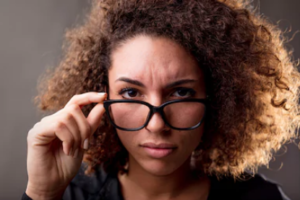
You cannot be physically fit in the absence of exercise, even if you’re naturally on the thin side.
Physical health is synonymous with exercise.
Having an efficient cardiovascular system and strong joints come only with structured, rigorous workout sessions, not from luck or “good genes,” though the so-called good genetics come in very handy when pursuing a particular sport.
Strong muscles and bones typically result when a person has been carrying around a lot of extra body fat for a while, even if he or she doesn’t exercise.
The musculoskeletal system is forced to become strong to support all the excess weight.
But this kind of strength can also be achieved by a lean person who works out.

Depositphotos.com
Certainly you’d rather be strong because you work out, not because your body has been forced to carry excess fat around for years.
Never think that you don’t need to exercise because you’re “naturally” thin or because you think you look good in a swimsuit or certain clothes.
And very tall people need to exercise as much as average height people, and very short people need to exercise as much as average height people.
This is because height is not a factor in who needs to work out.
Every BODY needs to exercise: And it needs to be structured activity with rhyme and reason rather than haphazard movements that strain one side of the body more than the other.
If you do construction work for a living, or serve tables, are a nurse, a tree worker, roof worker or are a stay-at-home mother of seven kids under the age of 12, you STILL need to devote special time just for cardiovascular exercise and strength training workouts.
 Lorra Garrick has been covering medical, fitness and cybersecurity topics for many years, having written thousands of articles for print magazines and websites, including as a ghostwriter. She’s also a former ACE-certified personal trainer.

Can Healthy People Benefit from Avoiding Gluten?

Is gluten really the monster that celiac disease makes it out to be?
Or if you’re normal can you eat gluten without worrying?
Do you even KNOW what gluten is? (more…)


Thin People Having Heart Attacks Won’t Make Obesity Healthy

The body positive very overweight women need to stop pointing out that thin people have heart attacks in an attempt to validate obesity.
This is like saying that smoking is okay because nonsmokers get lung cancer! (more…)
Can Fat Be Healthy just Because Marathon Runners Drop Dead?

A most weak defense by obese people who claim they’re healthy is when they point out deaths from marathon running.
Obesity or being significantly overweight is a well-proven health hazard; you cannot be healthy and very overweight at the same time. (more…)