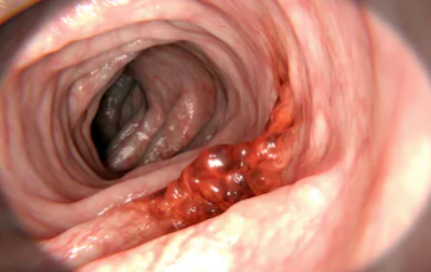
Ribbon Stools Caused by IBS vs. by Colon Cancer: Comparison
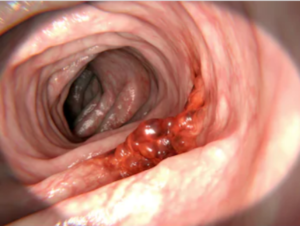
Both colon cancer and IBS can cause stools to come out like ribbons.
We’ve all heard that thin flat bowel movements are something to be concerned about.
“Ribbon” or “pencil” shaped stools are almost always on symptom lists for colon cancer, which can affect adults of any age, though it’s far more common in men and women over 45.
But irritable bowel syndrome, too, can alter the shape of bowel movements to come out thin and long.
Ribbon Shaped Poops from IBS vs. Colon Cancer: Appearance Comparison
Patients are often concerned about the frequency, shape and texture of their bowel movements,” says Dr. Brian Lacy, MD, of Dartmouth Hitchcock Med Center, who specializes in functional disorders of the gastrointestinal tract and author of “Making Sense of IBS.”
What is a normal stool?
“It is important to first understand what is considered normal with regard to stool frequency,” begins Dr. Lacy.
“A large study performed years ago in Britain determined that the average range of bowel movements is three per day to three per week.
“Stool form can also range from loose to firmer. This depends on a number of factors, including diet, stress, exercise and medications.
Ribbon-like stools can occur in younger patients and generally represent strong contractions of the colon flattening out the stool.

Freepik.com
“In the absence of warning signs (low blood count, unintentional weight loss, evidence of blood in the stool or a family history of colon cancer in a first degree relative), the occasional occurrence of ribbon-like stools is usually nothing to be concerned about.
“However, in a patient who is older, or in a patient with warning signs as mentioned above, ribbon-like stools could mean something serious, such as a lesion in the colon.
“This should be discussed with your health care provider who can perform a careful abdominal and rectal exam and order tests as appropriate.”
Comparison of Appearance in the Toilet Bowl of Ribbon Stools from Colon Cancer and Those from Irritable Bowel Syndrome
“Spasm in the colon which can cause a ribbon like stool is common in IBS patients,” explains Dr. Lacy.
“But, the appearance may be the same as someone who has partial obstruction or who has colon cancer.
“However, someone with colon cancer likely has other symptoms (e.g., weight loss, anemia, blood in the stool).
“That is why those are considered warning signs and warrant evaluation and a colonoscopy.”
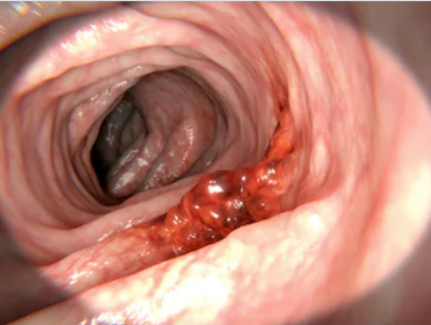
In a colonoscopy a doctor uses a long, flexible tube with a camera at its end, called a colonoscope, to look inside the colon and rectum.
The procedure helps doctors check for inflammation, precancerous polyps and of course, colon cancer.
A colonoscopy is necessary for a diagnosis of IBS, because IBS is a diagnosis of exclusion.
 Dr. Lacy combines his love of science, medicine and people to uncover the causes of symptoms like stomach pain, gas, bloating, diarrhea, constipation and regurgitation.
 Lorra Garrick has been covering medical, fitness and cybersecurity topics for many years, having written thousands of articles for print magazines and websites, including as a ghostwriter. She’s also a former ACE-certified personal trainer.
.
Top image: Shutterstock/Juan Gaertner

IBS Chest Pain vs. Cardiac Chest Pain: Symptom Comparison

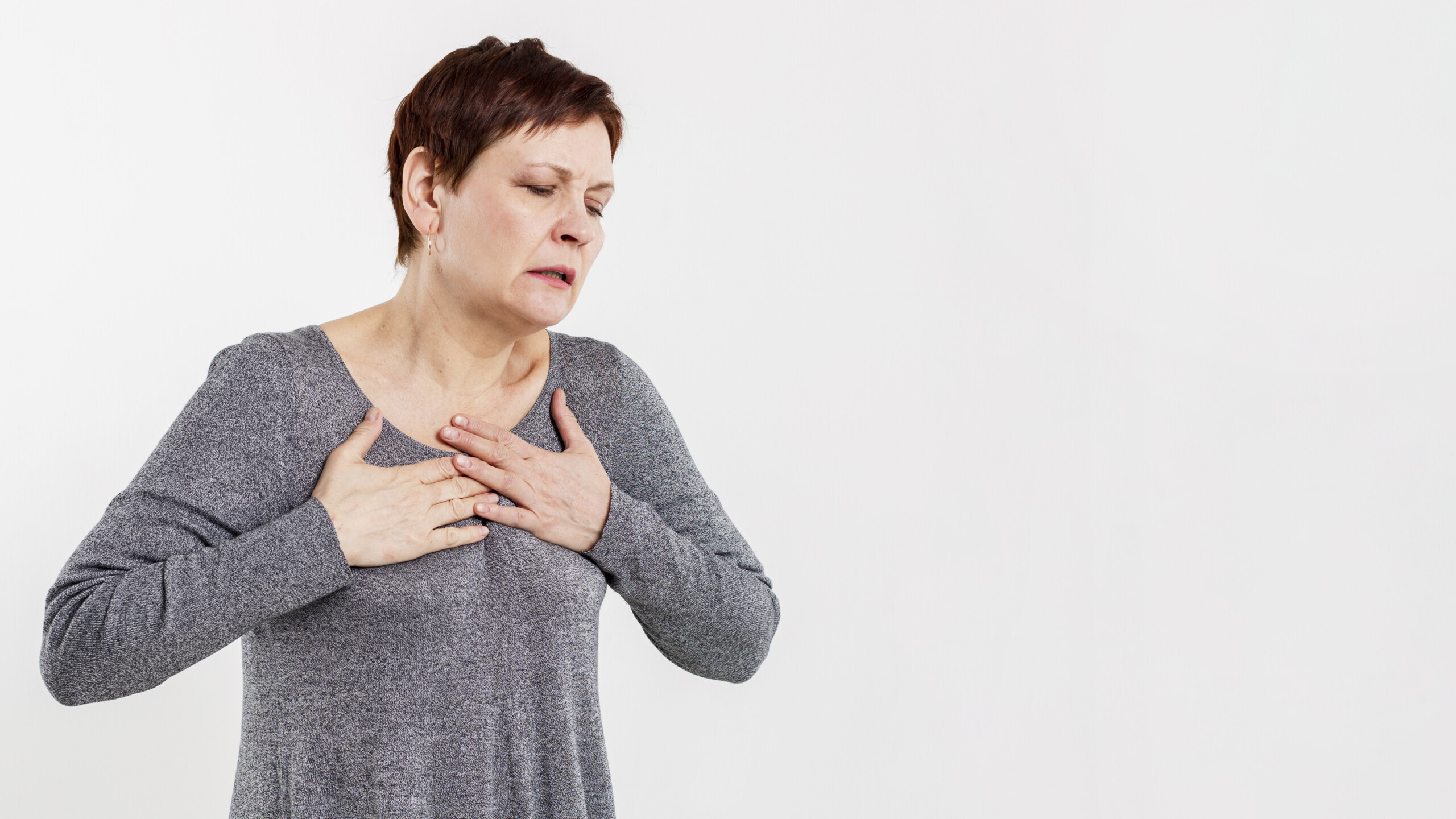
Your chest pain may be irritable bowel syndrome—you HOPE, since you’re also fearing it’s related to your heart.
If you have IBS and one day you get chest pain, this doesn’t mean it’s from your irritable bowel, yet it also doesn’t mean it’s from your heart, either (e.g., could be a muscle strain).
Just how much overlap is there between the symptoms of IBS and a heart problem?
If you’ve been diagnosed with IBS and have new-onset chest pain or some kind of aching in that area, then gee, this sure is scary, no matter how much you try to convince yourself, “It must be my IBS.”
The Courage to See a Cardiologist
“Chest pain is a common disorder that can affect men [and women] of all ages,” says Dr. Brian Lacy, MD, of Dartmouth Hitchcock Med Center, who specializes in functional disorders of the gastrointestinal tract and author of “Making Sense of IBS.”
“The first step in the diagnosis of chest pain is to determine whether it is cardiac in origin (from the heart) or from another organ system.
“This is obviously critical, as chest pain from the heart will be treated very differently than chest pain from chest wall muscles or the ribs.”
IBS Chest Pain Symptoms Compared to a Heart Problem
Dr. Lacy explains, “Chest pain that is cardiac in origin is often (but not always, and that’s the hooker here) associated with an elevated pulse (tachycardia), shortness of breath, diaphoresis (sweatiness) with pain that radiates from the chest into the neck and left arm.
“Chest pain that originates from the esophagus or stomach is usually underneath the sternum or in the epigastric region, does not radiate to the neck or left arm, and is unlikely to be associated with diaphoresis or shortness of breath.”
Note that both heart attack pain and gastroesophageal reflux disease (which originates from the esophagus) can cause pain in the back, but irritable bowel syndrome does not.
“IBS, which is often associated with spasms of the colon or small intestine, can cause chest pain in some individuals,” says Dr. Lacy.
“It is easy to understand how a patient with IBS, who has spasms in the colon or small intestine, might also have spasms in another part of the GI tract such as the esophagus.”
Cardiac Issue
Angina is chest pain resulting from insufficient blood flow in the heart, caused by obstructed coronary arteries.
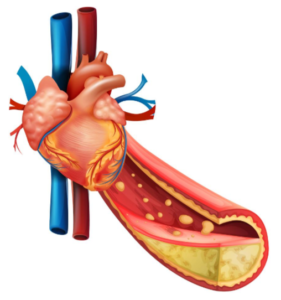
Source: vecteezy.com
A key difference between angina chest pain and that from IBS is that, in the case of stable angina, the discomfort will arise only during physical exertion or periods of intense emotion.
Sometimes the exertion is merely that of walking up a single flight of stairs.
Pain in the chest from IBS will not come from physical exertion or be associated with exercise or highly charged emotions.
However, things get very tricky with unstable angina. In this case, the chest pain can come during sedentary periods, even during sleep, awakening the person.
Unstable angina that’s caused by clogged arteries is an urgent situation, meaning that a heart attack can occur at any time.
We don’t want to get to a point of, “Is it IBS or unstable angina?”
What about how these different chest pains feel?
The sensation that arises during a heart attack may be quite severe – more so than any pain stemming from irritable bowel syndrome or even angina.
However, not all heart attacks present with severe chest pain. The discomfort may only be mild or dull.
IBS chest pain will never be severe, crushing (like a heavy weight is there) or have a feeling of constriction or tightness.
But remember, not all heart attack or angina sensations have these features, either.
“One approach that many health care providers take to try to determine whether chest pain is cardiac in origin or from another organ system (such as the esophagus) is to ask the patient about risk factors for heart disease,” says Dr. Lacy.
“Thus, an obese man [or woman] in his 60s or 70s who smokes cigarettes, has diabetes, has high blood pressure and elevated cholesterol, is at a much higher risk to have heart disease than a man in his 30s who is lean, does not smoke and does not have diabetes, elevated cholesterol or high blood pressure.
“Conversely, a younger man [or woman] with known IBS and intermittent spasms and cramps of the intestinal tract is more likely to have a spastic disorder of the esophagus (and thus chest pain) than a man who does not have IBS.”
If you’re worried your chest pain might be heart related, it’s time to see a cardiologist, who may recommend a cardiac stress test.
Additionally, for those suffering from IBS-C/CIC, you may want to try LINZESS® , and for IBS-D, Viberzi®, as these are very effective medications recommended by Dr. Lacy.
Dr. Lacy combines his love of science, medicine and people to uncover the causes of symptoms like stomach pain, gas, bloating, diarrhea, constipation and regurgitation.
Lorra Garrick has been covering medical, fitness and cybersecurity topics for many years, having written thousands of articles for print magazines and websites, including as a ghostwriter. She’s also a former ACE-certified personal trainer.
.
Top image: Freepik.com

Why You Should Exercise 7 Days a Week

Exercising seven days a week is a good thing, not a bad thing.
Your ancient ancestors worked their butts off seven days a week, and that’s why you’re here!
Think of all the things that primitive hunter-gatherers (and even modern-day hunter-gatherers) had to do just to survive.
Benefits of Exercising Seven Days a Week
Daily structured exercise means greater fat-burning (yes, it will make a difference over time) and better fitness.
The analogy: Think of practicing the violin only five or six days a week, versus seven. Over time, that seventh day will make a difference.
What’s harmful is excessive sitting seven days a week, a product of a modern way of living, replete with technology that makes daily living increasingly easier.
If you lift weights, say, four times a week, and do cardio on the remaining three days, that’s perfectly fine.
If you lift weights three times a week and do cardio four times a week, that’s fine too.

Or, if your goals are oriented more towards non-strength training, it’s perfectly okay to lift weights twice a week but do cardio on those other five days.
Don’t let the naysayers (who spend two to four hours, seven days a week, plopped in front of the TV) trick you into thinking there’s something sinister about exercising every day.
Marketing campaigns for physique transformation programs usually advise taking one day off per week, to “rest.”
Just because this is recommended doesn’t mean it’s harmful to work out every single day.
This one day a week of rest is advised to increase adherence to the program.
Many doctors and even personal trainers will recommend this, if for no other reason, so you can just kick back and have fun.
If that’s what suits you, do it. But if you feel like something’s missing on that one day a week you’ve decided to forgo working out, then resume your workouts to seven days a week.
It will not harm you or sabotage your goals. If that’s what you thrive on, then go for it.
Guidelines for Exercising Seven Days/Week
This doesn’t mean that every single day should involve a prolonged and grueling, strenuous workout.
It also doesn’t mean that if you’re already lifting weights three times a week, that the seventh day should be a fourth weight training day. This actually wouldn’t be a smart idea.
You have many other options that don’t involve barbells and other lifting equipment.
That seventh day should be a light day, such as a leisurely hike, fun inline skating, walking on a treadmill while watching TV, practicing your karate forms, yoga, calisthenics or basic stretching.

Never target the same muscle groups two days in a row when it comes to strength training.
So your regimen might look like this:
Monday: Back/biceps
Tuesday: Step class
Wednesday: Chest/shoulders/triceps
Thursday: Martial arts
Friday: Legs (squats, lunges, machines)
Saturday: Running
Sunday: Yoga
So go ahead, exercise every single day if that’s what you’d like to do!
After all, with all the time you may be spending sitting at the computer, you’ve earned it.
 Lorra Garrick is a former personal trainer certified through the American Council on Exercise. At Bally Total Fitness she trained women and men of all ages for fat loss, muscle building, fitness and improved health.

How to Get ER Attention for a Migraine
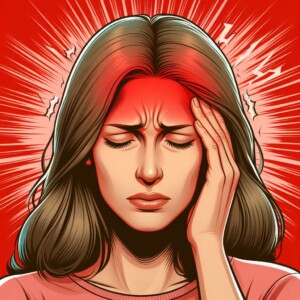
Do ER doctors avoid taking your migraine complaints seriously because perhaps they think you might be an opioid addict faking a headache?
Here’s how to get treated promptly and efficiently in the ER for all of your future severe migraine attacks. (more…)

Dry Scaly Skin Above Eyelids that Itches: Causes & Solutions

Itchy scaly and flaky skin above the eyelids—sometimes it even stings.
There are many causes, and the solution depends on the causes. The flaking and itchiness can seemingly come out of nowhere. (more…)
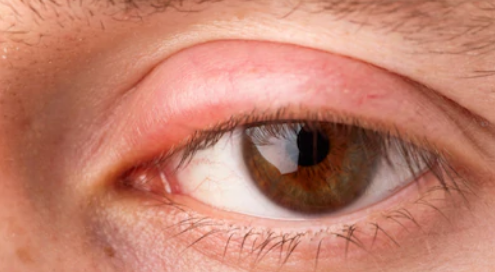
How to Safely Treat Eyelid Allergies: Dermatologist Instructions
“Anything you put on your eyelid can be absorbed into the eye itself and could can cause problems,” says Dr. Janet Prystowsky, who’s a board certified dermatologist in New York, NY, with 30+ years’ experience. (more…)

How Stress Increases Stroke Risk

Stress increases stroke risk.
If you suffer from a lot of stress, then beware, as this is a risk factor for stroke, which strikes 700,000 Americans every year, the third leading medical cause of death in the U.S. Stress = stroke, essentially.
John M. Kennedy, MD., a cardiologist, explains: “The classic story from physiology textbooks describes how the human ‘stress response,’ also known as the ‘fight or flight’ response, is what enabled early man to survive as a species.
“The stress response, triggered by fear, stimulates a profound and sudden flooding of stress hormones, adrenaline and cortisol, into our bloodstream which cause dilated pupils, a racing heart, soaring blood pressure, and rapid breathing.
“These physiologic changes shift our body into overdrive, and prepare us to either fight or run for our life.
“Originally, this was a protective and adaptive response that helped us ward off meat-eating predators, and enabled us to survive.”

Shutterstock/tommaso79
The problem is that today’s crises don’t require a fight or flight response. Instead, modern man ends up immobile, unable to fight, unable to run, leap or jump. Instead, he remains inert and immobile.
1) Trapped in a traffic jam, late for work or an important appointment
2) Trapped in a stressful business meeting
3) Trapped in a cubicle at a dead-end job, or
4) Trapped in a stressful relationship.
A fight or flight means physical exertion that dispenses certain hormones that counteract stress hormones.
But inertia, sitting in the car cussing during that traffic jam, produces NO counteracting hormones. Thus, the stress hormones build up over time and damage the body.
“Today, the stress response is activated much more frequently and for many more mundane daily challenges,” says Dr. Kennedy, medical director of preventative cardiology and wellness at Marina del Rey Hospital, and author of the book, “THE 15-MINUTE HEART CURE: The Natural Way to Release Stress AndHeal Your Heart In Just Minutes A Day.”
“Getting stuck in traffic or waiting in line at Starbucks can lead to similar increases in stress hormones which over time can wreak havoc on our cardiovascular tissue.
“Externally, stress causes us to feel anxious, jittery, agitated, angry and depressed. Internally, stress causes a number of physiologic changes that increase our risk of heart attack and stroke which include:
“Increased inflammation; Elevated blood pressure; Increased heart rate; Increased platelets (blood corpuscles responsible for clotting); Increased fibrinogen (protein involved in blood clots).”
Together, these physiologic changes create the perfect storm for a cardiac event or stroke.
“And all of these physiologic changes increase atherosclerosis, the disease responsible for plaque formation on the walls of blood vessels.
“Eventually, these changes damage the delicate inner lining of the blood vessels and lead to a heart attack or stroke.”
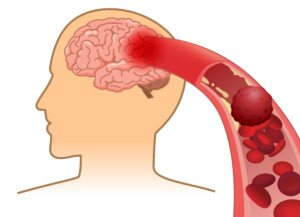
Think of it this way: Thickened blood predisposes someone to stroke. That’s why people take “blood thinners” to lower risk of stroke.
Shutterstock/solar22
Thickened blood is more likely to clot, and a blood clot in the brain is what a stroke is. So why does our blood thicken when we are faced with stress and anxiety?
Our blood thickens to prepare the body for an anticipated wound! When facing a crisis, the body “thinks” it will either have to fight, or run for its life.
We evolved to get thicker blood in anticipation of a gash suffered in a fight with a wild animal, or during flight from a predator chasing us!
Thickened blood helps protect against bleeding to death from that gash or wound.
The fight or flight requires a physical exertion that produces hormones that neutralize the hormones that cause blood thickening.
However, modern man sits still during stress; no physical exertion to counteract stress hormones.
The result? The blood remains in a thickened, more “clottable” state on a chronic basis, and hence, increase of stroke!
 Double board certified in cardiovascular disease and also internal medicine, Dr. Kennedy’s special interest is stress and how it adversely affects a person’s delicate cardiovascular system.
Lorra Garrick has been covering medical, fitness and cybersecurity topics for many years, having written thousands of articles for print magazines and websites, including as a ghostwriter. She’s also a former ACE-certified personal trainer.
.
Top image: Shuttersrtock/Phovoir

What Not to Say to Someone Whose 4 Year Old Can’t Talk

Do you know someone whose four-year-old child is not yet talking?
Perhaps the child could say a handful of words on command, and may even be speaking two-word duos to communicate, such as “more food” or “need that.” (more…)

Walking vs. Medication for Type 2 Diabetes to Lower Sugar

Wow, it’s now been shown that walking, in the form of a daily step count, is at least as good as medication for lowering blood sugar in type 2 diabetes.
This happens when a doctor writes a prescription – not for a drug, but for a daily step count – and hands it to the diabetic patient.
A very clever study comes from the Research Institute of the McGill University Health Centre.
Dr. Kaberi Dasgupta already knew that regular walking can bring a 40 percent reduction in vascular event rates in a 10 year period for type 2 diabetics.
But Dr. Dasgupta says in a report in Diabetes, Obesity, and Metabolism that merely telling patients “to be more physically active simply doesn’t work.”
The directive of “be more physically active,” or something similar like “get more exercise” is way too abstract for a sedentary person who’s drawn to spending large amounts of time in a chair or couch.
Dr. Dasgupta, principal author of the study, says that the objective of the study was “to use step counts almost as a medication.”
She specializes in prevention and management of blood vessel disease in diabetics and those at risk for diabetes.
For years, she’s been intrigued by the concept of counting daily steps and how this impacts health.
Counting steps eliminates the hassle of keeping track of distances or times.
The counting is done with a pedometer, absolving the patient from any conscious tracking other than to periodically check the pedometer to make sure they’re on course for completing a minimal number of steps by bedtime.
The Step Counting Study
• 364 patients and 74 doctors representing different Montreal hospitals
• Some patients had written prescriptions for step counts and were given a pedometer.
• One year later it was found that the patients who’d been given the step count prescriptions had taken 1,200 more steps per day, on the average, than the patients who’d not been given the prescription.
• It’s amazing what difference a piece of paper can make, though the pedometer certainly helped as well. The other patients were merely TOLD to walk more.
• Patients with type 2 diabetes, on the step count prescription, lowered their glucose levels.
This is the first study showing that a written prescription for taking more steps can benefit health.
Hmmm, what if a prescription was written for strength training?

Freepik.com
It would have to be very specific, since “do strength training” is far more abstract than “get in 10,000 steps a day and this pedometer will record your steps.”
But perhaps a prescription for strength training can come with a tension band and illustrated instructions for the band!
I’d love to see a study on how effective this would be for people with type 2 diabetes or other kinds of patients including healthy who are simply having their annual physical.
At least 10,000 steps a day is recommended for all people, not just those with type 2 diabetes.
Under 5,000 steps a day is a potential forerunner of developing this metabolic disorder as well as suffering from vascular events like a transient ischemic attack.
 Lorra Garrick has been covering medical, fitness and cybersecurity topics for many years, having written thousands of articles for print magazines and websites, including as a ghostwriter. She’s also a former ACE-certified personal trainer.
.
Top image: Depositphotos.com

Feeling off Balance after Treadmill Walking: Causes, Solutions
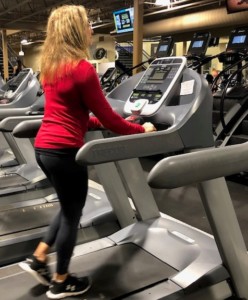
There’s basically one reason why you feel off balance after stepping off the treadmill, but there’s more than one solution to this benign problem.
First of all, when I was a personal trainer at a health club for several years, I worked with many treadmill users.
What I found was that in 100 percent of the cases in which a person reported feeling off balance or “dizzy” upon getting off the treadmill, that individual had been HOLDING ONTO the machine.
Before you assume that you have a medical problem that causes you to feel off balance after getting off a treadmill, I recommend you break the habit of holding on.
New to Treadmill Walking?
If you’re new to using this machine, the best time to break a bad habit is when it hasn’t yet become a habit. Do not hold on.
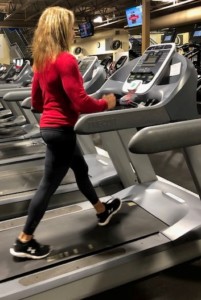
Start out slowly. Don’t feel you must jack the incline up to 15 percent, the speed at 4 mph, then grip the front bar and yank with each fake step. I see this all the time and it’s ridiculous and worthless.
Cause of Feeling off Balance after Walking on Treadmill
If you’re holding on, this deactivates your body’s balance mechanism. It’s like flipping off its switch. There is no need to balance if you’re holding on. It’s that simple.
So — you’re walking for, say, half an hour, even 10 minutes, all while your internal balance device is switched off (because you’re holding on).
You then step off the treadmill. Bam! Your body’s balance device is suddenly switched back on and must work immediately.
This causes that off balance feeling. It’s a sudden transition from total deactivation to total reactivation. It takes your body several moments to adjust.
But what if you haven’t been holding on yet still feel balance issues after you get off the treadmill? And what if this is the only time you feel this strange dizziness?
Quite simply, your body is not used to walking on a moving tread belt.
However, your body will quickly adjust to this.
But I’m betting that near 100 percent of people who feel dizzy or unsteady after walking on a treadmill were holding onto the machine.
Remove your hands for your next session.
Use a slow speed.
Avoid high inclines until your body acclimates.
I had senior citizens and obese beginners walking on the treadmill without holding on.
I even had a client with Meniere’s disease (which causes unsteadiness and dizziness) walking without holding on.
Walking on a treadmill without holding on will improve your body’s internal balancing device!
Model: Sharon Smith, 71 years young.