
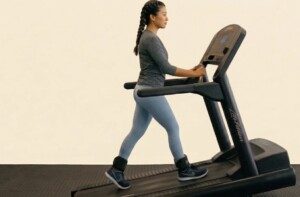
I saw a woman wearing ankle weights as she walked on an inclined treadmill, but she was holding on.
This defeated the purpose of the ankle weights. In fact, holding on defeats the purpose of the incline as well.
Do you wear ankle weights on a treadmill but hold on?
If so, ask yourself why you’d add resistance to your lower legs with the ankle weights, only to subtract overall workload by holding on!
Are you thinking, “Well I have to hold on or it’ll be too difficult”?
Well here’s an idea: Instead of holding on (which mimics using a walker, among other problems), why not reduce the speed and/or lower the incline?
Imagine you decide to walk hills outdoors with ankle weights. The hill might be a street or a hiking trail.
You wouldn’t be holding onto anything. Your arms would be swinging naturally. But you’d adjust your speed to make the walking doable on the grade of the street or trail.
Depending on what type of workout you’d want or what your goals are, you’d adjust the speed to enable a sustained walk with a good challenge, or, maybe a lighter effort – again, depending on your goal.
Or maybe you’d vary your speed to get a mix of intense work with more casual output.
The bottom line is that you’d adjust your speed as the grade changes and also according to your objectives.
Speed Adjustment for an Inclined Treadmill
Likewise, when you’re using a treadmill incline, you should adjust the speed so that you can maintain a hands-off workout – whether you’re wearing ankle weights or not, whether the grade is set to 10%, 15% or 30%.
The crazy thing is, people who hold onto the machine will think that the reduction in speed that’s necessary to sustain a walk at a high incline is way too slow to get a good workout.
For instance, without your hands on the bar in front or the side rails, you may need to use a speed of only 1.5 mph if the incline is at 18%, let’s say.
People tend to associate faster speeds with more effective exercise, so it’s unthinkable to walk at a “crawl” without holding on, and instead, they grip the machine at a high incline so they can walk on a tread moving at 3 or even 3.5 mph.
This blows my mind, because if they were outside on 18% nature trails, they’d be moving at only 1.5 mph! Somehow, this “crawl” doesn’t seem so slow when it’s done outdoors!
If you think a pace under 2 mph is too slow, let’s see for how long you can sustain this without holding on when the incline is at 18%, let alone 20 or 22%. If the machine goes only up to 15%, set the pace to 2 mph and see how 20 minutes of this nonstop, hands off, makes you feel.
If it’s easy, then next time do it at 2.5 mph. If that’s not much more challenging, then go at 3 mph at 15%. That’s pretty stiff for a sustained walk hands-free.
Outdoors, you’ll see hikers walking way slower than 3 mph on grades that appear to be around 15%. Adding ankle weights to the mix will make it even tougher.
There is no shame in walking very slowly on a high incline, especially with ankle weights.
The irony is that the woman I saw had, shortly prior to getting on the treadmill, been doing a wicked one-leg routine involving jumping. Balance certainly wasn’t why she had to hold onto the treadmill.
In fact, balance is rarely the issue, especially when the people I see holding on will then be doing lunges and squats, even kicking at the heavy bag!
Holding onto the treadmill – with or without ankle weights – completely defeats the purpose of the incline. In addition, your core ends up doing minimal work, because the core is what keeps your spine erect when walking an incline.
Next, the calorie expenditure is reduced (the calorie readout is generated by the settings, not the user).
Next, when you hold on, this deactivates your body’s balancing mechanism. I can go on and on, but hopefully by now, you get a very strong picture of why it’s just so inefficient to hold onto a treadmill.
This is a fake way of walking and all it does is make your body think it’s using a walker.
