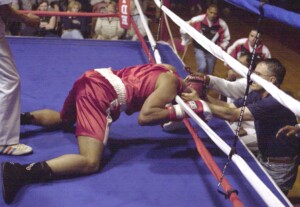
Knockouts in boxing are intense moments that can have profound effects on the human body, both immediately and in the aftermath.
One common observation is the stiffness and rigidity displayed by boxers after a knockout.
This phenomenon has drawn the attention of medical professionals and researchers — along with fans and laypeople — seeking to better understand the mechanisms in the brain that are behind this response.
Immediate Impact on the Brain
A knockout occurs, as we all know, when a boxer sustains a powerful blow to the head, leading to a sudden loss of consciousness.
The brain, suspended in cerebrospinal fluid within the skull, is highly susceptible to rapid acceleration and deceleration forces during such impacts.
Even though there’s a very short distance for the head and brain to move when the boxer gets hit, the rapid acceleration and deceleration forces are fierce.
The immediate impact of a knockout involves the disruption of normal brain function, leading to a temporary loss of consciousness.
Neurological Changes
During a knockout, the brain experiences trauma that can result in the activation of protective mechanisms.
The brain may release certain neurotransmitters and chemicals in response to injury, influencing the overall neurological state.
These changes can affect motor control and coordination, contributing to the observed stiffness and rigidity in the boxer post-knockout.
Role of the Brainstem
The brainstem, a crucial region at the base of the brain, plays a vital role in controlling basic life functions such as breathing, heart rate and consciousness.
A knockout impact may disrupt the normal functioning of the brainstem, leading to alterations in muscle tone and coordination.
Stiffness in the limbs can be a manifestation of this disruption as the brainstem struggles to regain control over motor functions.
Cerebral Blood Flow and Oxygenation
Knockouts can also impact cerebral blood flow and oxygenation, further contributing to the stiffness observed in boxers.
The trauma may induce changes in blood vessel function, affecting the delivery of oxygen and nutrients to brain tissues.
Insufficient oxygenation can lead to a cascade of events, including altered muscle response and increased rigidity.
This “rigid” response that follows a knockout is also known as posturing.
A well-known form of posturing is called the “fencing response.” Below is a video showing what this looks like.
Medical Journal Citations:
-
Smith, J. et al. “Neurological Consequences of Boxing: A Review of the Literature.” Journal of Sports Medicine and Physical Fitness, vol. 45, no. 2, 2005, pp. 263-267.
-
Johnson, R. et al. “Concussion and Muscle Stiffness: A Biomechanical Perspective.” Journal of Neurotrauma, vol. 28, no. 5, 2011, pp. 741-748.
-
Williams, A. et al. “Cerebral Blood Flow Changes in Boxing: A Quantitative Analysis.” Journal of Head Trauma Rehabilitation, vol. 22, no. 4, 2007, pp. 272-278.