There’s a really wrong way to respond if your child asks about a service dog they see in public with a disabled individual.
What’s alarming is that a disability advocate posted a troubling exchange on Facebook and actually endorses it. The post is below; take a look at it.
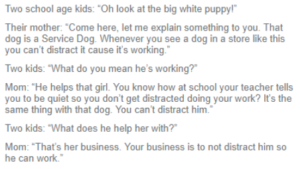
The mom’s response to the last question is wrong on a few levels, and I sure hope you see it that way.
If you don’t, you’ll be sure to see it that way once I explain why the response was way off the mark.
#1. Just Answer the Question
When your kid asks you a question, they’re looking to you for information that they can’t just readily collect. It’s your chance, as the parent, to show your child that you’re a reliable, trusted source of information and guidance.
To reply, “That’s her business,” is to brush off your child’s innocent curiosity.
An explanation by the mother of why the girl needs a service dog would not in any way violate the girl’s privacy or be a breach of her “business.”
A generic explanation would suffice more than enough to satisfy the child’s inquiry.
Sounds like this mom was too lazy or annoyed to put value on taking a little bit of time to feed her child knowledge. The specific nature of the disability is the girl’s business; not the child’s.
BUT – every child should be told why some people have service dogs in public.
Why deprive young minds of this information? If they’re old enough to wonder why someone has a dog with a vest that says, “Please don’t pet me; I’m working,” then they’re sure as heck old enough for the parent to educate them.
Brushing off your child’s question sends the strong message that you’re not exactly top dog when it comes to a source of knowledge. Is that the impression you want to create?
#2. Brushing off the Child’s Question Sends the Message that Disabled People are “Less Than”
The curt “That’s her business” might imply, to that impressionable young mind, that those with a disability are less than.
It can send the message that disabled individuals are SO different from “normal” people that it’s taboo to have conversations about how these highly intelligent animals can service people with a variety of disabilities and medical conditions.
The message comes out: Society has two factions – people who are normal and people who are disabled.
Do you really want to teach your kid that having a disability makes one have less value as a person – so much less value that the concept of service dogs can’t even be discussed?
“That’s her business” suggests that people with physical, medical or mental challenges are to be buoyed off, segregated, set apart from everyone else.
They’re to be swept under the rug and excluded.
Though to an adult, “That’s her business,” or a similar response, may seem innocuous and even a lesson in politeness, you have to realize just how impressionable a young child’s mind actually is.
“That’s her business” is in the same league as pulling a child away from a visibly disabled individual who’s coming their way.
It broadcasts that message: “Stay away from anyone with a disability or who looks or moves differently.”
What SHOULD the Parent Say?
It’s pretty easy. Just tell them why some people have a service dog. This is simple stuff. If the person the dog is with doesn’t have a visible disability, then doggone, explain this to your kid in vocabulary that aligns with their age or cognitive level.
For example, you could say, “She doesn’t seem to have a problem walking, but she could have an invisible disability such as deafness. She might have diabetes, in which case, the dog can sense when her blood sugar gets too low and give her a signal that it’s time to eat something.”
Or perhaps, “Maybe that woman has dizzy spells, and when she feels off-balance, the dog leans into her to keep her steady.”
If the dog handler is in a wheelchair, tell your child that the dog probably retrieves things off the floor that the person drops, and provides other helpful physical assistance.
“Don’t Pet Me!”
Explain that you should never pet ANY dog without first asking the owner. The funny thing is, I’ve been told by owners of typical dogs that it wouldn’t be a wise idea for me to pet them (and of course I didn’t), but — I’ve also been given permission by a disabled person to pet their service dog!
ASK FIRST. Always. During adaptive hours at a climbing gym I used to go to, a man would bring in his yellow lab service dog, complete with vest that said “Don’t pet me.”
But the man was perfectly okay with adults and kids, left and right, fawning over this beautiful dog – and that dog relished all the attention.
Approaching Someone with a Service Dog
The verdict isn’t out on whether it’s “okay” to ask someone why they have a service dog. This can flip both ways. Some people would hate to be asked, while others would welcome the opportunity.
Some individuals would be more than happy to use the “nosy” question as a teaching moment for the asker, especially if the disability was not obvious.
For example, not everyone knows that dogs can be trained to detect a seizure 10-15 minutes in advance and signal to the owner to prepare for the event.
The dog handler might be very eager to reveal this astonishing skill to the asker.
One time at the gym I noticed a very able-bodied, fit looking man with a service dog. I just had to ask what his disability was. This was after I asked to pet the dog, which he allowed.
The invisible disability was PTSD related to past drug addiction.
For 10 minutes the man told me his life story – without me once prompting for it. I had only asked what the disability was. But the man found it therapeutic to bring up his past and how he turned his life around.
Bottom Line
By having a hush-hush, mind-your-own-business attitude towards those with a disability kind of reinforces the concept of regarding them as, well, less than.
At the same time, there needs to be a balance between what and when we say and ask things.
However, there should not be this hush-hush, “that’s her business” approach when the discussion is well out of earshot from the dog handler.