
Can Prolonged Sitting on the Toilet Cause Sciatica?
Yes, sitting a long on the toilet and reading can cause sciatica, says a spine doctor.
It may seem benign — sitting on the toilet for extended periods and reading, talking on the phone, texting, what-have-you — but this can lead to sciatica, says Dr. Michael Perry, MD, member of the North American Spine Society and American College of Sports Medicine.
In sciatica, the sciatic nerve is irritated. One cause of irritation is pressure against the nerve.
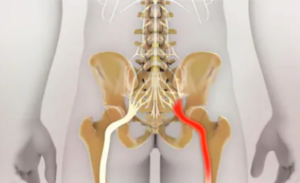
Sciatic nerve. Shutterstock/Nathan Devery
This can easily be caused by extended time sitting on a toilet, especially if the seat is hard — which it typically is.
The leaned-forward position that most people assume adds even more pressure on this major nerve.
Have you ever developed a numbness and tingling along your hamstring group after sitting on a toilet for a while? That’s the sciatic nerve being imposed upon.
“When you are sitting down, whether it is on a toilet or in a chair, you are applying more pressure to your discs than when in any other position,” says Dr. Perry.
“Some people tend to pull out a newspaper or a magazine while leaning forward on the hard toilet seat for an extended period of time.
“If that person also has an underlying disc abnormality, this significant and extended pressure can cause further deterioration.
“You may begin to experience shooting pain, electrical shocking pain or numbness because of this increased pressure while sitting in this position.
“If someone has a disc abnormality and they do feel this pressure and increased sciatica symptoms, it should be treated.
They should remain cautious and alert of sitting on the toilet for an extended period of time.”
If you cannot help but spend a lengthy amount of time on the toilet due to a major bowel movement or constipation, then try your best to periodically lift the affected leg off the seat to help relieve some of the pressure on the sciatic nerve.
 Dr. Perry is chief medical director and co-founder of USA Spine Care & Orthopedics, and is frequently sought out for his minimally invasive spine surgery expertise.
 Lorra Garrick has been covering medical, fitness and cybersecurity topics for many years, having written thousands of articles for print magazines and websites, including as a ghostwriter. She’s also a former ACE-certified personal trainer.
Top image: Shutterstock/Viacheslav Nikolaenko

Can Excessive Walking Cause Knee Bursitis?
If you already have bursitis in your knee, then it stands to reason that excessive walking will make you aware of it.
But this doesn’t mean that a lot of walking actually causes bursitis in the knee.
We live in a society that’s so sedentary that a lot of walking is viewed as something potentially harmful, when in fact, lots of walking is exactly how the human species survived and flourished. The problem is all the sitting that we do.
But let’s get back to bursitis of the knee. Something causes this when people have it.
Bursitis doesn’t just happen. A bursa is a fluid-filled sac (it’s supposed to be filled with fluid).
“The knee joint contains several bursae, which can be grouped by location into the medial, lateral and frontal bursae,” says Devin B. Peck, MD, owner of Austin Interventional Pain in Austin, TX.
Medial means inner; lateral means outer; and frontal means front.
“There are five medial bursae, four lateral and five frontal bursae,” continues Dr. Peck.
Causes of Bursitis in the Knee
“The most commonly-affected by inflammation leading to bursitis are the suprapatellar and pes anserine bursae. Pes anserine bursitis results from overuse and is common in runners.”
Now you might be thinking, if bursitis is common in runners, why wouldn’t a lot of walking be a cause?
This is because when we do a lot of walking, it tends to be for the sake of either transportation (such as a lot of walking on the job) or non-hard-impact exercise (fitness walking).

When bursitis is caused by running, it’s because the patient has been running way beyond that required for transportation or general fitness.
In other words, the patient has likely been training for long-distance running events or breaking personal record sprint times over short distances, which may include hurdling.
The patient may also have been running only in the name of fitness, but logging five miles at a grueling pace on hard concrete every single day. That’s still a lot of running.
This kind of running is not what ancient hunter-gatherers did for survival.
Sure, they jogged, but it was for transportation over natural terrain, not marathon training on an asphalt street.
Sure, they sprinted, but only to catch their dinner or escape from danger, rather than over and over and over on an asphalt surface every day to break personal record times.
Bursitis in the knee isn’t always caused by running, but if you’ve been diagnosed with it, it’s extremely unlikely it was caused by walking.
Dr. Peck also says, “It may lead to pain and a discrete area of tenderness over the medial tibial condyle, the bony protuberance on the inner aspect of the lower knee.”
 Dr. Peck’s areas of interest include chronic and acute musculoskeletal pain, sports injuries, arthritis and cancer pain, among many others. Austin Interventional Pain was established in 2019.
 Lorra Garrick has been covering medical, fitness and cybersecurity topics for many years, having written thousands of articles for print magazines and websites, including as a ghostwriter. She’s also a former ACE-certified personal trainer.
.
Top image: depositphotos.com
Why Does Hip Replacement Cause Sore Thigh Muscles?
Have you noticed that the muscles in your thigh are persistently sore only since your hip replacement surgery?
There is a gait abnormality that can cause this problem, says Devin B. Peck, MD, owner of Austin Interventional Pain in Austin, TX.
It is called Trendelenburg gait, and it is characterized by weakness in the patient’s hip abductor muscles.
The hip abductor muscles enable you to move your upper legs away from the midline of your body (“abduct” means to move away from).
Think of the “hip abduction” equipment at the gym. You sit in it and abduct your hips to move your thighs away from each other.
So these muscles, then, are weak in someone with osteoarthritis of the hip joint.
“After hip replacement, retraining of the muscles of the thigh is necessary, but may result in soreness,” says Dr. Peck.
“In addition, soreness can be a result of simple post-operative pain, as the muscles of the lateral thigh are generally retracted for access to the joint for surgery.”
If the soreness in your thigh muscles persists, however, you’ll want to strengthen the hip abductors—which actually are located mostly in your butt, but may seem like they are “upper leg muscles.”
However, one of them, the vastus lateralis, is located along the side of the thigh.
Lying on the floor, on your side, and lifting a straightened leg up and down, with the inner part of your foot parallel to the floor, will engage the hip abductor muscles.
So will the equipment at the gym mentioned previously.
When using this equipment, it’s more effective to use a moderate amount of weight that allows you to abduct as much as you can, rather than a ton of weight that limits your range of motion.
Dr. Peck’s areas of interest include chronic and acute musculoskeletal pain, sports injuries, arthritis and cancer pain, among many others. Austin Interventional Pain was established in 2019.
Lorra Garrick has been covering medical, fitness and cybersecurity topics for many years, having written thousands of articles for print magazines and websites, including as a ghostwriter. She’s also a former ACE-certified personal trainer.
.
Top image: Shutterstock/Shaynepplstockphoto

Stabbing Sharp Knee Pain ONLY when You Walk?

“A meniscal tear, either medial or lateral, can result in sharp [knee] pain with walking,” among other possible causes, explains Devin B. Peck, MD, of owner of Austin Interventional Pain in Austin, TX.
The meniscus is cartilage (a shock absorber).
Dr. Peck continues, “While there can be pain at rest, it is less common, and if present would typically worsen with walking.
“There may also be a sensation of ‘catching’ in the knee with extension, especially if a small piece of the meniscus has separated from the main portion (a ‘free fragment’).”
Knee extension is when you straighten out your lower leg from a bent position.
“There may be difficulty straightening the knee all the way, and it may feel unstable with walking,” says Dr. Peck.
“Degenerative joint disease – or osteoarthritis – of the knee can also present with pain only with walking,” though it won’t necessarily be what you’d describe as stabbing or sharp.
However, bone-on-bone contact from severe osteoarthritis is certainly no picnic, either.
“Weight-bearing leads to more axial stress on the knee joint, and repetitive motion leads to wear-and-tear stress on the joint.
“There can be swelling, decreased range-of-motion or even joint deformity.
“These deformities are often either valgus deformities, in which the joint deviates inward (knock-knee), or varus, in which the joint deviates outward (bow-legged).”
Dr. Peck’s areas of interest include chronic and acute musculoskeletal pain, sports injuries, arthritis and cancer pain, among many others. Austin Interventional Pain was established in 2019.
Lorra Garrick has been covering medical, fitness and cybersecurity topics for many years, having written thousands of articles for print magazines and websites, including as a ghostwriter. She’s also a former ACE-certified personal trainer.
Sharp, Shooting Knee Pain only when Sleeping
Can sharp knee pain only when sleeping be caused by cancer?
“Pes anserine bursitis is inflammation of the bursa or sac of lubricating fluid located on the inner aspect of the lower knee,” says Devin B. Peck, MD, owner of Austin Interventional Pain in Austin, TX.
What can cause really bad pain in the knee only when sleeping?
Dr. Peck explains, “When sleeping on your side, you can experience pain from this source if the knees lay atop each other, putting pressure on this bursa.
“In fact, this type of bursitis can present as pain only with sleeping or lying down.”
Place a pillow between the knees and legs when you’re sleeping on your side and see if that helps.
“Knee pain that awakens you from sleep can indicate degenerative arthritis,” says Dr. Peck.
What about cancer?
“Joint pain is very rarely the presenting symptom of cancer,” says Dr. Peck.
“With bone tumors, there will commonly be associated symptoms such as weight loss, fatigue or other symptoms, and pain will typically be progressively worse over time.”
If you have pain in your knee that seems to occur only overnight, awakening you from sleep, chances are very unlikely that this is cancer.
“Most osteosarcomas occur in children and young adults,” says the American Cancer Society’s website.
“Teens are the most commonly affected age group, but osteosarcoma can occur at any age.”
Also, if this tumor is causing someone pain in the knee at night or awakening them from sleep, it’s also causing pain during the day.
This article is really about pain in the knee only when sleeping.
Another possible cause is chondromalacia patella or femoral patellar syndrome, a problem that involves the kneecap.
Risk factors for this are running, jogging and jumping.
This is probably also causing you some discomfort during the day but is not quite on the radar, but once the knee becomes still while you’ve been sleeping for a while, things just stiffen up.
Dr. Peck’s areas of interest include chronic and acute musculoskeletal pain, sports injuries, arthritis and cancer pain, among many others. Austin Interventional Pain was established in 2019.
Lorra Garrick has been covering medical, fitness and cybersecurity topics for many years, having written thousands of articles for print magazines and websites, including as a ghostwriter. She’s also a former ACE-certified personal trainer.
Source: cancer.org/acs/groups/cid/documents/webcontent/003129-pdf.pdf

Severe Knee Pain when Sitting: Causes, Solutions
Have you found that after sitting for a while, your knee begins hurting badly?
But then it gets better after you’ve been up for a while? What’s going on here?
“One of the most common causes of knee pain is known as patellofemoral syndrome which simply refers to pain sensed by the nerves surrounding the kneecap,” says Devin B. Peck, MD, owner of Austin Interventional Pain in Austin, TX.
“This may result from a wearing away of the cartilage between the patella or kneecap and the femur, known as chondromalacia patella.” The femur is the thigh bone.
“This can lead to inflammation between the femur and patella, leading to pain with movement.
“There is often pain when standing and walking after a period of prolonged sitting, a phenomenon known as theater sign.”
Patellofemoral syndrome may also lead to what is known as a tracking problem with the patella.
The patella bone is supposed to track nicely in its groove, but if it strays off its natural fit in the groove…you may experience a lot of pain after sitting for prolonged periods.
Oddly, it may feel nearly fine after you’ve been up and about for a while.
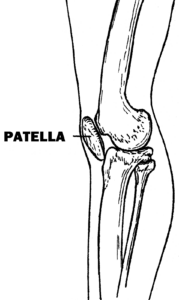
Patellar tracking problems happen more often to women, but men are not immune.
Improper biomechanics during exercise or athletics may cause it.
Chondromalacia patella in athletes is commonly caused by jumping or fast running. But longer, slower running can also cause it.
Solutions
- Avoid the offending activity.
- Do leg extensions (“leg extension machine”) with light weight and high repetitions.
- Avoid hyperextending the knee.
- As you get used to the leg extensions, increase the weight so that you’re doing strength training on the machine twice a week.
- However, on other days, do weightless knee extensions, 20 reps toes pointed to ceiling, 20 with toes pointed out and 20 with toes pointed in.
After following these measures, you should no longer suffer so much with severe knee pain while sitting.
One More Possible Cause of Sitting Knee Pain
Much less likely, but not impossible, is a condition called patellar tendonitis: inflammation of the tendon that joins the patella to the tibia (main shin bone).
While seated, the pain can be triggered if your leg is bent under a chair. However, the pain wouldn’t necessarily be severe.
Running, jumping and squatting are chief causes of patellar tendonitis.
Dr. Peck’s areas of interest include chronic and acute musculoskeletal pain, sports injuries, arthritis and cancer pain, among many others. Austin Interventional Pain was established in 2019.
Lorra Garrick has been covering medical, fitness and cybersecurity topics for many years, having written thousands of articles for print magazines and websites, including as a ghostwriter. She’s also a former ACE-certified personal trainer.
.
Top image: Freepik

Painful Bony Lump on Kneecap (Cancer?) Explained by Doctor

A doctor, not a layperson in a forum, explains possible causes (cancer??) of a painful bony lump on your kneecap (patella).
“The most common cause of a lump on the patella is Osgood-Schlatter disease,” says Devin B. Peck, MD, owner of Austin Interventional Pain in Austin, TX.
“This is caused by inflammation of the patellar tendon and is most common in adolescents,” says Dr. Peck.
“Risk factors include overuse from sports and periods of rapid growth as during adolescence. It is benign and is often easily treated with rest and ice.”
What about cancer?
Dr. Peck says, “A painful lump on the patella is very unlikely to be cancer. Most bone tumors are not malignant and may not be painful.
“With bone tumors, there will commonly be associated symptoms such as weight loss, fatigue or other symptoms, and pain will typically be progressively worse over time.
“There may be no pain, and bony tumors sometimes present as fractures, as bones affected by tumors become weaker.
“However, any new lump or mass should be brought to the attention of your physician.”
Dr. Peck’s areas of interest include chronic and acute musculoskeletal pain, sports injuries, arthritis and cancer pain, among many others. Austin Interventional Pain was established in 2019.
Lorra Garrick has been covering medical, fitness and cybersecurity topics for many years, having written thousands of articles for print magazines and websites, including as a ghostwriter. She’s also a former ACE-certified personal trainer.
Top image: Shutterstock/Syda Productions
Knee Pain after Hip Surgery: Causes, Solutions
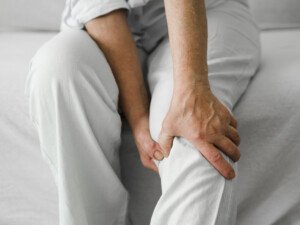
A physician cites three possible causes of knee pain following hip replacement surgery.
“Knee pain after hip surgery is a poorly-understood phenomenon,” says Devin B. Peck, MD, owner of Austin Interventional Pain in Austin, TX.
“A small retrospective study examined 13 patients who’d had hip replacement,” continues Dr. Peck. “Eight of the patients reported knee pain after the surgery.”
Three Possible Causes of Knee Pain after Hip Replacement Surgery
Dr. Peck explains, “Biomechanical measurements before and at six weeks after surgery [in the aforementioned study] did not demonstrate significant differences.
“Reasons for this phenomenon remain unclear, but may include changes in gait and leg length, and elimination of a greater pain-generator (hip), leading to more noticeable discomfort in the knee.
“Patients with severe hip osteoarthritis may develop a gait abnormality, known as Trendelenburg gait, due to weakness in the hip abductor muscles.
“This gait can lead to uneven pressures across the knee joint, and resulting arthritis in that joint.”
Hip abductor muscles are located on the outer side of your hips and are primarily responsible for moving your leg away from your body’s midline.
Solutions to Knee Pain Following a Total Hip Replacement Surgery
“The best way to optimize outcome after any joint surgery is to optimize preoperative conditioning,” says Dr. Peck.
This means “participation and compliance with a formal PT program along with home exercises (very important!).”
If the patient has excess body weight, then losing this weight will also help relieve some of the pain, since the knee, being the most unstable joint in the entire body, is very sensitive to excess body fat.
Hence, even a 10 percent weight loss will yield some improvement in the way this joint feels.
The patient may believe that fat loss is impossible due to limitations in the ability to use the lower body.
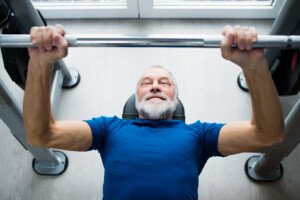
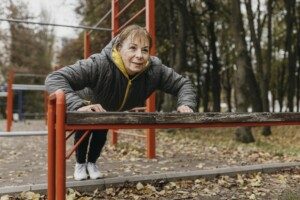
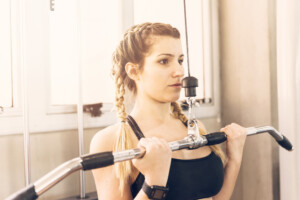
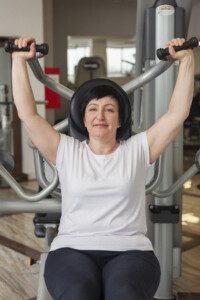
However, upper body strength training exercises will facilitate fat loss.
By engaging in these exercises, you build lean muscle mass, which increases your overall metabolism.
This enhanced metabolic rate helps your body burn more calories, both during exercise and at rest.
This loss of body fat is so important for anyone who’s struggling with knee pain following surgery of the hip.
And of course, consuming fewer calories will get weight loss going.
This deficit forces your body to burn stored fat for energy.
Consuming fewer calories begins with replacing soda with water; juice with whole fruit; more home cooking and less fast-food, and mindful eating: the avoidance of eating for reasons other than hunger, such as when watching TV or using the computer.
Remember, even a 10% weight loss can improve knee discomfort that has resulted from a hip surgery.
Upper Body Strength Training Exercises
Shutterstock/Halfpoint
Freepik
Freepik

Shutterstock/Microgen
Freepik
Dr. Peck’s areas of interest include chronic and acute musculoskeletal pain, sports injuries, arthritis and cancer pain, among many others. Austin Interventional Pain was established in 2019.
Lorra Garrick has been covering medical, fitness and cybersecurity topics for many years, having written thousands of articles for print magazines and websites, including as a ghostwriter. She’s also a former ACE-certified personal trainer.
.
Top image: Freepik.com
How Long Does Knee Arthroscopy Rehab Take?
“There is a great deal of variability in terms of length of time taken to recover from knee arthroscopy,” explains Devin B. Peck, MD, owner of Austin Interventional Pain.
Dr. Peck continues, “This variability depends on both patient factors, including age, pre-operative physical condition and compliance with rehabilitation, as well as procedure factors, i.e., what type of repair is performed.
“In a patient with good pre-procedure fitness, recovery from simple arthroscopy including washout of debris but not requiring repair of major ligaments, can take as little as two to four weeks.
“Recovery from large repairs, such as of the anterior cruciate ligament (ACL), can take several months.”
Really bad ACL injuries can take about nine months to completely recover from as far as returning to pre-injury athletic activity.
Dr. Peck’s areas of interest include chronic and acute musculoskeletal pain, sports injuries, arthritis and cancer pain, among many others. Austin Interventional Pain was established in 2019.
Lorra Garrick has been covering medical, fitness and cybersecurity topics for many years, having written thousands of articles for print magazines and websites, including as a ghostwriter. She’s also a former ACE-certified personal trainer.
.
Top image: Shutterstock/kazoka


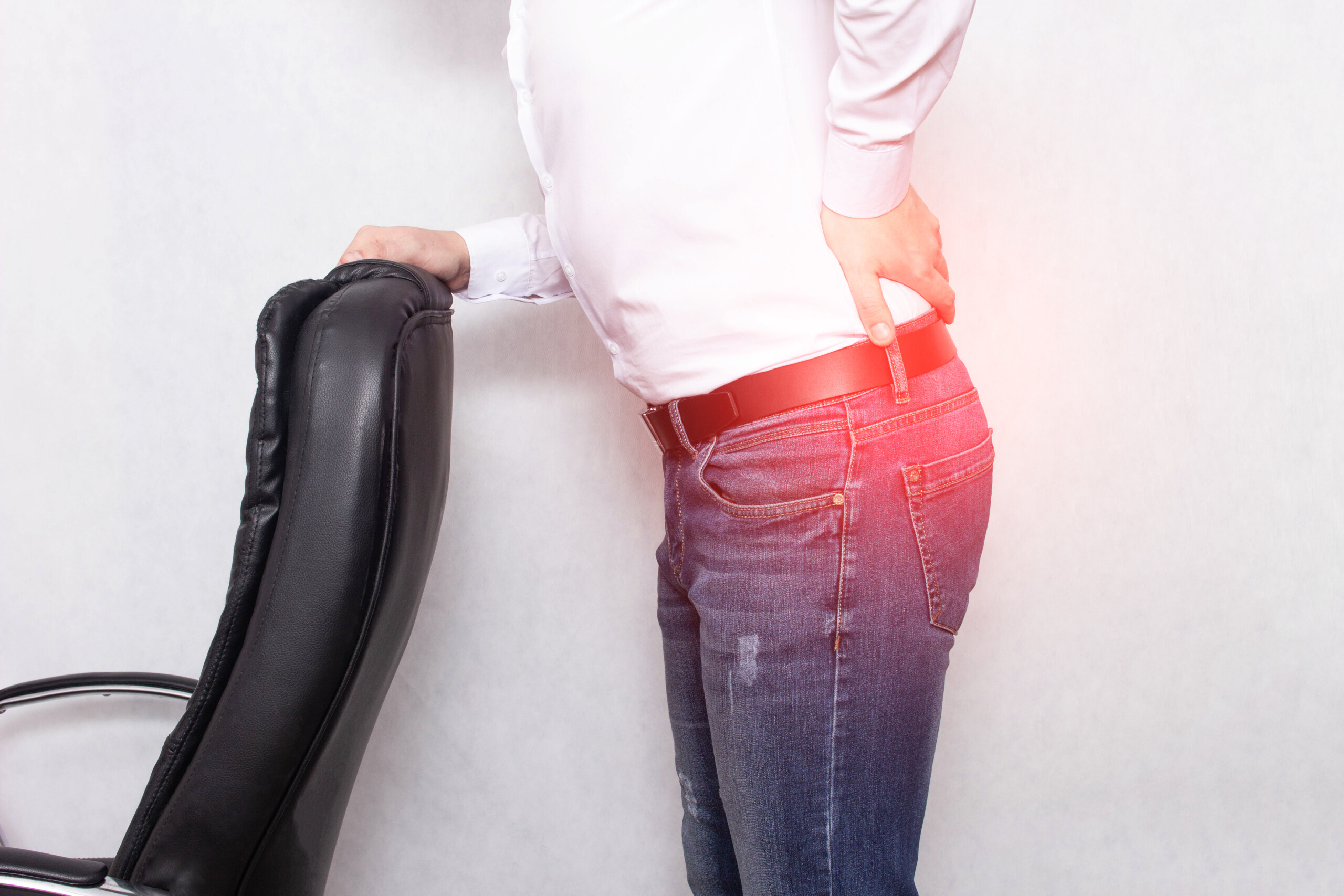
Hip Pain when Standing Up: Causes & Solutions
“Hip pain present while standing may represent degenerative joint disease (osteoarthritis) of the hip,” says Devin B. Peck, MD, oowner of Austin Interventional Pain in Austin, TX.
The hip joint consists of a ball-and-socket design. The bone “ball” is not supposed to make contact with the bone of the socket.
There’s cartilage in between to prevent this. Wearing down of the cartilage is what occurs in osteoarthritis. Wearing down means less shock absorption.
Sometimes the cartilage is so worn down that these bony portions begin rubbing against each other, causing hip pain, including when you stand up.
Dr. Peck explains, “Risk factors include obesity, advanced age or prior trauma. This is the most common cause of hip pain in people over age 65 and can present as groin or thigh pain.”
Another risk factor is lack of weight-bearing exercise such as leg presses, squats and walking lunges.
“Severe, sudden onset of severe hip pain which may occur only with standing should raise concern for hip fracture.
“This can occur without significant trauma in patients with osteoporosis.”
In fact, a hip fracture can be caused by standing up from a seated position in someone with very brittle bones.
“Trochanteric bursitis is another common cause of hip pain which can be present when standing up, walking, climbing steps, driving or lying on the side.”
Solutions
“If pain is due to osteoarthritis, exercises that strengthen the abductors of the hip (gluteus minimus, gluteus medius, vastus lateralis) are important,” says Dr. Peck.
“A simple exercise is to lie on your back with knees bent, squeeze the buttocks, and hold for five seconds for 30 reps.” See the image below of the bridge position.
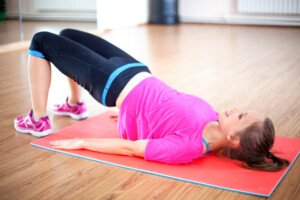
Bridge hold. Freepik.com, Mangostar
“To make this more challenging, you can lift your pelvis up off the floor and hold for five seconds,” says Dr. Peck.
“Be sure to brace the abdominal muscles while doing this to avoid low back strain.”
Dr. Peck’s areas of interest include chronic and acute musculoskeletal pain, sports injuries, arthritis and cancer pain, among many others. Austin Interventional Pain was established in 2019.
Lorra Garrick has been covering medical, fitness and cybersecurity topics for many years, having written thousands of articles for print magazines and websites, including as a ghostwriter. She’s also a former ACE-certified personal trainer.
.