
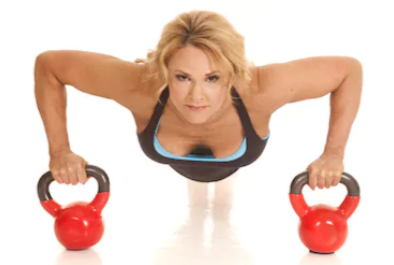
Can You Do Chest Workouts after Mastectomy + Reconstruction?
After a breast cancer double mastectomy, you can eventually get back to any chest workouts you desire!
This means bench press, dumbbell chest press, pushups, the “pec deck” machine – you name it. (more…)

Is a Blood Pressure Reading of 140 over 85 Bad?

Is a blood pressure of 140 over 85 much better than 140/90, which marks the beginning of high blood pressure?
A reading of 140 over 85 needs to be interpreted within context. (more…)
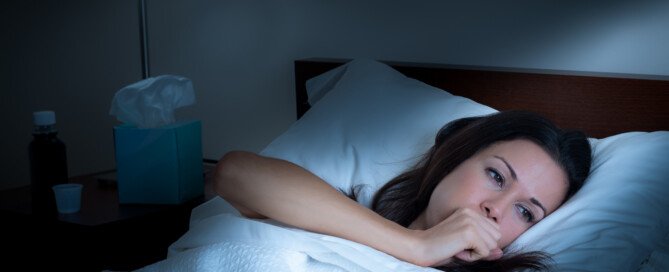
Coughing Overnight Caused by Lisinopril vs. Acid Reflux

Both Lisinopril and acid reflux can cause overnight coughing.
The affected person isn’t necessarily awake during all that coughing, either, even though other people in the house may be. The Lisinopril cough and the acid reflux cough can also occur in the same person throughout the same night.
This is why one might wonder if there’s a way to tell the difference between a cough caused by Lisinopril (a high blood pressure drug) and acid reflux, which is exacerbated by a lying-flat position, allowing acidic contents from the stomach to reflux upward and into the throat.
The condition of acid reflux affecting the throat is is called laryngopharyngeal reflux (LPR).
“Acid reflux is a common cause of heartburn; a chronic cough may also occur,” says William Manger, MD, PhD, founder of the National Hypertension Association, professor emeritus at the New York School of Medicine, and author of the book, “Live Longer, Live Better: Avoid the Risks.”
A burning sensation in the chest is not always present because the acid doesn’t stay in the esophagus long enough (as it makes its way to the throat) to cause the so-called heartburn.
The cough is due to the acid making contact with the vocal cords. This triggers mucus production to coat the cords to protect them from the acid.
This entire process causes a tickling sensation or otherwise irritating feeling in the throat, causing coughing – even while someone sleeps. It doesn’t sound pretty, but it’s not an urgent situation, either.
“Measuring the acidity in the swallowing tube may be helpful in diagnosing acid reflux,” says Dr. Manger. “Raising the head of the bed may be helpful in avoiding acid reflux and cough at night.
“It may be necessary to avoid the use of Lisinopril to determine whether it is the cause of the cough.”
Do not stop taking Lisinopril without first consulting with your prescribing physician.
“I am not aware that there is any marked difference in the sound of the cough caused by Lisinopril or acid reflux,” adds Dr. Manger.
“If the cough continues despite discontinuing of Lisinopril then it seems that Lisinopril is not the cause of the cough.”
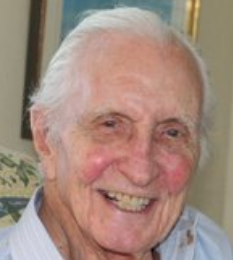 Dr. Manger, who began practicing medicine in 1949, has conducted research on the mechanism of salt-induced hypertension, and has published research in peer-reviewed journals. He passed away in 2024 at the age of 103.
 Lorra Garrick has been covering medical, fitness and cybersecurity topics for many years, having written thousands of articles for print magazines and websites, including as a ghostwriter. She’s also a former ACE-certified personal trainer.
.
Top image: Shutterstock/EHStockphoto

Can Sudden Drop in Blood Pressure Occur when Sitting?

If you’ve ever felt faint upon sitting, you may have wondered if this is because your blood pressure drops when you lower your body.
“A sudden drop in blood pressure should not result from sitting,” says William Manger, MD, PhD, founder of the National Hypertension Association, professor emeritus at the New York School of Medicine, and author of the book, “Live Longer, Live Better: Avoid the Risks.”
Dr. Manger explains, “However, a sudden drop in blood pressure may occur with suddenly standing from a seated or recumbent position.
“This may especially occur in older persons, since their vascular response to standing (i.e., their blood vessels’ constriction to standing) may be less rapid than that occurring in younger persons.”
When you stand, the vascular system is supposed to, via valves in the veins, prevent blood from draining out of the brain due to gravity.
This vagal response in some people is delayed or slow to react, hence causing that syncope sensation or a feeling like one is going to pass out.
During these episodes, called orthostatic hypotension, the blood pressure suddenly drops in response to a quick rise from a seated, recumbent-seated (reclined back) or lowered position.
Lowered positions that can result in orthostatic hypotension include sustained squatting or kneeling; the positioning for the bent-over dumbbell row exercise; and yoga positions.
Solutions for Preventing Syncope or a Faint Feeling
• Rise slowly from your chair or bed.
• Rise slowly from your squat or kneel.
• Clench your fists upon rising. Some yoga instructors advise their students to do this when rising off the floor to a standing position.
• Don’t obsess about the condition. This tends to bring it on more. Some people find that when their orthostatic hypotension is absent, it’s when their mind is distracted by busyness as they bolt up from a seated position.
• Stay hydrated.
If you forget to take the above measures and feel the room turning black, of course you already know that sitting back down again corrects the problem – or at least leaning into something stable and bending forward.
We’d really be in big trouble if sitting caused a sudden drop in blood pressure, what with all the sitting that modern peoples do every day.
Dr. Manger, who began practicing medicine in 1949, has conducted research on the mechanism of salt-induced hypertension, and has published research in peer-reviewed journals. He passed away in 2024 at the age of 103.
Lorra Garrick has been covering medical, fitness and cybersecurity topics for many years, having written thousands of articles for print magazines and websites, including as a ghostwriter. She’s also a former ACE-certified personal trainer.
.
Top image: Shutterstock/wavebreakmedia
Can High Blood Pressure Directly Cause Tinnitus?
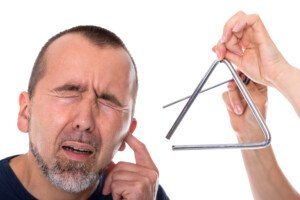
Subjective tinnitus is when you “hear” noise inside your ears and has a large number of potential causes.
Since tinnitus and high blood pressure are quite common in the general population, it only stands to reason that sooner or later, a tinnitus sufferer will begin wondering if high blood pressure (hypertension) can actually cause the so-called “ringing in the ears.”
Be very careful about how you interpret other websites listing “high blood pressure” as a “cause” of tinnitus.
A direct cause of a symptom is not the same as an agent that makes a pre-existing symptom more noticeable or worse.
On the mayoclinic.com site for tinnitus, under the main header of “Causes,” there is a sub-header titled “Blood vessel disorders linked to tinnitus.”
The term “linked” does not mean causative.
The site further explains as follows: Hypertension and factors that increase blood pressure, such as stress, alcohol and caffeine, can make tinnitus more noticeable.
Thus, while high blood pressure is not a direct cause of tinnitus, it can make you notice it more.
“There is no evidence that high blood pressure alone can cause tinnitus,” says William Manger, MD, PhD, founder of the National Hypertension Association, professor emeritus at the New York School of Medicine, and author of the book, “Live Longer, Live Better: Avoid the Risks.”
Tinnitus, which is very common, is a symptom, not a disease.
“Tinnitus is usually associated with a loss of hearing caused by a variety of conditions,” says Dr. Manger.
The American Tinnitus Association lists the following “catalysts” of tinnitus:
• Hearing loss from age
• Exposure to loud noise
• Excessive earwax
• Loose hair from the ear canal
• Head or nasal congestion
• Foreign objects or dirt in the ear
• Head or neck trauma
• TMJ disorder (benign condition affecting the jaw joint)
• Side effects of some drugs
• Meniere’s disease (inner ear disorder)
You may learn that you have high blood pressure at about the same time that you develop tinnitus or notice some kind of ongoing hissing or very high frequency tone in your ears.
This establishes duality of conditions, not cause and effect.
Dr. Manger, who began practicing medicine in 1949, has conducted research on the mechanism of salt-induced hypertension, and has published research in peer-reviewed journals. He passed away in 2024 at the age of 103.
Lorra Garrick has been covering medical, fitness and cybersecurity topics for many years, having written thousands of articles for print magazines and websites, including as a ghostwriter. She’s also a former ACE-certified personal trainer.
.
Top image: Shutterstock/Tibanna79
Sources:
mayoclinic.org/diseases-conditions/tinnitus/symptoms-causes/dxc-20180362
ata.org/understanding-facts/

Can a Stomach Virus Raise Blood Pressure?

Many people want to know if a stomach virus can actually raise blood pressure.
Blood pressure is the force with which blood presses against the inner walls of vessels.
A virus is a microscopic organism that can cause anything from a minor nuisance in the body to a life-threatening situation.
But is there a connection between a viral infection of the stomach and an increase in blood pressure?
“There is no evidence that a stomach virus can raise blood pressure,” says William Manger, MD, PhD, founder of the National Hypertension Association, professor emeritus at the New York School of Medicine, and author of the book, “Live Longer, Live Better: Avoid the Risks.”
Dr. Manger adds, “However, if a stomach virus causes significant abdominal pain, an elevation in blood pressure may result from the pain and discomfort.”
Thus, there is no direct path through which a stomach virus spikes blood pressure.
Of course, physical (and mental) pain or stress can elevate one’s blood pressure – regardless of the cause of that pain.
When the body is under stress, it releases hormones like adrenaline and cortisol.
These cause the heart to beat faster and blood vessels to narrow, temporarily raising blood pressure even in people without hypertension.
Dr. Manger, who began practicing medicine in 1949, has conducted research on the mechanism of salt-induced hypertension, and has published research in peer-reviewed journals. He passed away in 2024 at the age of 103.
Lorra Garrick has been covering medical, fitness and cybersecurity topics for many years, having written thousands of articles for print magazines and websites, including as a ghostwriter. She’s also a former ACE-certified personal trainer.

At What Level Do You Really Need Blood Pressure Drugs?
Nobody likes to be told they need drugs for high blood pressure.
But at some point, intervention with prescribed drugs will be advised by one’s physician if the blood pressure reaches a certain point – but what point?
“Systolic blood pressure of 140 millimeters of mercury or greater in normal adults usually requires medications to maintain the systolic pressure at a level of about 130 millimeters of mercury,” says William Manger, MD, PhD, founder of the National Hypertension Association, professor emeritus at the New York School of Medicine, and author of the book, “Live Longer, Live Better: Avoid the Risks.”
In other words, if the so-called top number is 140, your doctor may recommend a prescription for a medication that lowers blood pressure.
Though 140 is the cutoff point for when blood pressure is considered high, don’t let the concept of “cutoff” trick you into thinking that this isn’t anything to mind.
If you don’t get that 140 into the 130s (and ideally 120s), then it can stealthily creep up into the 150s, then 160s and even higher over time – increasing your risk of a stroke or heart attack.
Ask your physician about what you can do to lower that top number without drugs.
Dr. Manger strongly recommends DASH: dietary approaches to stop hypertension.
Sticking to this dietary approach has lowered the blood pressure of many people and is recommended by the American Heart Association.
In addition, if you’re worried about having to take drugs to lower your blood pressure, you should take up exercise.
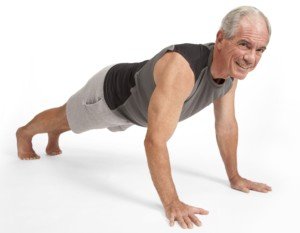
Shutterstock/Straight 8 Photography
If you’re already exercising, chances are pretty good that it’s inadequate.
Why Exercise Can Fail at Lowering Blood Pressure
The overwhelming reason for this is because the exercise isn’t challenging enough to the body.
For instance, if your idea of effective exercise is that of sweeping under the kitchen table after your kids eat their meals, and other common household chores, you’re not fooling your body.
As a former personal trainer, I have always denounced the idea that housework is an effective substitute for structured aerobic and strength training exercise.
Another widespread blunder is that of holding onto a treadmill while “walking.”
If you want to naturally lower your blood pressure, remove your hands and walk the way nature intended, getting your heart rate up.
Holding on can actually raise blood pressure – not to mention skewer posture.
The act of holding on mimics the clenching of both fists that doctors and nurses recommend to people who suffer from orthostatic hypotension – feeling faint seconds after rising from a prolonged seated position or a bent-over position.
The fist clenching raises blood pressure to prevent passing out. I’ve seen people tightly gripping the treadmill front bar as they “walk” at fast speeds.
Walking on a treadmill for 30 minutes, let alone an hour, while gripping and thus causing elevated blood pressure, just isn’t smart.
Drug Intervention
If you’re concerned about your blood pressure reaching a level where drugs are necessary to lower it, then regularly check your blood pressure.
In addition:
• Lose weight if needed; don’t settle for a psychological approach that stunts weight loss efforts.
• Quit smoking.
• Limit drinking.
• Commit to sessions of aerobic and resistance exercise.
• Follow the DASH diet to lower blood pressure naturally.
Dr. Manger, who began practicing medicine in 1949, has conducted research on the mechanism of salt-induced hypertension, and has published research in peer-reviewed journals. He passed away in 2024 at the age of 103.
Lorra Garrick has been covering medical, fitness and cybersecurity topics for many years, having written thousands of articles for print magazines and websites, including as a ghostwriter. She’s also a former ACE-certified personal trainer.
.
Top image: ©Lorra Garrick

Dark Circles Under Eyes a Symptom of High Blood Pressure?
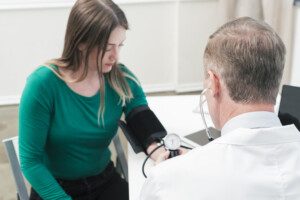
“There is no evidence that dark circles under the eyes are caused by high blood pressure,” says William Manger, MD, PhD, founder of the National Hypertension Association, professor emeritus at the New York School of Medicine, and author of the book, “Live Longer, Live Better: Avoid the Risks.”
The idea that high blood pressure causes dark circles under the eyes is a popular one.
But popularity does not make it true.
If high blood pressure has nothing to do with the cause of dark circles under both eyes, then what causes this unappealing feature?
• Aging. The skin gets thinner, revealing the blood vessels beneath.
• Rubbing or scratching the eyes. Be more conscious of how often and how aggressively you do this. Sometimes it’s done as a response to anxiety or stress.
• Allergies
• Fatigue
• Dermatitis
• No known pinpointed cause other than hereditary factors.
It would actually be great if high blood pressure could easily darken the skin under the eyes in a unique way that differs from the typical and benign darkening, as this would be a tell-tale sign of the so-called silent killer that can cause a stroke or heart attack.
However, high blood pressure (hypertension) is notorious for getting really up there without causing any symptoms, which is why you should regularly check it – but without becoming obsessive about it.
Dr. Manger, who began practicing medicine in 1949, has conducted research on the mechanism of salt-induced hypertension, and has published research in peer-reviewed journals. He passed away in 2024 at the age of 103.
Lorra Garrick has been covering medical, fitness and cybersecurity topics for many years, having written thousands of articles for print magazines and websites, including as a ghostwriter. She’s also a former ACE-certified personal trainer.
.
Top image: Freepik
Why Are Some Cardiologists Not Concerned of Borderline Qtc?





Are you scratching your head wondering why your cardiologist is not the least bit concerned over your borderline QT prolongation?
This lack of concern is certainly not a rare event, in that it happens quite commonly. But we have to put it into context too. (more…)
Avoid Colon Cancer: Whole Grains, Exercise, No Processed Meat