
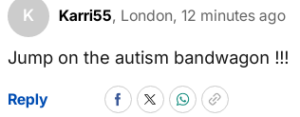
The “everyone has autism now” camp should know that the first man diagnosed autistic had the high functioning type that they say isn’t “real” autism.
“Mild” autism DOES exist, and it’s just as real and tangible as more severe presentations with limited speech.
Skeptics of the increased autism diagnoses in seemingly “normal” adults need to remind themselves that:
- Autism is a spectrum.
- That “normal” but quirky adult has had lifelong struggles that you don’t see.
- Getting a college degree, living independently and having a professional career are NOT markers of normality!
“Anyone these days can be diagnosed with autism.”
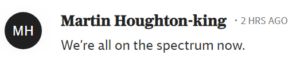
Singer-songwriter Robbie Williams, 52, was recently diagnosed with autism.
The skeptics assert: “That’s not the autism we used to know. The adults being diagnosed today are just quirky, socially awkward or introverted and want to get on the latest bandwagon.”
But there’s a fascinating historical problem with that argument.
Who was Donald Triplett?
Go all the way back to the beginning of the modern history of autism, and you find Donald Triplett.
Donald was the first person formally diagnosed with autism.
In 1938, when he was five, his parents took him to Johns Hopkins psychiatrist Leo Kanner because the highly verbal boy was socially detached, was fixated on numbers and data, and repeated phrases (all are traits common in many of those “fake” adult autism cases).
Dr. Kanner subsequently included Donald as “Case 1” in his landmark 1943 paper describing the condition that would eventually be called autism.
- Donald graduated from Millsaps College in 1958.
- He drove a car, played golf and traveled extensively and independently, including abroad.
- He worked at his family’s bank for nearly 65 years.
- Crikey! These are all the things that the critics say disqualify an autism diagnosis!
The increase in adult autism diagnoses has the skeptics on fire.
Yet Dr. Kanner clearly saw features in Donald that late-diagnosed Autistics typically have, such as social difficulties, stimming (repetitive body movements), hyperfixations (“special interests”), a knack for easily absorbing dense information, and echolalia (repeating words or phrases).
It’s a myth that echolalia occurs only in “low functioning” Autistics. For some with late diagnosed autism, echolalia is a form of self-regulation or stimming.
Had Donald been born to my parents, he would not have been taken to a psychiatrist.
My parents didn’t believe much in psychology and, though they at times thought their kids were disrespectful, overly sensitive, aloof, odd, socially inept or “lacked social graces,” never thought any of us needed to see a psychiatrist.
Skeptics need to remember that sometimes, that childhood diagnosis is the result of the parents’ lower threshold of tolerance. My parents had a very high threshold.
Though we got spanked, grounded and lectured, we would’ve had to have set fires before they’d bring us to any kind of psychologist or mental health counselor.
Skeptics Grossly Underestimate Autistic People
So if I can’t be autistic because I’ve lived independently since 22 and have never been on Medicaid, skeptics are essentially saying that autism always comes with high support needs or the inability to have a professional career or drive their kids to school. How insulting.
- Donald Triplett wasn’t “too high functioning” to be autistic.
- Despite his autism he was remarkably capable.
Those who believe many today are getting falsely diagnosed with autism clearly don’t grasp that the diagnostic requirements for autism literally spell out Donald Triplett.
The diagnostic requirements haven’t broadened nearly as much as the naysayers believe since 1943.
The surge in diagnoses is driven by fierce publicity for autism acceptance, easier accessibility to autism evaluations and easy access to information about autism (even though some of that needs to be taken with a grain of salt, e.g., not all autistic people avoid eye contact or lack friends).
Nobody is saying that it’s impossible to be misdiagnosed with autism.
But the doubters need to ditch their belief that genuinely autistic people must necessarily be severely disabled, unable to work, unable to have a conversation and unable to live independently.
That simply isn’t what the history of autism shows.
Depictions of autism throughout film history have fueled the myth that there’s no such thing as autism with low support needs (known as Level 1 autism).
Only relatively recently has there been a rash of TV and movie characters — with high levels of independence and achievement — either coded for autism or identified as being diagnosed with autism.
What always gets me about these ignorant skeptics is that they’ll say someone’s late autism diagnosis is fake and for attention, yet in the next breath would label me and other late diagnosed adults as weird, rude, blunt, eccentric, fidgety, socially inept, too little or too much emotion, void of empathy, being too sensitive to sounds and smells, and talking too much about their obsessions. Go figure.
Donald Triplett died in 2023 at 89.
