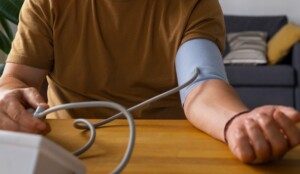
A Johns Hopkins Medicine study suggests that where you put your arm can change the number on the blood pressure screen.
Researchers found that two common positions — resting the arm on the lap or letting it hang at the side — can produce higher readings than when the arm is properly supported on a desk.
The study, published in JAMA Internal Medicine (2026), compared all three positions.
- With the arm resting on the lap, systolic blood pressure was nearly 4 mmHg higher.
- With the arm hanging unsupported, the top number was nearly 7 mmHg higher.
Tammy Brady, MD, a senior author of the study and Johns Hopkins researcher, says arm position can make a “huge difference” when blood pressure is being measured.
The researchers say their findings support existing recommendations that the arm should be comfortably and firmly supported during the test.
What exactly is blood pressure?
Blood pressure is a measure of the force of blood pushing against artery walls.
A typical reference point is 120/80, although blood pressure categories are based on established clinical thresholds.
Hypertension (high BP) often has no obvious symptoms. It’s dubbed the “silent killer.”
Untreated high blood pressure can raise the risk of heart attack, a weakly pumping heart, stroke and chronic kidney insuffiency.
Make It More Accurate
American Heart Association guidelines recommend several steps for a proper measurement.
The cuff should fit the upper arm correctly. The patient’s back should be supported, feet should remain flat on the floor, and legs should not be crossed.
The arm also needs to be positioned correctly. The center of the cuff should be at about heart level while the arm rests on a desk or table.
A patient may be sitting on an examination table rather than next to a desk, leaving the arm without a convenient support. However, there are nurses who will hold the arm up to mimic resting it on a desk, while the BP is being taken.
But keep in mind that someone holding your arm doesn’t provide the same support as resting the arm on a desk.
How the Study Was Done
The researchers enrolled 133 adults between August 2022 and June 2023. Participants were 18 to 80.
The study used six different groups so that the order of the three arm positions varied among participants.
This helped prevent the order of testing from being responsible for differences in readings.
During a single visit, participants first emptied their bladders and walked for two minutes, representing the short walk into a doctor’s office.
They then sat quietly for five minutes with their backs and feet supported.
Researchers selected an upper-arm cuff based on each participant’s arm size.
A digital blood pressure monitor was used to take three sets of three readings, with 30 seconds between measurements.
The measurements were performed between 9 a.m. and 6 p.m. Each participant went through the same basic testing process during that visit.
Before each round, the cuff was removed. Participants then walked for another two minutes and sat quietly for five more minutes before the next measurements. This gave researchers a consistent break between testing conditions.
The room was kept quiet and private, limiting distractions that could affect a blood pressure reading.
Participants were specifically told not to talk with the research team or use their phones while measurements were taken.
The participants also walked and rested between measurement sets.
Later, each person had another three readings with the arm supported on a desk.
That extra set helped researchers account for normal variation from one blood pressure reading to another.
Blood pressure can naturally change from one measurement to the next, even when the testing conditions are similar.
- When the arm rested on the lap, systolic blood pressure was 3.9 mmHg higher than with desk support.
- Diastolic pressure, the bottom number, was 4.0 mmHg higher.
- With the arm hanging unsupported at the person’s side, systolic pressure was 6.5 mmHg higher.
- Diastolic pressure was 4.4 mmHg higher.
Systolic pressure is the top number and represents pressure when the heart pumps.
Diastolic pressure is the bottom number and represents pressure between heartbeats.
A 6.5 mmHg difference can move a systolic reading from 123 to 130, or from 133 to 140. That can change how a reading is classified.
The paper points out that the findings may apply specifically to automated blood pressure monitors. They may not necessarily apply to measurements made with other types of equipment.