
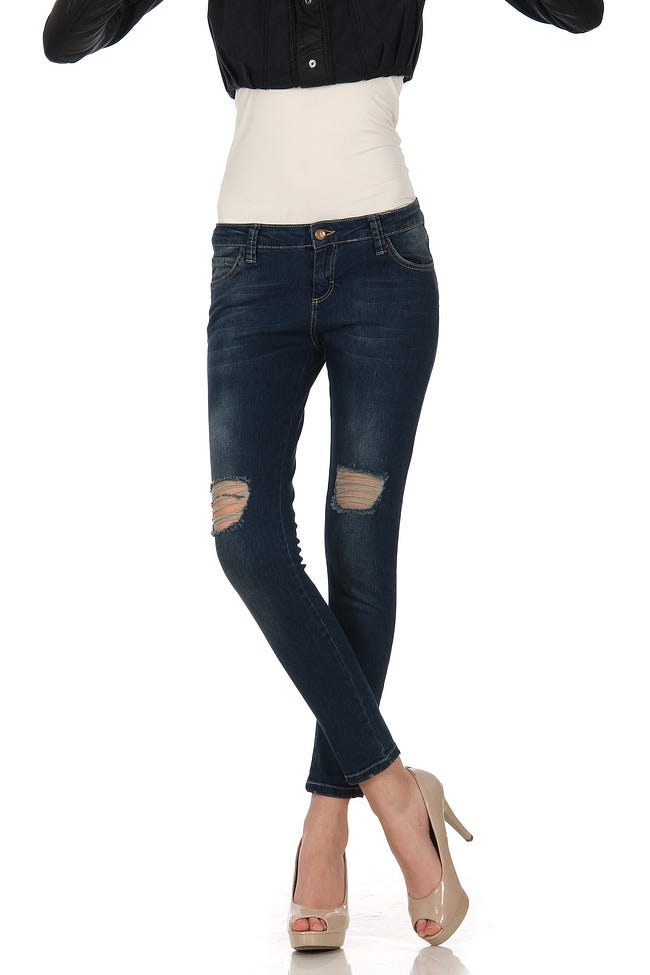
Thin may very well be more realistic than morbidly obese. Think of how difficult it’d be for a straight-size or thin woman to eat enough to get fat.
When I was a personal trainer one of my clients weighed 105 pounds. She simply could not eat two pieces of pie and ice cream at one sitting.
She hated the feeling of fullness; it made her feel sick; and it didn’t take much to get her near that point. It would’ve been impossible for her to eat enough to gain a hundred pounds.
However, from a mechanical standpoint, it’s much easier for the typical 250 pound woman to get down to 150 pounds by adopting a portion-controlled diet of mostly whole rather than processed foods.
Though obesity is on the rise, any very crowded venue will reveal plenty of women whose bodies would be considered thin by most people.
Just what is an “unrealistic” body type anyways?
By today’s standards, it’s the type of body that a typical female runway or magazine model has. But how is it unrealistic?
- Does this label refer to the impossibility that some women have experienced at trying to attain such a body?
- Or does it mean that only a tiny percentage of women wear a size 4 dress?
If the term “unrealistic” refers to the impossibility of having such a body, then this label should also be tacked onto a size 26 woman.
After all, how many naturally slender woman could balloon up to 280 pounds if they really tried to — especially those who are already consuming 2,000 calories a day?
So by that line of logic, morbidly obese women have very “unrealistic body types.” Or to put another way, “unattainable.”
My 105 pound client stood 5’7. She did not have anorexia nervosa or a medical condition that caused her to vomit. She came to me hoping to gain weight.
A food diary revealed she was consuming about 1,500 calories a day. Do you realize just how many more calories she’d have to consume to get that so-called, “real,” fat body?
When I told her to eat three pieces of pie instead of one, she said, “I can’t; I’d puke.”
And yes, I know that three pieces of sugary pie are bad for ANY body, but that’s not the point here.
The point is that she, like many thin women with so-called unattainable bodies, simply cannot eat enough of even their favorite foods to get heavy.
Thus, from HER point of view, the body of a 5’7 woman of even 170 pounds, let alone 200, would be “unrealistic” for her to attain.
The “unrealism” cuts both ways.
Yet the concept of unrealistic body type is primarily used by body positive advocates and many women in general to refer to thin fashion models or svelte film stars or recording artists.
What is a realistic body type?
The answer is simple: One that you can easily find in a crowd. Thus, developing countries can look at the United States and declare that obesity is a very unrealistic body size: It’s uncommon to find it in their crowds.
But let’s look at this from an overall perspective. If we want to get really technical about all of this, thin women have very realistic bodies, but so do morbidly obese women and everyone in between.
So where did this idea ever originate that Victoria’s Secret models have unrealistic bodies?
The Type of Woman’s Body that IS Unrealistic
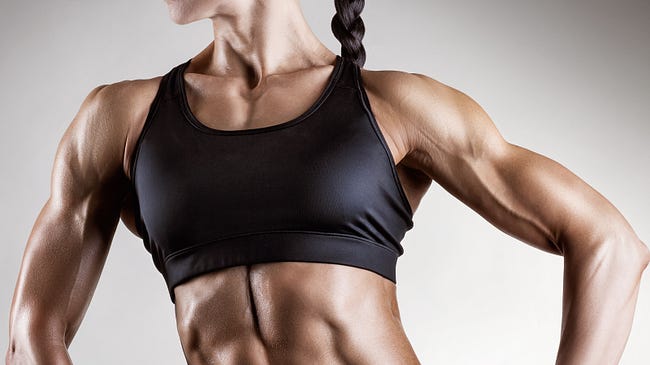
Check out a CrossFit competition or natural bodybuilding or physique contest.
Pronounced musculature in a woman is way more unrealistic, as far as its attainability AND commonality, than is looking like a Vogue model.
How many of THESE types of bodies will you see at a crowded venue on a hot summer day in which women will typically be wearing sleeveless or short-sleeve shirts and shorts that will show their body composition?
Go ahead, try it. See how many ripped and muscular women you can find. Then count the number of women with model-type or skinny bodies, and then the number of women who are moderately overweight, and then count the obese and morbidly obese ones.
 Shutterstock/Artem Furman
Your lowest number, by far, will be for the muscled women — assuming that the crowded venue isn’t a fitness convention or CrossFit competition.
Here’s a Little Psychology 101
A heavy woman longs to be straight-size (e.g., 130 pounds at 5’4). For years she’s struggled to obtain such a size but has never succeeded.
This doesn’t mean she can’t ever succeed and that she should just chalk it up to her genetic blueprint.
It very most likely means she’s always gone about the plan the wrong way, such as starving herself, hardly eating any carbs or avoiding exercise.
Nevertheless, she still envies those thin models in magazines because they convey to her a woman who can eat any quantity of anything and still be a size 4.
· Frustrated, desperate and angry that she can’t get smaller than a size 16, this woman comes up with the theory that being a size 8 is unrealistic and unattainable.
· By convincing herself that even a straight-size body is unrealistic, she now can relieve herself of the pressure of struggling to lose weight.
· The guilt is gone.
· The frustration is gone.
· After all, it’s impossible to attain an unrealistic body!
This thin-is-unrealistic philosophy has caught on like wildfire. But again, the irony is the flipside: That it would be exceedingly difficult for a thin woman to voluntarily gain a hundred pounds.
When slender movie stars are required to gain weight for a role, it requires a dedicated daily plan that they must keep track of — and that’s just for 30 pounds.
Though there are obese women today who, years ago, weighed only 115, their weight gain was not as simple as, “Okay, I want to be a size 26, so I’m going to increase my daily caloric intake to 7,000 calories.”
Their weight gain often unintentionally occurs due to lifestyle changes, emotional trauma that triggers overeating, and in some cases, a new medical condition contributes.
But even women with these various challenges have been known to knock their weight back down to near its original via a disciplined, sensible approach.
The point is that a thin woman who normally consumes 2,000 calories a day — or, as in the case of my rail-thin client, just 1,500 calories a day — will find it impossible to switch to a 5,000 calorie/day diet and stick with it.
Women Can Learn from Skinny Men
Ask any scrawny man who’s tired of looking like the type of guy who gets sand kicked in his face at the beach.
So many reed-thin men want to gain mass but struggle to, despite trying their hardest to eat more food and stick to a weightlifting regimen.
Many men with “chicken legs” want weight gain but can’t get it.
So maybe from their point of view, the guy with the muscular legs and big biceps has the “unrealistic” body type!
Let’s also not assume that every skinny person eats tons of food. Not one of my scrawny clients’ food diaries revealed a big appetite.
· Why is it difficult to believe that some slender women actually DO account for every single calorie to maintain a svelte build?
This doesn’t mean they have an eating disorder! Tracking calories, in and of itself, is not a mental health issue.
If it’s put within the context of a woman with anorexia nervosa who’s counting every calorie to make sure she doesn’t exceed 520 calories per day, then yes — it’s part of her illness. Context is important.
- Why is it so challenging to accept the idea that some very lean people hate the kinds of foods that easily pack on weight?
- And here’s a novel thought: Some slim people have — naturally — very small appetites. My mother is one. I have to remind her to eat!
We really have to put this concept of “unrealistic body type” into perspective.
If this article provided you with helpful information or reassurance, please consider supporting my work through Ko-fi. Donations help me continue writing detailed medical content that’s easy to understand.
