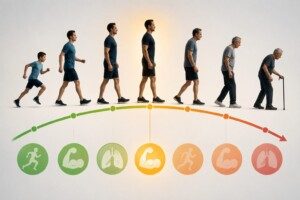
Is 35 the “new old,” in that this is the point at which the human body begins slowing down, losing fitness and getting weaker?
A huge study out of Sweden has revealed that the decline in fitness, muscle strength, and endurance often begins around age 35.
At the same time, the study carried an important upside. Even people who became active later in adulthood were still able to noticeably improve their physical abilities.
The research came from the Karolinska Institutet through a project called the Swedish Physical Activity and Fitness study.
Scientists followed hundreds of randomly selected men and women in Sweden for almost half a century.
Participants were repeatedly tested between 16 and 63, giving researchers an unusually detailed look at how the human body changes over time.
The findings were published in the Journal of Cachexia, Sarcopenia and Muscle.
Much aging research compares separate groups of people at different ages.
For example, researchers may compare 25-year-olds to 60-year-olds at a single point in time.
This study worked differently. Instead of swapping groups, scientists kept measuring the same individuals again and again over several decades.
That gave them a much more reliable picture of long-term physical decline and healthy aging.
Fitness Decline Starts Earlier Than Most People Think
Researchers found that overall physical capacity started decreasing around age 35, regardless of different exercise backgrounds or activity levels. After that, the decline continued gradually with age.
Does this mean that if you’re deadlifting 313 at age 35, you won’t be doing this at 50? Of course not. That’s not how it works.
The decline at around 35 would most be obvious in people with a sedentary, non-exercising lifestyle preceding their 35th birthday.
The decline would be — overall speaking — much less obvious in those who, since early in life, leading up to their 35th birthday, have been workout enthusiasts who’d always put a high premium on physical fitness.
Then again, it depends on how you measure fitness. If a gym rat’s top 100 meter speed at age 35 is 11 seconds, and they keep doing sprint workouts for the next 10 years, it’s extremely unlikely that at 40, they’ll still be clocking 11 seconds.
However, their overall fitness may seem hardly changed — we’ve all seen older men and women killing it at the gym, knocking off pushups and pull-ups, flipping around a huge tire, walking hard inclines on a treadmill without holding on.
Though we don’t know what kind of fitness level they’d had at 34 or 35, the fact that they’re in such great condition well into middle age is very telling of just how impactful lifelong exercise can be.
Nevetheless, the study puts that key downhill age at 35, in the following areas:
* Cardiovascular fitness
* Muscle strength
* Muscular endurance
The losses became more noticeable as participants grew older. But don’t let this discourage you if you’ve never exercised much before.
A sedentary person of 50 or 60 or even 70 can gain considerable fitness with consistent workouts.
Exercise After 35
People who became physically active later in adulthood still improved their physical performance by roughly 5 to 10 percent.
After the human body’s peak years pass by, there’s still plenty of room for achieving higher fitness levels in those who’ve never stepped inside a gym or gone for a jog in a park.
According to the study‘s lead researcher Maria Westerståhl, physical activity can slow down age-related decline, even if it can’t stop it entirely.
The team plans to continue studying the participants as they get older. The next round of testing is expected when participants reach 68.