
The three or four fatal squat fails on YouTube look exactly the same as the many others where people literally walk away from or stay conscious and moving.
But there has to be a difference – perhaps in angle or position by the millimeter – that made Yashtika Acharya’s back squat a lethal fail, along with the well-known video in the lifting community of the woman using a Smith machine who collapses under the weight in her daughter’s presence, appearing instantly killed.
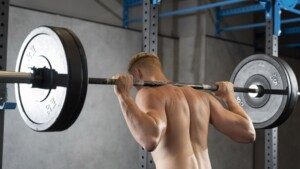
The commonality in these videos (the nonfatal ones can easily be found with searches like “squat fails” or “leg day gym fails”) is that the bar is solidly on the lifter’s neck at some point – either from the start (unsafe form) or as the person loses control.
The athlete loses control and it appears that the bar presses into their neck, pushing them towards the floor in a forward direction.
Some videos where they survive the bail-out and even seem fine right after show their faces going into the floor while the bar seems stuck into their neck for at least a second.
Why do nearly all these athletes survive while a few die?
Tiny Differences in Bar Position Determine Fate
Fatal cases would likely involve the bar landing a few centimeters higher than usual. This tiny difference (a common shirt button is 2 to 2.5 cm in width) can’t be detected in those several fatal cases, especially since the camera isn’t zoomed on their neck.
Visual variables prevent detection, such as angle of filming and hair over the bar. Even in slow motion, a button width difference is difficult to observe.
When the bar bears down on the cervical (neck) spine instead of the trapezius or lower neck, the risk changes dramatically.
From the viewpoint of the viewer, the exact point where the uppermost part of the trap ends and the lowest part of the cervical spine begins is impossible to identify in these kinds of videos.
The higher up the cervical spine the bar bears down on, the more likely the lifter will sustain a fatal crushing.
The upper cervical vertebrae protect the brainstem, which controls breathing and heart rate.
Damage here can cause instant loss of respiration or cardiac control, even without obvious external trauma.
The effects of damage here from blunt trauma are in an instant, immediately rendering the athlete’s body lifeless looking.
In the fatal case of Justyn Vicky, the life instantly drains from his body as he tumbles backwards after his spotters forward roll the bar off his neck along his head to the floor in front of him, forcing his face into his chest (this part is blurred out in some of the videos).
Angle and direction of force make or break outcomes.
- Most survivable fails involve angled force as the lifter folds or twists.
- In survivable accidents, a frame-by-frame analysis may reveal why the lifter got lucky, such as the bar having only light contact, if any, with their neck on the way down due to just the way their neck is turned or other uncontrolled but lifesaving variables.
- A fatal incident would certainly involve direct vertical compression.
A straight-down load compresses the spine rather than sliding off it.
Compression injuries transmit force directly through the vertebrae into the spinal cord and brainstem, which is far more dangerous than a glancing blow.
So even though there are videos of athletes, including female, seemingly being crushed in the neck by a barbell that slams them to the floor, these accidents would’ve had to have involved angled, and thus, dispersed, force – even though the visual makes it appear direct and vertical.
And you have to wonder if, had the bar been just one button width higher as it bore into their neck, would these lucky athletes still have survived?
Reflexes: Another Variable
In nonfatal fails, lifters instinctively drop their hips, push forward or roll the bar. Their accident may still come off as looking the same as the fatal ones, but all it takes is milliseconds difference in reflex time to alter the absorption of the load just enough to spare brainstem and spinal cord damage.
In the tragic cases, their reflexes may have failed due to fatigue, surprise or some other variable that can never be known.
In the lucky cases, maybe it was also just … plain luck of physics that day … and perhaps on another day they could’ve died.
One thing you might be wondering: fatigue. Wouldn’t the lucky ones also have been fatigued – at least if they’d already been working out for a bit prior to their gym fail?
Fatigue and Neurological Shutdown
Extreme fatigue can delay protective reflexes. How fatigued had Justyn Vicky been prior to his very last lift?
How fatigued had been Yashtika Acharya? She was an elite competitor, so she may have been sustaining grueling workouts for quite a while prior to that deadly lift.
Also, her instability seems to have been initiated by the soft mat she’d been standing on.
When the nervous system is already overwhelmed, reaction time slows just enough to allow catastrophic compression – even in the case of the woman using the Smith machine.
Two videos may look identical, but one lifter’s nervous system fires slightly slower.
That difference can be the line between a bruise and fatal neurogenic shock.
Why Videos Distort Perception of Risk
Millions of back squats happen every day. Even extremely low-probability biomechanical failures will occasionally occur.
When alignment, fatigue, reflex timing and equipment all fail simultaneously, the result can be fatal despite appearing identical in videos to harmless fails.
Survived accidents are shared widely because the person lives. They become part of “funny compilations” of gym fails.
We have to wonder how many more fatal back squat accidents there’ve been over the past, say, 20 years, that never made it to YouTube – either because they weren’t filmed, or, nobody posted them (for obvious reasons).
There’s at least one publicized example of a squat fatality that wasn’t caught on video: Dolores Boschert, 23, was found pinned under a Smith machine about 30 minutes after the accident.
That “funny” compilation fail could’ve ended up tragically had the bar’s force been shifted just a small number of degrees, or had the bar been just a fingernail-width higher up on the neck.
Nevertheless, most squat mishaps aren’t fatal because force is dispersed, reflexes engage and the bar doesn’t fully compress the upper cervical spine.
- Deadly cases occur when those protections fail all at once.
- The mechanism looks the same on video, but biomechanically, it’s not.
Below are links to three videos showing lethal consequences of careless squatting and spotting.
youtube.com/shorts/JUkkqOsFeyM
youtube.com/shorts/5rl2DlcLsD0
https://x.com/c4jimenez/status/1496321097083625481