
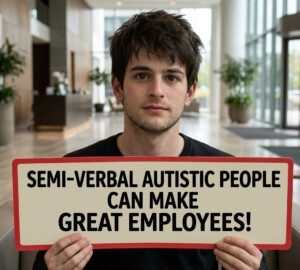
Ever wonder if those with semi-verbal autism can be gainfully employed with no job coach?
We never see stories about them.
This may be the first story you’ll read about a person with limited spoken language who has a job working alongside typical people – and doesn’t require a supportive employment coach at their side. I know this individual.
First off, it’s important you know the difference between semi-verbal autism and someone who’s verbal but chooses not to talk.
In true semi-verbal autism, the individual has a neurologically based impairment that prevents normal spoken communication.
This is not a choice. It’s the way their brain is wired. They can talk but are limited in how to use words to communicate.
They may even be able to read aloud fluently, yet spontaneous speech is very limited, and conversation is not possible.
Also impossible is narrative speech, such as describing their bedroom or what they did on their recent trip to Disneyland or what they like most about their favorite sport or musical performers.
The part of the brain that enables conversation or normal verbal communication simply does not work for them.
An Autistic who’s considered “verbal” will be fully capable of conversation and narrative speech – when they want to be.
But social anxiety or some other factor, that’s not related to neurological development, may lead to the choice of barely speaking.
When I did community connection work, I one day had a woman with me, along with another, who was her housemate with a host home provider.
The first woman spoke only when essential. For example, she got uptight that the back of my car didn’t have a holder for her thermos – uptight enough to let out some speech: “How come the back of your car doesn’t have a cup holder?”
I’d also see her having conversation with her housemate when they were inside a store at the mall.
The housemate told me they’d always have conversations. But this individual was extremely shy and, to put it succinctly, didn’t care for communication with humans.
This Man Is Semi-Verbal and Works a Regular Job Independently
I was recently assigned as a job coach for a man, 29, and let’s call him Trevor.
Trevor is unable to execute conversation. He is not capable of narrative speech.
He can ask questions related to his interests, but they are to the tune of “What are you drinking?” and “What are you doing right now?”
He’s fascinated by what someone has in any kind of beverage container and will always ask, “What are you drinking?”
I’ve heard him ask only a few other questions.
For instance he once asked a coworker, “How is your mother?” (This was a general inquiry; nothing was going on with the recipient’s mother.)
Trevor is also capable of reporting a problem, but in the most simplistic way.
When the color printer chucked out a black-and-white result, he used his cell phone to call the director and actually stated something like (his speech is often difficult to understand): “Hi Barb, it came out black and white, can you come up?” And then he ended the call.
Back-and-forth verbal exchange has never happened and will never happened.
Trevor fits the criteria for semi-verbal.
I’m a job coach for one of his two jobs.
The job I coach for is at the office building he works at in the mornings.
He’s a gopher (e.g., delivers mail, stuffs envelopes, restocks the break room, moves furniture) and will always require a job coach.
His other job is at a high-end hotel where he works as a buffet attendant, serving food upon request. No speech is required.
I was told by several people involved in his care that he has never had a job coach for this position!
The hotel just up and hired him, told him what to do, and he’s been doing it ever since with no special supervision.
People come through the line, tell him what they want (which could be verbal or by pointing), and he portions out the food and puts it on a plate.
Presumably, he says to each and every guest, “How are you doing today?” This is one of his favorite questions.
Where are the stories about semi-verbal autistic people who work independently?
I’ve never found any. This doesn’t mean they don’t exist. But in stories of gainfully employed autistic people, there’s never any mention of anyone being nonverbal.
Seems that a responsible journalist would mention they were nonverbal if indeed they were nonverbal. I know I would have.
This is crucial information, because many employers and the parents themselves automatically presume incompetence!
When a semi-verbal autistic person is independently holding down a job, this needs to get out there!
They make great employees! They won’t be the ones goofing off gossiping while on the clock!
I’ve known quite a few highly verbal, conversationally-adept autistic people who lead a day program life. Some even drive and have fluent literacy.
One must wonder just how much the presumption of employment incompetence has contributed to this.
Trevor’s mother never bought into the presumption of incompetence just because her son has limitations in spoken language, will never live independently and can’t even make a haircut appointment on his own.
Kudos to her for getting her son with semi-verbal autism and an intellectual disability into workforce life.
Nonverbal Autism and Independent Employment
I’ve done a deep search and came up empty. There’s plenty of stories online about autistic people, with higher support needs, working independently in the community.
They are quoted in the articles, or, sometimes, there’s a video of them talking about their job.
If there’s a nonverbal Autist out there who works a job independently, I’d love to cover their story.
Recently I came across a story of a nonverbal woman who conducts simple tasks at a shop of sorts, but she requires supervision. This isn’t independent employment.
Though Trevor definitely has speech, his case is noteworthy because there’s very limited coverage of employees with semi-verbal autism who work independently.

Lorra Garrick is a former personal trainer certified by the American Council on Exercise. At Bally Total Fitness, where she was also a group fitness instructor, she trained clients of all ages and abilities for fat loss and maintaining it, muscle and strength building, fitness, and improved cardiovascular and overall health. She has a clinical diagnosis of ASD.
Related Posts

Four Autistic Adults Who Are Running Thriving Businesses

10 Reasons an Adult Suspects Being on the Autism Spectrum

10 Benefits of a Late in Life Autism Diagnosis

Autistic Music Band to Be Featured in New York Film Festival

Ageism and Exclusion Exist in the Autism and Advocate Community