Do you “look” too typical for your autism diagnosis to be believed and thus wish you “looked autistic” so people would stop thinking you’re incompetent, lazy, rude and other negative things?
I decided to explore this topic after reading a thread in which the OP said they (no gender reveal) wished they did look autistic.
The reason had to do with this individual passing too much for non-autistic – without much masking at all.
And this natural presentation of someone more typical was creating problems.
For example, when they would disclose their autism as a reason for an accommodation or difficulty in a social setting, nobody was ever understanding or patient because this person didn’t “look autistic.”
They were passed off as lazy, rude, attention seeking, self-centered, etc.
The OP figured if maybe they had that autism “look,” people would be a whole lot more understanding.
The responses in this thread were interesting, and predictably, some focused on how autism does not have a look.
A few commenters countered that by asking something like, “If autism doesn’t have a look, how is it that people can often immediately tell someone is autistic even when they’re high functioning?”
I myself have had my Autie radar go off within moments of seeing someone in the mainstream public such as at a library or as an employee at Walmart, and to have it confirmed by that individual upon asking them if they’re on the Spectrum.
A woman told me that within moments of meeting me, she knew I was autistic, even though I had not walked in on my toes, made stimming sounds or exhibited stereotypical body movements such as hand flapping, finger flicking or outright avoidance of eye contact. Somehow, she just knew. And she was an NT.
So I must’ve had a look, because it certainly hadn’t been anything I said, such as info dumping about flicker fusion rates in various animals.
However, anatomically, I appear VERY NORMAL.
I walk normally. I don’t execute odd gestures. I suppress bigger or odd stims in public. Maybe it was a vibe that gave it away?
But even on TV (docudrama, news, reality), in which vibes can’t be detected, viewers can spot autism soon after the individual appears on screen, and then the autism is later revealed.
Masking vs. Deliberately Acting Autistic
The “look” boils down to subtle body movements, mannerisms, speech intonation and facial expressions that the observer could be noticing.
The “look” could also be more obvious such as steady rocking while seated and avoiding eye contact while talking.
It could be a slightly awkward gait and odd facial expression while just walking around.
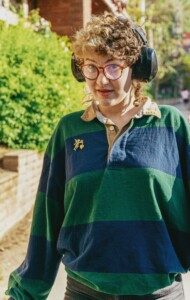
Looking autistic could mean wearing noise cancelling headphones plus sunglasses inside a building.
I know an autistic woman who got her diagnosis in middle age. She’s attractive and stylish. She sounds typical when speaking and walks like anyone else does. But keep watching; you may see some finger flicking as she walks.
Acting autistic on purpose could mean unmasking, exaggerating subtle mannerisms that are part of your autism, or, it can mean making up stims that you normally don’t do, deliberately speaking in monotone, flapping your hands about when you never do this, inventing a peculiar gait, etc.
Be Yourself, and Let the Leaves Fall Where They May
You don’t need to purposely try to “look” autistic just to make NTs feel at ease.
I’ve reached a point in my life where if my natural state of existence rubs a neurotypical the wrong way, then so be it. Let them scratch their head; how they interpret me is none of my business.
Of course, if the stakes are high (e.g., meeting with a banker regarding an application for a home equity line of credit), then you’d better believe I’m going to be doing some masking.
In my case, masking is primarily suppression of stimming, and fake smiling and forced nodding when I think it’s time to do these things while the other person is talking.
It’s also commenting or brief questions that don’t necessarily feel natural or intuitive, such as they pull out a picture of their baby; I’m expected to say something validating, so I must quickly make something up to appease that person – even though I feel like I’m reading off a script.
We’ve all heard of masking and unmasking. But deliberately trying to look autistic? That’s really a new one.
It’s kind of like reverse unmasking, in that the look you’re trying to create isn’t your authentic self, not any more than is high masking your true self.
Another point to ponder is the possibility that your desire to come off as visibly autistic is related to years of automatic or subconscious masking.
Maybe you don’t have to willfully act autistic after all, but instead, just need to relax the mask and be more true to yourself.
However, if you ever feel it’s important to pass as autistic in specific settings, such as those for which you need more patience or accommodations, you could consider wearing an autism acceptance shirt.