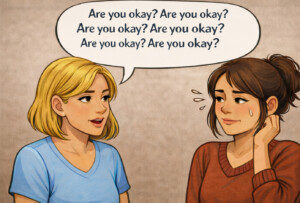
If you have a habit of often asking people if they’re okay, you need to stop this.
At first, this habit may sound noble and caring, but we need to look at this beyond the surface.
This topic pertains strictly to asking “Are you okay?” in the context of casual, social or work related interactions with someone, rather than you just witnessed them bang a knee into a table edge, or perhaps they suddenly put a hand to their head and go “This headache.”
So outside the context of observed physical pain, you shouldn’t keep asking others, in daily interaction, if they’re okay, every time you perceive the slightest speck of uptightness or anxiety in the other person.
This puts the recipient on the spot and makes them feel they must justify that eyebrow twitch, momentarily unblinking eyes, shift in position, subtle throat clearing, what-have-you.
It makes them feel like they’re under your magnifying glass. In fact, they may not even know what about their eyelids, finger movements or other body part made you wonder if they’re okay.
This then leaves them wondering what they did to bring out one of the most overused questions in the English language.
The Difference Between Attentive and Intrusive
No, I’m not the nitpicky one here. The asker is. I don’t want to be made to feel I must monitor my facial movements or mannerisms so that someone, whom I’ll be in the presence with for a while, doesn’t keep asking if I’m okay.
There’s a real difference between being attentive and being intrusive.
Again, it makes sense to ask “Are you okay?” when someone starts coughing uncontrollably or looks physically unsteady, etc. That’s basic human decency.
But frequently asking the same person if they’re okay every time you detect the slightest flicker of tension — a raised eyebrow, a pause before speaking, a shift in posture — crosses into something else entirely.
I’m having this experience with a new woman I’m working with, as a direct support professional.
She’s very high functioning and highly verbal. And too observant, it seems.
I just get a lot of “Are you okay?” from her, and I’m tired of answering, “Oh, yes, I’m fine,” while at the same time, feeling put in an awkward spot and wondering did my voice just sound edgy, or maybe it was the way I changed hand position on my car’s steering wheel? What in the fudge.
The time is not right to inform her that she needs to stop doing this. Eventually, I will.
It falls under my job description as a DSP to eventually clue her in about this. It’s not appropriate interaction. I’m sure she does this with many others as well.
It doesn’t matter what her background is (e.g., maybe she spent several years helping to take care of a sick family member). I just can’t keep being put in a position where I have to reassure her with, “Yes, I’m fine.”
When you repeatedly question someone’s emotional state (or perceived emotional state) over minor, ambiguous cues, you put them on that big red spot.
- Suddenly they’re not just existing; they’re being observed.
- They become hyper-aware that their smallest mannerisms are being interpreted as signs of distress.
An ordinary blink becomes a “signal.” A neutral expression becomes “uptight.”
And now they’re expected to explain themselves: “I’m fine. I was just thinking.” Or, “Nothing’s wrong; I’m just contemplating a few possibilities.”
Or worse, they feel pressured to perform reassurance so the other person can relax. I hate doing this.
It’s a leap for me to go from feeling neutral to broadcasting reassurance.
Is this because of my autism? Maybe. Maybe not. This woman I work with is also autistic.
- But I can easily see a neurotypical finding it irksome to have to keep fielding the question.
- I’ve also gotten the question too many times from neurotypicals themselves.
So it makes me wonder: Is this typical social behavior on their part? Or do I give off a vibe that makes them wonder if I’m okay?
If I’m giving off a vibe, these people – whether they’re neurotypical or HFA — need to be more discriminate about when to ask if someone’s okay.
I’m now finding myself self-monitoring in the presence of this individual so she doesn’t think I’m not okay.
The weird thing is that I tend to have a matter of fact or neutral demeanor, even flat at times.
She must be watching every eyebrow movement or the cadence of my eye blinking, or God only knows what.
Before you say, “Well, as a direct support professional, you should be more tolerant of the individual’s over-asking of certain questions, or, she’s just trying to be kind.”
Yada yada yada. As mentioned, I’ve gotten this from neurotypicals as well.
I’ve asked “Are you okay?” on very rare, very rare occasions – when physicality was involved, such as with, for instance, what appears to be a dizzy spell.
When I was a personal trainer, I may have asked it upon seeing a client put a hand to their shoulder after performing a chest routine.
But it’s unthinkable to me to just casually keep asking it to someone I’m with for a while or even briefly. Like dang, I’d realize it’d put them on the spot.
It shifts the burden onto the recipient to manage the asker’s perception. Instead of simply being present in the moment, they’re defending their normal human variability.
Remember These Points
- Not everyone smiles constantly.
- Not every quiet pause is anxiety.
- Not every serious face is a crisis.
People have resting expressions (the iconic Resting Bitch Face), internal thoughts, inner analyses and idiosyncratic habits that don’t require commentary.
The Inference of Frailty
Repeatedly asking “Are you okay?” can also imply fragility — that the person seems perpetually on the brink of falling apart.
Even if that’s not the intention, it can land that way. Nobody wants to start monitoring themselves to avoid triggering yet another check-in.
Real care respects autonomy. It allows space for someone to volunteer what they’re feeling rather than being prompted to account for every micro-expression.
If someone consistently says they’re fine, take them at their word. Trust is built not just by checking in, but by knowing when to let someone simply be.