
Why do so many moms think nothing of feeding their thin kids a junk food diet, as though ultra-processed food can’t possibly harm a thin body?
I was inspired to cover this topic upon realizing that a woman I recently met encourages her severely autistic and nonverbal son, 16, to devour all the highly processed food he wants.
The way she spoke about it when we were arranging for me to take him out as a community connector was just unsettling.
At one point she even said, “Oh, if you can’t figure out what he wants for lunch, he’s always good with a Coke and McDonald’s fries.”
One of the first things he learned on his AAC iPad, which “speaks” for him, is the McDonald’s icon. There are other icons on there for various junk items like soda and pizza.
I worked with him only twice, and on that second day, when I brought him home, he went straight to the refrigerator, took out store-bought pizza and put it in the microwave.
He then tapped his AAC device and it spoke, “I want a Hawaiian roll.”
Mom finished microwaving the pizza, put the roll beside it and poured him soda. Good Lord.
I got the impression in those two days, along with a third initial day, which was the meet and greet, that this kid lives on ultra-processed foods – and his mother thinks this is perfectly okay because he’s thin and active.
The mother herself may be a far ways off from having a health-conscious approach to life. I do know for sure she’s a smoker, which doesn’t indicate health consciousness.
Now before you defend her actions in the name of some autistic kids are extremely picky about what they eat, and you must give them whatever it is they’ll accept, there are a few flaws with this argument.
#1 Many Parents Feed Their Typical Kids a Junk Food Diet
The fact that moms and dads all over the U.S. give their overweight kids (autistic or not) free range on highly processed, high sugar, unnatural foods is very old news. That’s been tapped into plenty.
But there’s a subset of these parents who believe that as long as their kid is skinny, there’s no harm in providing them a junk food menu.
This is nuts. Lack of excess body fat is not protective against SAD: standard American diet.
#2 Junk Food Is As Bad to a Thin Body As It Is to a Fat Body
Studies describe “normal-weight metabolic obesity,” where individuals have a normal BMI but still develop insulin resistance, high blood fats, fatty liver disease and systemic inflammation due to poor diet quality (Ruderman et al, Diabetes, 1998; Shea et al, Journal of the American College of Nutrition, 2016).
Ultra-processed foods — high in sugar, refined carbs and often chockful of dyes and preservatives — impair insulin signaling and gut microbiota, regardless of body size (Monteiro et al, British Medical Journal, 2019).
Kids and teens with trim bodies can still show early markers of cardiovascular risk, including elevated triglycerides and blood pressure (Skinner et al, Pediatrics, 2018).
Neurodevelopment is also affected: Diets low in micronutrients and omega-3s are linked to poorer attention, poor mood regulation and poor academic performance (Nyaradi et al, American Journal of Clinical Nutrition, 2013).
A child, tween or teen can look full of vitality and stellar health – all while their organs, metabolism and brain are quietly being stressed.
Now of course, it’s WAY better to be thin on a junky diet than fat on a junky diet, if for no other reason, the existence of gravity.
Furthermore, obesity has its own, separate agencies that negatively impact health.
Parents who justify the junk food freedom because “I don’t have to worry; he’s as thin as a rail,” or, “She can afford to eat whatever she wants, she’s a stick,” are deceiving themselves and absolutely should NOT permit an ultra-processed diet any more than if their kids were fat.
#3 “He Needs Meat on His Bones”
Could it be that some moms — who think it’s okay to stock the cupboards, fridge and freezer with munchies, Little Debbie and Hostess, bottles of soda and frozen meals that have like a hundred ingredients – actually want to see some weight gain in their kids?
Well, this just doesn’t seem like a common scenario. After all, consider the following points:
• Parents are more likely to assume their kids will “fill out” as they get older.
• Many parents will say, “I was like that at their age; it was never a problem.”
• Parents wouldn’t mind if their kid was thin as long as they seemed healthy and had a normal and especially big appetite.
• Unless the child clearly hardly eats, the parents won’t view the thinness as a health threat.
Nevertheless, filling up on junk food is a poor way to gain weight.
A pediatrician will tell the parents to buy more healthful foods and not encourage fast food or other overly processed fare.
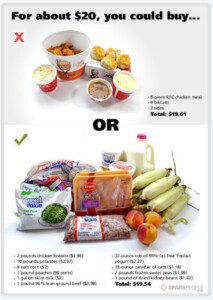
#4 Junk Food Is Cheaper than Healthy Food
This is a myth. I’ve provided an image below to prove this. Nothing further need be said.
#5 “My Kid Won’t Eat Healthy Food”
Getting back to autism, it’s true that a high degree of pickiness seems to be more prevalent in autistic kids and teens.
Parents will swear that their autistic child won’t eat anything except three or even two specific food items, such as chicken nuggets and white bagels smeared with Nutella.
“Otherwise they’ll starve; they won’t touch anything else; I don’t want them to starve.”
If this describes your autistic child, you must ask yourself:
“Before chicken nuggets and her other favorite highly processed foods were invented, just how did autistic kids with super picky eating habits ever survive?”
But they did! Autism has been around long before the advent of ultra-processed foods.
They had to have been eating to stay alive, and before Big Food became the behemoth that it is, autistic people were eating the same, mostly whole-food diet that everyone else was eating.
If your child – autistic or not – won’t eat healthful or whole foods, that’s because their brain has been trained to have a tender spot for overly processed foods.
And it’s pretty tough to break this training. But don’t give up.
This idea that a child will starve unless they get their chicken nuggets, grocery store frozen pizza and loads of other beige foods and sugary drinks needs to be seriously challenged.
How do we know that kids won’t starve if most of their junk diet is replaced by healthful foods? We know this because when people are stranded in the wilderness, they will eat ANYTHING.
The hunger drive is a beast. Stranded people will eat insects, catch critters and eat them raw, leaves, twigs, and even one guy, who was stranded in the mountains, ate lotion.
Don’t underestimate the hunger drive in a child or teen – be they autistic or neurotypical.
- This isn’t about making a skinny child gain weight. If they’re naturally thin, that’s perfectly fine.
- It’s about replacing most of the junky, heavily processed foods with more natural, healthier foods.
- A fast metabolism or very active body is NOT protective against the harm of highly processed foods.