Fishy Smell Around Penis: Causes and Solutions

A urologist explains the causes of a fish-like smell around the penis.
That fishy smell from your penis is caused by certain problems that you can remedy. A fishy smell around your penis is not normal. A fishy stink on or around the penile region has specific causes.
David H.C. King, MD, Medical Director, Urology Services, El Camino Hospital Los Gatos, speaks about the causes and solutions to a fishy smell coming from the penis.
Dr. King explains, “The most common causes of bad smell around the penis would be related to poor hygiene and skin infections.
“Uncircumcised men need to pull their foreskin all the way back to wash the head of their penis once or twice a day with soapy water.
“If that is not done, then secretions and a substance called smegma can accumulate and cause a bad smell.”
What exactly is smegma?
The top layer of the skin is called the epidermis. When the epidermal cells flake off and get mixed with an oily subtance called sebum, a pasty substance with a foul-smell results: smegma.
This accumulation collects in the moist areas of the genitals, particularly in men who have not been circumcised.
Dr. King continues: “The foreskin always needs to be put back covering the head of the penis or else a painful condition called paraphimosis can occur, which traps the foreskin above the head of the penis.”
In paraphimosis, the foreskin cannot be pulled back down into its normal position.
The foreskin can get trapped behind the penis if left retracted for too long, because this then causes the male organ to swell.
“Both uncirumcised and circumcised men can have bad smell around their penis if they get an infection from their sexual partners called bacterial vaginosis, gardnerella, or trichomonas,” says Dr. King.
Some men, who have a fishy smell about their genitalia, report that the odor is very similar or just like the odor from a woman’s vagina —
— a fishy odor caused by bacterial vaginosis, which is when the normal balance of vaginal bacteria becomes upset.
Other Causes of a Fishy Odor About the Penis
Urinary tract infection — this causes foul-smelling urine, and since urine exits the penis, then this foul smell can make its way onto the male organ.
Ketonuria (in diabetics) — the urine contains ketone bodies (byproducts of fatty acid breakdown)
Some men report that the bad or fishy smell about their penis is still there despite daily cleaning with soap and water, and even retracting the foreskin.
The reasons for this, explains Dr. King, are:
“In that case it could be either the man’s own body odor causing a smell or a persistent bacterial or yeast infection.
“A skin swab culture should be taken to diagnose an infection and be treated appropriately.
“If the culture is negative, then personal pleasant smelling lotions or deodorant can be used.”
 With 20+ years in general urology, Dr. King specializes in prostate disorders, kidney stones and urinary problems in men and women.
 Lorra Garrick has been covering medical, fitness and cybersecurity topics for many years, having written thousands of articles for print magazines and websites, including as a ghostwriter. She’s also a former ACE-certified personal trainer.
.
Top image: Shutterstock/Andrey_Popov

Frequent Urge to Urinate: Bladder Cancer Possible

A urologist explains frequent urination and bladder cancer.
Feeling of having to urinate, but nothing comes out, can be sign of bladder cancer, though urinary urgency as a symptom of this disease is relatively rare.
A frequent feeling of having to urinate can have other causes. When you actually urinate a lot, this isn’t the same as merely feeling the urge, that unpleasant, annoying pressure.
And despite attempting to void, there is no urine output, and the feeling of urgency persists.
“There are a myriad of causes for constant urinary urgency,” says David H.C. King, MD, Medical Director, Urology Services, El Camino Hospital Los Gatos. These include a urinary tract infection (UTI).
Women and the Urge to Urinate
“In women, the most common causes are having a UTI or a condition called overactive bladder (OAB),” says Dr. King.
“Interstitial cystitis (IC), which can be associated with bladder pain, can also cause urinary urgency.”
Men and the Urge to Urinate
“In men, the most common causes relate to consequences of having benign prostate hypertrophy (BPH).
“In both men and women, very acute onset of urinary urgency can be associated with bladder cancer.”
Bladder Cancer Facts
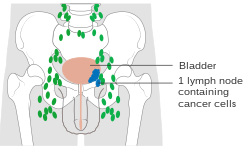
- In 2009 there were nearly 71,000 diagnosed cases of bladder cancer in America
- Over 14,000 deaths (not from those 71,000 cases, but that statistic includes people diagnosed in previous years).
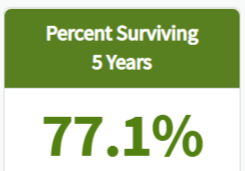
seer.cancer.gov
Symptoms: The hallmark symptom is blood in the urine. However, if you notice that it’s reddish, don’t panic too soon, because the red color can have other causes, including consumption of beets and red licorice.
The next symptom is frequent urge to urinate, which as mentioned at the beginning of this article, can be described as simply feeling that urge, but no urine comes out.
However, another symptom is actually producing a lot of urine throughout the day (this can also be a sign of diabetes or drinking a lot of fluids, as well as a side effect from some medications).
Risk factors: Over 50 percent of cases are linked to cigarette smoking.
Plus, recurring UTIs, high saturated fat diet; being male; family history; secondhand smoke; age; Caucasian race; and external beam radiation.
Workplace exposure to toxins are also a risk factor, and the following occupations have such exposure: hairdressers, machinists, printers, truck drivers, painters, and rubber/chemical/textile/leather/metal workers.
Does wheelchair confinement increase the risk of bladder cancer?
“Wheelchair confinement itself does not increase the risk of bladder cancer,” says Dr. King.
“However, some consequences of wheelchair confinement such as requiring a chronic catheter for bladder drainage or recurrent UTIs can cause a rare type of bladder cancer called squamous cell carcinoma of the bladder.
“The more common symptom of bladder cancer is blood in urine rather than pain.”
With 20+ years in general urology, Dr. King specializes in prostate disorders, kidney stones and urinary problems in men and women.
 Lorra Garrick has been covering medical, health and cybersecurity topics for many years, having written thousands of feature articles for a variety of print magazines and websites. She is also a former ACE-certified personal trainer.
Top image: Shutterstock/cliplab
Sources: Cancer.gov Urologychannel.com

Causes of Cloudy Urine, How to Examine, Cancer

It’s scary to see cloudy urine coming out of you.
If you’ve been noticing that your urine is cloudy, this is not something you should shrug off.
But medicine.net and mayoclinic.com do not list cancer as a possible cause. But keep reading…
Cloudy urine can be a sign of urinary tract infection. If your excrement smells really bad, and especially if you have fever and chills, there’s a good chance it’s a UTI.
If the only symptom is the murky excrement, you should still see a doctor.
This is because it can mean kidney stones or infection, gonorrhea or a yeast infection in the vagina.
Another cause of cloudy urine is a buildup of red or white blood cells, phosphates or fat.
A common cause of cloudy urine is a buildup of sediment in the fluid—sediment in the form of tiny crystals.
This situation is harmless. And guess what: cervical fluid can mix with your excrement and make it cloudy.
Additional causes of cloudy urine
(no particular order)
Diabetes
Enterovesicular Fistula
Schistosomiasis
Enlarged Prostate
Certain Prostate Problem Treatments
And according to the Mt. Sinai Medical Center site for urology, another cause is prostate cancer. But this is not a direct cause. Nor is it a common cause.
“Prostate cancer doesn’t typically cause cloudy or murky urine,” says Mark Levandovsky, MD, Founder and Medical Director of Preventive Medicine and Cancer Care. Dr. Levandovsky is a board certified internist and oncologist/hematologist in practice for 25 years.
Dr. Levandovsky explains, “The most common cause of such a urine would be obstruction (from prostate enlargement due to prostate cancer), which in turn can cause bleeding and/or urinary tract infection, causing a change in urine quality.”
What You See
One thing you should be very aware of is that poor or dim lighting in a bathroom could taint your view of your urine and even how it appears in the toilet water.
Even if the lighting is good, your positioning on the toilet could hamper your view by creating a shadow. It’s just an awkward way to view things.
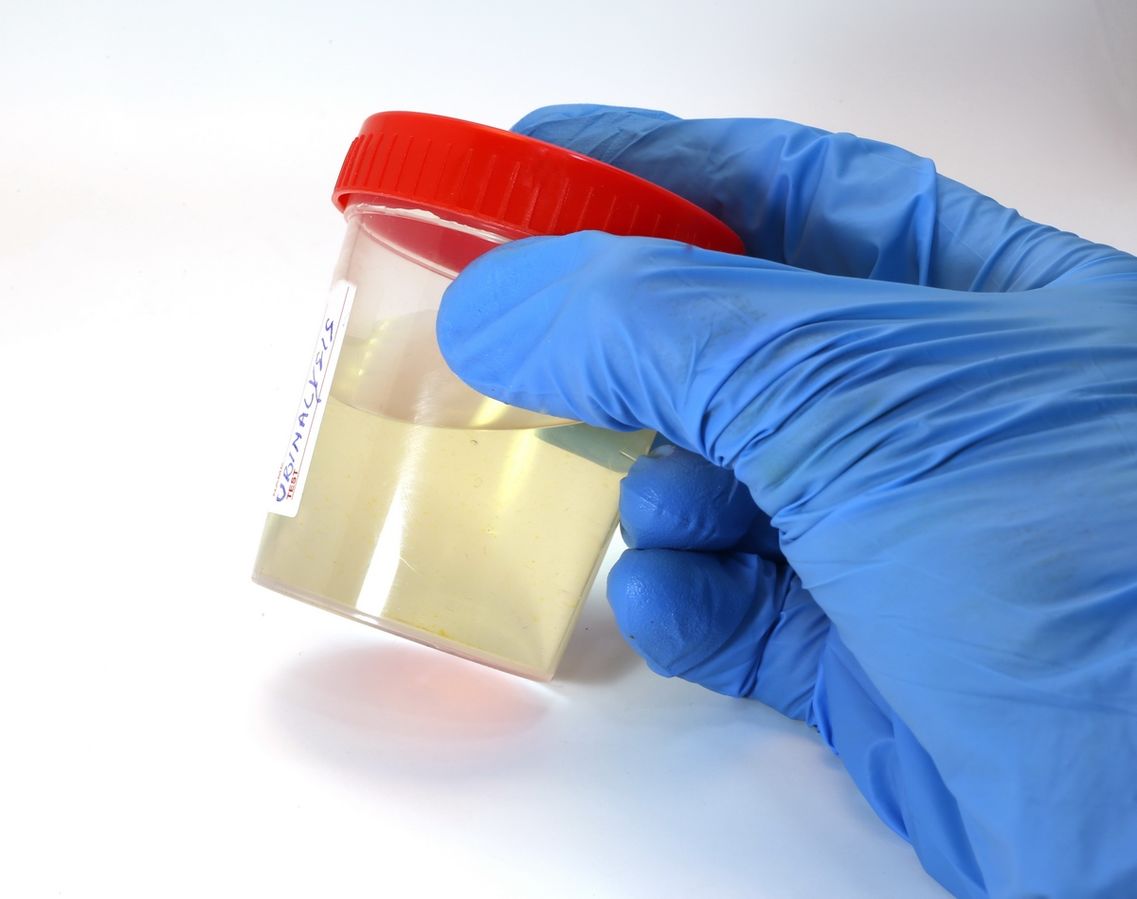
To be extra sure about what you think you may be observing, relieve yourself in a clear plastic cup, then examine its contents.
Slowly poor the contents into a clean sink of clean water.
Examine the fluid as it pours and as it enters the water.
When in doubt, always consult with a physician — and this should be a urologist rather than a primary care doctor.

Dr. Levandovsky provides personalized care to health conscious individuals as well as cancer patients and survivors, focusing on an integration of genetic/molecular risk assessments, prevention, education, nutrition and psycho-oncology.
Lorra Garrick has been covering medical, fitness and cybersecurity topics for many years, having written thousands of articles for print magazines and websites, including as a ghostwriter. She’s also a former ACE-certified personal trainer.
.
Sources:
nlm.nih.gov/medlineplus/ency/article/003139.htm;
netdoctor.co.uk/ate/liverandkidney/202365.html;
medicinenet.com/cloudy_urine/symptoms.htm;
healthgrades.com/symptoms/cloudy-urine; miami-urology.com/robotic-surgery/cloudy-urine
Top image credit: Federico Candoni

Causes of Dark or Brown Urine: Over a Dozen

The causes of dark or brown urine are many, ranging from benign to possibly fatal.
Benign Causes of Dark or Brown Urine
Have you eaten recently any of the following? Fava beans, rhubarb pie, black licorice, blackberries or dyed foods?
These foods can darken urine. The darkness in your urine, if caused by these foods, will take a few days to return to normal once you cease eating these items.
“Depending on the circumstances, dark urine is most commonly due to dehydration,” says Carolyn Dean, MD, ND – Medical Advisory Board Member, Nutritional Magnesium Association at nutritionalmagnesium.org.
“But it may also indicate that an excess of potentially dangerous waste products are circulating in the body.
“For example, dark brown urine may indicate liver disease due to the presence of bile in the urine.”
If you continue to have dark or brown urine, check to see if you’re on any of the following medications:
Methocarbamol
Primaquine
Nitrofurantoin
Metronidazole
Chloroquine
Laxatives that contain cascara or senna
The following medical conditions can cause brown, dark or tea colored urine:
-Bleeding in the kidney, ureter or bladder
-Melanoma (urine color can be dark brown or even blackish)
-Acute glomerulonephritis, a kidney ailment that impedes a kidney’s ability to remove excess waste and fluids
-Liver disease, particularly cirrhosis and hepatitis
-Hemolytic anemia (abnormal breakdown of red blood cells)
-Tyrosinemia, a rare genetic disorder: elevated blood levels of tyrosine, which is an amino acid
-Rhabdomyolysis, a side effect from statin medications that causes muscle pain. Urine may be reddish brown or golden brown, a hallmark sign of “rhabdo.”
-Porphyria, a usually inherited disorder that affects the nervous system.
“Intense or excessive exercise can also create dark urine,” says Dr. Dean.
“Intense exercise can cause muscle injury that causes your body to release waste products in excess.”
-Copper poisoning
Dr. Dean says the following also can lead to brownish urine: “Biliary obstruction, gallstones, bladder stones, bladder cancer, jaundice, kidney cancer, pancreatic cancer, malaria or even the side effect of blood-thinning medications.”
When blood gets old, it turns brown, which is why the urine becomes this color when there’s old blood in it.
Another cause of darkened urine is urologic surgery or a urinary tract infection.
Self-Inspections of Urine
Make sure that you have adequate light when inspecting your urine.
Watch it as you void, and view the color in the toilet water.
The toilet bowl should be clean, and the water clear; not dyed from cleansers.
If anything appears concerning, then you should void into a clear plastic cup the next several times for a better inspection.
However, enough dehydration (even if you’re not thirsty) can make urine a dark yellow or even a light orange.
If you can’t connect your dark or brown urine to any of the above items that are not illnesses, then seek a consultation with a urologist.

Dr. Dean, in practice for 35+ years and author of “The Magnesium Miracle,” is also a naturopath, nutritionist, herbalist, acupuncturist, lecturer and consultant.
Lorra Garrick has been covering medical, fitness and cybersecurity topics for many years, having written thousands of articles for print magazines and websites, including as a ghostwriter. She’s also a former ACE-certified personal trainer.
Source: merck.com
Top image credit: James Heilman, MD

Dang Itching in Neck after Exercise: Causes, Solutions

A leading dermatologist explains why the neck sometimes itches during or after exercise.
Itchy neck, especially the back, during exercise driving you nuts?
Or maybe the back of your neck, or front, doesn’t start itching like mad till after you’re done exercising.
Either way, the cause of all that itching about your neck is the same, be it during, or after, your exercise session.
Have you noticed that the itching of your neck happens only during certain kinds of exercise?
Perhaps it happens most prevalently during workouts in which you sweat like crazy, such as a fierce workout on the revolving staircase, or a lot of hard incline running on the treadmill.
“When we exercise, our muscles use energy to perform the muscular contractions that move our body parts,” says Neal Schultz, MD, a dermatologist with a private practice in the NYC area, and founder of dermTV.com.
“In the course of muscle contractions, energy is used somewhat inefficiently, which causes the creation of heat first in the contracting muscles, and then around the muscles, which starts to raise our body temperature.”
For this to occur, you need not be exercising to the point of exhaustion, nor do you need to be doing cardio necessarily.
Dr. Schultz continues, “But the body is very smart, and in its eternal effort to maintain homeostasis and a constant (98.6F) temperature inside our body, the body brings blood from the inside of our body which is rising above 99 degrees, to the skin which is normally 80-90 degrees, in an effort to try to remove the heat that is building up from muscle action and metabolism.”
So as your exercise intensity on the revolving staircase, or in that group fitness class, starts escalating, this homeostatic process starts kicking up more and more.

Shutterstock/El Nariz
“By sending more blood to the relatively cooler skin, the heat is more easily dissipated to the environment to help maintain normal internal body temperature and prevent it from rising,” continues Dr. Schultz.
“But when we bring that heat to our skin, that heat causes a small amount of inflammation in the skin, which causes special cells in the skin which contain a lot of histamine (called mast cells) to release their histamine as part of the body’s way to fight and correct this ‘unnatural’ temperature increase in the skin.
“It is the release of this histamine in the skin that causes the itching.”
So hence, your neck starts itching at some point into the exercise.
Other parts of your body may also be itching, but what can make the neck, especially the back, itch the most, or be the only part that’s itching, is that for some people, a lot of heat and sweat get built up in this region of the body.
Plus, if you have a ponytail or a clump of hair smothering your neck, this adds to the heat, and compounds the itching problem because now, you have moist, matted hair adding to the picture.

Start scratching, and you further increase the production of the histamines: more itchiness.
Solution for an itchy neck from exercise?
See what you can do with your hair as far as keeping it off your neck.
Have a towel with you to periodically pat your neck dry. Don’t scratch your neck.
You can also take an over-the-counter antihistamine 30 to 60 minutes prior to exercising, though a side effect may be drowsiness, in which case, a physician can prescribe an antihistamine without this side effect.
Topical lotions can be applied after exercise to calm the itching of your neck, if patting it dry and avoiding scratching don’t help.
 Dr. Schultz has been treating his patients’ dermatologic conditions for 30+ years, with particular emphasis in skin cancer prevention and treatment, acne treatment and laser surgery.
Lorra Garrick has been covering medical, fitness and cybersecurity topics for many years, having written thousands of articles for print magazines and websites, including as a ghostwriter. She’s also a former ACE-certified personal trainer.
.
Top image: Freepik/Racool_studio

Itchy Ankles Causes and Solutions

Are itchy ankles driving you batty?
There are several possible causes of itchy ankles.
I will highlight more obvious causes of itchy ankles (even though what seems obvious to one person may not be to the next person), and then some causes of ankle itching that most individuals would never consider.
Wool socks are a culprit, says Neal Schultz, MD, a dermatologist with a private practice in the NYC area, and founder of dermTV.com.
Do your ankles always or frequently itch during or after hiking, when you wear the wool socks?
Wool socks that are tight against your skin can cause ankles to itch.
Even non-wool socks that are tightly around the skin can cause this problem. Wool socks can cause contact dermatitis, which will make the ankles itch.
Next up are mosquito bites, says Dr. Schultz.
You may not be aware you were bitten, and then find that suddenly, your ankle is itching.
If you absolutely must wear wool socks for keeping warm during cold-weather outings, then see if you can loop the socks over the top of your outdoor boots or hiking footwear.
Another option is to wear cotton socks against your skin, then wool over the cotton.
To avoid mosquito bites, make a point of applying repellant to your feet and ankles.
Other Causes of Itchy Ankles
Poor circulation can be one of them, continues Dr. Schultz, and this can cause swelling also.
He continues, “Over-drying of the skin of the ankles, which causes a condition called asteatotic eczema.
“Because there are so few oil glands near your ankles to make lubricating oils, over-use of harsh soaps will strip the skin of the lubricating oils, which causes the skin to become over-dried by loss of natural moisture, and that causes itching.”
Neurodermatitis is another culprit, “which happens as a result of a simple local itching of the ankle (or any other place on the body), to which people logically and rationally respond by scratching, except that the scratching causes inflammation in the skin and a release of histamine, which causes more itching.
“So there’s more scratching, and you’re then in an itch-scratch cycle where the itching begets more scratching and the scratching begets more itching,” explains Dr. Schultz. “It’s like a positive feedback loop.”
If your ankle itches and you’ve ruled out the above causes, or most of them, anyways, ask yourself if you had a Band-Aid or some kind of taping on the ankle very recently.
An allergic reaction to the chemical in the adhesive will cause itching, and scratching it will aggravate the problem.
Calamine lotion, and not scratching, will clear up the irritation.
Dr. Schultz has been treating his patients’ dermatologic conditions for 30+ years, with particular emphasis in skin cancer prevention and treatment, acne treatment and laser surgery.
Lorra Garrick has been covering medical, fitness and cybersecurity topics for many years, having written thousands of articles for print magazines and websites, including as a ghostwriter. She’s also a former ACE-certified personal trainer.
.
Top image: Shutterstock/Monster e
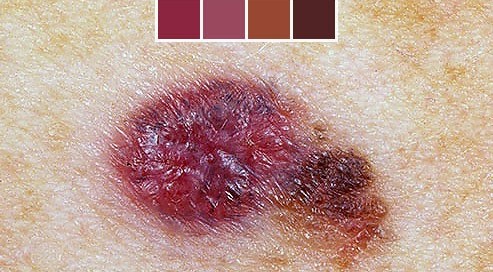
Moles & Melanoma Guide to Changes, Colors, Size & More
Every question you can have about moles and melanoma is answered right here, because I was fed up with years of seeing the same generic and vague information about moles and melanoma.
My questions were directed to Jason R. Lupton, MD, board certified dermatologist practicing in the San Diego, CA area.
A mole that is melanoma can sometimes itch.
Can it itch and still look the same as it always has? Or will an itching cancerous mole always look like it’s changing?
Dr. Lupton: A mole that itches may not always look like it’s changing.
Is mole itching from melanoma subtle and/or really annoying? Is it necessarily every day?
Itching associated with a melanoma can vary — it will not necessarily itch all the time. It may be subtle itching or may be quite pronounced.
It’s said that a risk factor for melanoma is a mole that stands out or looks different from others.
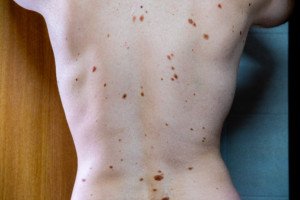
Atypical moles. Shutterstock/Mikel Ugarte Gil
But what if it has always been this way? Does the relative “differentness” in and of itself mean the mole is more likely to become malignant?
If a mole looks very different from others then I usually biopsy that one.
If a patient comes in for a skin check and one mole looks very different or atypical than the others, then often I will biopsy that mole to see how it looks microscopically.
A different-appearing mole may not necessarily be a bad mole — but it should be evaluated.
What makes a mole look “different” is the comparison of it to others.
Suppose a mole on someone’s calf looks different than all his others, but the calf mole has always looked the same.
What would be the significance if, in a parallel universe, this same person had only one mole on his entire body, on the calf, and thus, the concept of this mole looking different from others wouldn’t be applicable?
Often people have the same types of moles. That is, some people have many moles that have some redness to them, or that are all very dark, or that are brown and black, etc.
When doing a skin exam it is important to assess the types of moles someone has and what differences, if any, there are among them.
It is all done on a case by case basis – unfortunately, there are no rules to follow regarding this. If a mole looks different than the others then it may need a biopsy.
It all depends on whether that mole just looks different or if it also looks irregular or atypical — meaning irregular colors, border, size, recent changes, etc.
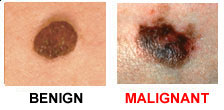
Is a certain type of mole more likely to become melanoma, other than ones bigger than 5 millimeters?
That is, dark moles, light moles, raised moles, oblong moles, ones with a hair, two-toned moles?
No — not really. Any mole can become a melanoma. Larger moles may have an increased risk — especially very large lesions.
Other than that, any spot on the skin can become cancerous — whether it is dark or light.
There is a type of melanoma — the amelanotic melanoma — that is particularly scary because it does not have the classic dark, changing colors most people associate with a “bad” mole.
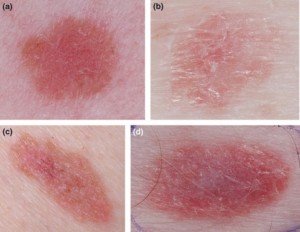
amelanotic melanoma
These can look like pink or light red or even flesh colored skin lesions — often patients are not worried or concerned about these.
We always read about changes to look for in moles.
But most melanoma occurs absent moles, so what else should we look for on skin in general, that might mean the deadliest skin cancer?
Over the past 25 years, the same handful of melanoma photos have appeared in magazines, pamphlets and the Internet.
They appear to have sprung from pre-existing moles, rather than just plain skin.
Any new lesion should be evaluated. A melanoma may arise anywhere on the skin — even the palms or soles of the feet or in the groin area. Any new lesion that is changing in any way should be evaluated by a dermatologist.
A melanoma will not remain static — it will continue to change and grow over time.
Why does melanoma get past so many people? 1) They don’t see it due to its location, 2) They see it changing but are in denial? Or 3) They don’t know about the warning signs of skin cancer despite all the media attention, and, though they are aware of the changing lesion, don’t think anything of it.
I think all three! Many people are not in tune with their moles and do not get regular screening exams.

Shutterstock/Image Point Fr
Also, if someone sees something changing they often have an alternate explanation for it — there is sometimes that element of denial — that a melanoma cannot happen to them.
Does a melanoma in a pre-existing mole always look suspicious? I realize that the first day the mole becomes melanoma, there is no way the naked eye could detect this.
But for how long can a mole have this deadly cancer before a person can see something suspicious?
This is unknown — some are more aggressive than others. A lesion may progress to a cancerous lesion and not be detectable for months or longer. It is really unknown.
If a mole changes colors from melanoma, will it necessarily also be getting bigger simultaneously, or changing in some other way concurrently?
Or if it gets bigger from melanoma, will it also necessarily be changing color?
A melanoma will often have changes — color and size. The initial changes may be subtle, so only one may be noticed at first, but if left over time, then a change in size is almost always seen.
How often can melanoma arise out of a very tiny mole, i.e., a birthmark?
After all, every skin cancer warning list mentions moles the size of a pencil eraser as being possible signs of melanoma.
The rules regarding melanoma are certainly not absolutes. A melanoma can be very small — not always bigger than a pencil eraser (as an aside I just discovered a melanoma on one of my patients last week — on her arm … it was only about 3 mm in diameter but was half brown and half red, so I biopsied it and it turned out to be a melanoma).
I think the important thing here is the guidelines are helpful, but you can’t be too tied to them.
If a lesion looks suspicious it should be biopsied — and everyone should have a yearly skin exam by a dermatologist to be safe.
Suppose a person magically knows that soon, he’ll develop a melanoma on a non-mole area of skin. He watches that area every day.
At some point, a malignant spot will become visible, when the day prior, it was not detectable.
So if this person watches his skin every day in that exact spot, how big will the melanoma be when he first sees it?
That is, could a malignant spot appear over night that’s 2 millimeters?
Or how big would it be from one non-detectable day to the next detectable day?
This is unknown — but my guess would be it would be a very small spot at first and then develop a more prominent lesion over time depending upon how long it’s left.
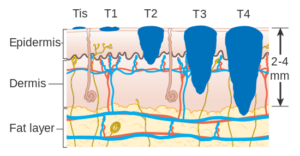
Stages of melanoma. Cancer Research UK
Can melanoma change visibly from month to month?
Week to week? What is the fastest a mole can change visibly to the naked eye?
In other words, suppose a person suspects skin cancer and thus watched the spot carefully.
If after two months, it looks the same, can the person assume it can’t be malignant? How about one month?
Good question. I usually tell my patients to watch their moles about every three months or so — to take an all-over look then … if you look too often you won’t notice subtle changes, but if you wait too long you may miss something.
There is no ideal rule — a melanoma can develop at any time and if something CONTINUES to change then it should be looked at by a dermatologist.
It also depends upon the type of lesion, the age of the patient, the body location, etc. So I can’t give an absolute on this one.
What skin conditions can really look like melanoma?
Birthmarks, normal moles, seborrheic keratoses, pyogenic granulomas, vascular lesions, dermatofibromas, dysplastic nevi (atypical moles), etc.
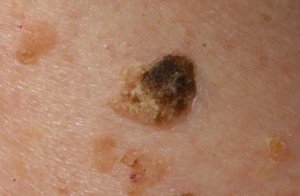
Seborrheic keratosis
It’s said that if caught early, 95 percent, 97 percent, or “near 100 percent” of melanoma can be cured.
Why not 100 percent? What happens in those 5 percent of patients that they die despite an early catch?
The early catch may not really be early — there may be micro-metastases or microscopic lymph node involvement that cannot be detected by current technologies.
It makes absolutely no sense that the human body didn’t evolve to have a stronger defense against the sun’s damaging rays.
Early man, including pale-skinned ancient Europeans, spent tremendous amounts of time in the sun.
It only makes sense that we all should have a built-in guard against skin cancer.
So why all the skin cancer in modern man, who spends less time in the sun than ancient man? Even modern-day sunbathers aren’t in the sun as much as primitive man.
I think it also has a lot to do with the depletion in the ozone layer, and with modern man there is limited sun exposure at times coupled with more intense periods … these episodic sun exposures may be associated with increased risks of skin cancer development.
 Dr. Lupton specializes in skin cancer prevention and treatment plus minimally invasive cosmetic procedures including mole removal, skin rejuvenation, wrinkle reduction and acne treatment.
Lorra Garrick has been covering medical, fitness and cybersecurity topics for many years, having written thousands of articles for print magazines and websites, including as a ghostwriter. She’s also a former ACE-certified personal trainer.

Pimples on Bald Head: Causes and Solutions

Pimples on your bald head driving you nuts?
There are several ways to prevent or get rid of annoying, unsightly pimples or blemishes, or what appear to be pimples, that have appeared on your bald head.
First of all, let’s get a dermatologist’s take on this common problem with men who are proud to be bald.
What is the most likely cause of pimples developing on a bald head?
This is “most likely to occur with men who shave their beards and head,” says Dr. Oanh Lauring, MD, founder of Lauring Dermatology in Nottingham, MD
“Normal skin bacteria gets into the nicked skin and inflames the hair follicles and promotes folliculitis.”
Solutions
Dr. Lauring advises not to shave against the grain of the hairs.
As for a solution to pimples or red bumps on the bald head, Dr. Lauring states, “Start out with over-the-counter benzoyl peroxide wash or salicylic acid wash; topical benzoyl peroxide to prevent flares, but some people may require topical antibiotics or steroids for flares of the bumps.
“Avoid using cocoa butter, Vaseline petroleum jelly to the scalp, as it may clog pores and promote folliculitis.”
Here are other solutions to pimples, blemish-like spots, or red bumps on your bald head, endorsed by members of the community for bald men, slybaldguys.com:
– Use a single blade to prevent razor burn. This is commonly done by bodybuilders to prepare for contests.
– Pimples can be caused by blocked pores, but pimple-like bumps, which aren’t technically pimples, can arise from shaving, so be alert to your shaving techniques.
So do not use any products on your head that can clog pores.
If you feel that the red “bumps” on your bald head are related to pores, rather than to shaving, apply an astringent or product that contains salicylic acid.
This might sting momentarily, but can diminish red areas, and in some men, can completely clear up trouble spots in a few days.
– Try exfoliation. You can exfoliate by gently (or more vigorously, according to some men) rubbing the exfoliation sponge along the irritated area. One man recommends the St. Ives apricot scrub.
Another man simply uses a brush; this can be either a facial or body brush.
Any store that sells bath products should have these. Natural bristles will probably work better than plastic ones, and are a bit softer to the touch.
– Ingrown hairs can cause “shaving bumps.” One man recommends Shave Secret, available at Walmart.
Another bald man reports that he tried just about everything for the pimples that kept appearing on his head; nothing worked.
Then he tried a 1 percent hydrocortisone cream and a 10 percent benzoyl peroxide product, and this worked.
Dr. Lauring explains, “African-American men are prone to ingrown hairs and subsequently unsightly scar bumps.
“People should avoid plucking or waxing, as this traumatizes the hair bulb and encourages the hairs to grow back into the skin.
“If an ingrown hair develops, it is best to use a needle to carefully loosen the hair from the skin, then clip the hair.
“When bumps occur and persist, they may require topical steroids or even steroid injections to stop the inflammation.”
Dr. Lauring adds, “Ointments absorb better than creams, but they tend to be more clogging to the pore if they are petrolatum-based.
“Topical steroids should always be used sparingly and for brief periods, as daily chronic use of topical steroids may promote more acne, folliculitis, skin thinning, skin lightening and stretch mark development.”
Sporting a bald head by choice isn’t as easy as it looks or seems.
The bald head requires continuous upkeep and is thus vulnerable to irritations such as pimples and other red bumps.
 Dr. Lauring is former chief of dermatology at Mercy Medical Center. Lauring Dermatology provides medical and cosmetic services including for skin cancer, acne, psoriasis, hair and nail problems, and skin rejuvenation.
Lorra Garrick has been covering medical, fitness and cybersecurity topics for many years, having written thousands of articles for print magazines and websites, including as a ghostwriter. She’s also a former ACE-certified personal trainer.
Top image: Shutterstock/ArtOfPhotos
Source: slybaldguys.com/smf/index.php?topic=10847.0
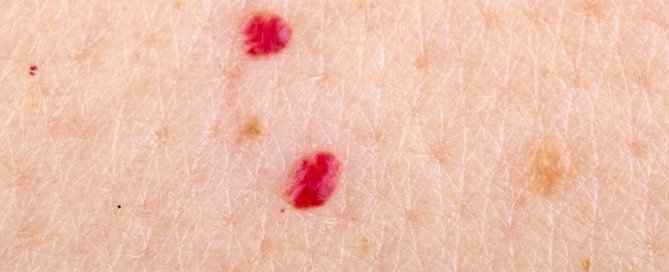
What Those Tiny Red Dots on Your Skin Might Mean
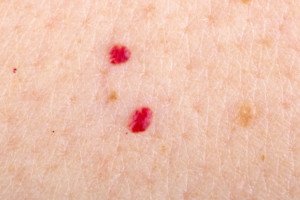
Have you noticed red dots suddenly appearing on your skin?
Or maybe a single red dot, and you wonder how long it’s been there on your skin? Could melanoma skin cancer first appear as a red dot, or is a red little spot on the skin usually harmless?
I have the answers, because I asked these questions to Dr. Oanh Lauring, MD, founder of Lauring Dermatology in Nottingham, MD.
Many people notice “dots” on their skin, and these skin dots or spots appear to be red.
This article is about red dots or spots (which may be elevated) on the skin, rather than red bumps or blemish-like spots.
“Red dots” on the skin can appear in many different ways.
One way is the appearance of pinpoint size specks. Let’s talk about these first.
The closer you examine your skin, the more of these tiny specks you may discover.
Some can be a little larger, like the size that a ball point pen would make, and then even larger yet, like 1-2 millimeters, even up to three mm.
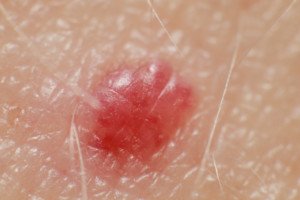
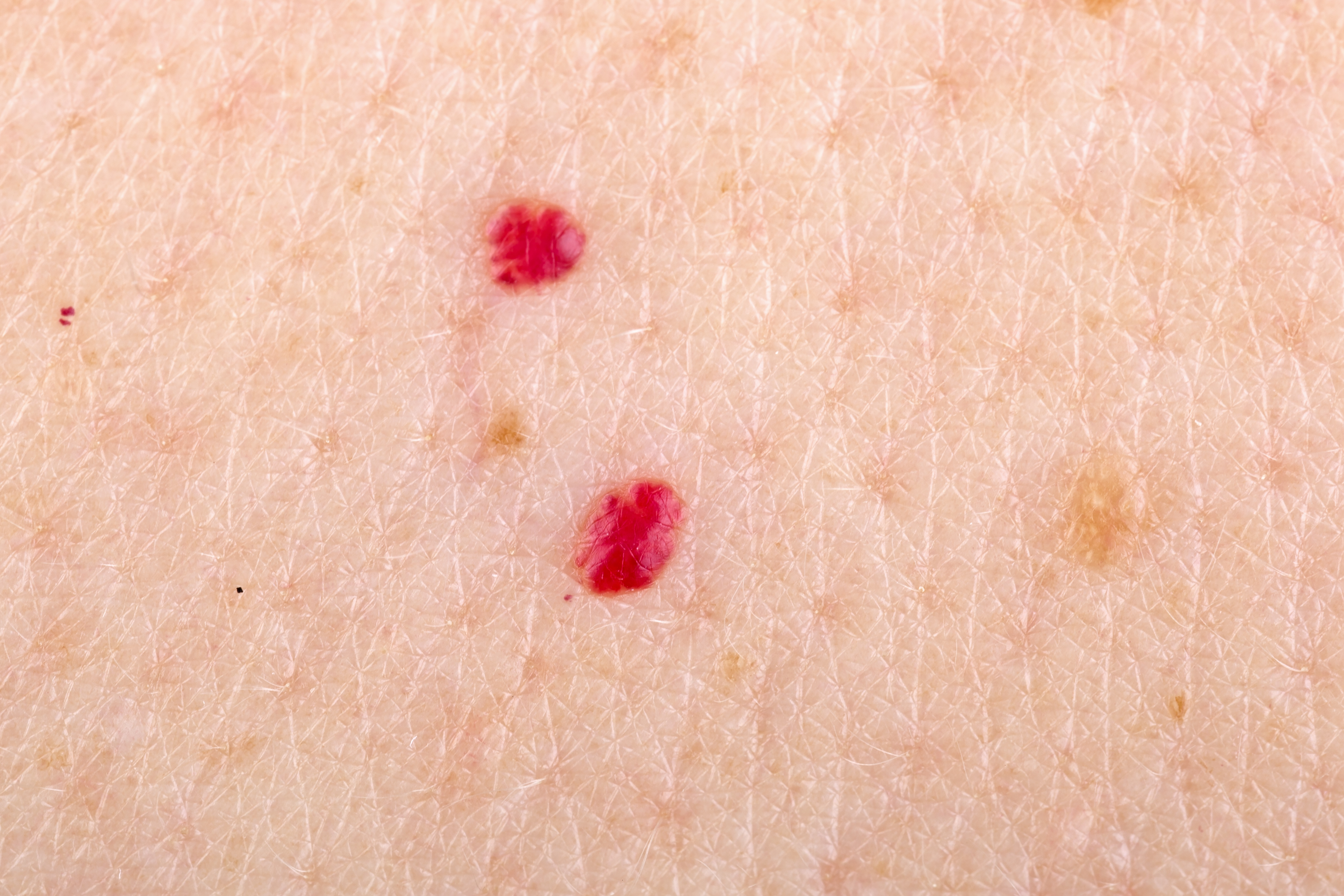
A cherry angioma. Shutterstock/dba87
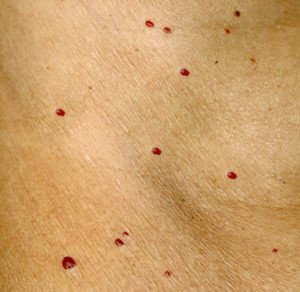
Upon close inspection, you realize that these “red dots” aren’t necessarily dot shaped, but can be erratically shaped, as small as they are.
They may also appear a dark red, a bit off-red or a dark pink.
Some people have loads of these all over their body (particularly the back and chest).
These are called cherry angiomas and are completely harmless (see the two images above of harmless angiomas, also known as hemangiomas).
They are blood vessels above the surface of the skin, come with age (though there’s an isolated version that’s present since birth and may be quite large), and will never become a problem.
More angiomas. Shutterstock/Timonina
Other causes of red dots or spots on the skin, says Dr. Lauring:
“Pinpoint red dots: causes include leukocyclastic vasculitis (usually benign inflammation of the capillaries that can be associated with infections, medications, autoimmune processes), Schamberg’s disease (benign disorder presenting as cayenne pepper like red dots on the lower legs of older people), extravasation of blood into the skin caused by scratching and damaging the capillaries.
Bigger red or swollen dots around the ankles: may be bug bite reactions (mosquitoes, bed bugs, scabies, chiggers).”
Extravasation
It’s easy to cause this without knowing it. If you notice a new reddish dot, spot or speck under your eyes, under your brows or near the bridge of your nose, don’t fear skin cancer.
This is most likely an extravasation caused by scratching there, or even by simply pressing a nail there to relieve an itch.
One little nail press is all it may take to damage tiny capillaries. This is harmless.
Extravasation is “leakage of red blood cells from after there is trauma to the blood vessel wall,” says Dr. Lauring.
This is what happens when a person plays volleyball for the first time or after a long absence, allowing the ball to smack repeatedly against the bare underside of their forearms.
Multitudes of red dots will appear later on.
Extravasation spots disappear in several days, often taking on an orange tinge as they fade.
You should get acquainted with what cherry angiomas look like, versus extravasation spots.
Both can be described as “little red dots on the skin,” yet both look completely different from each other.
Another cause is atopic dermatitis. Psoriasis, too, can create little red dots or spots on the skin.
Melanoma
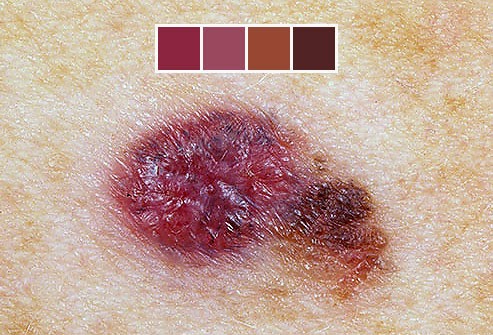
Melanoma skin cancer can present as a tiny red dot. Images of melanoma on the Web usually show brown, purplish and black blotches.
But melanoma can present as a small red spot on the skin.
Below are three images of what this can look like.
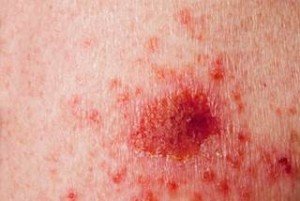
Melanoma. Cancertherapyadviso.com
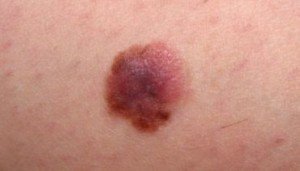
Melanoma. Nejm.org
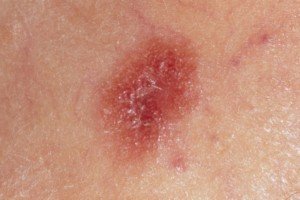
Melanoma. Nhs.uk
A man I know was diagnosed with melanoma at age 27. He showed me two melanoma spots near his wrist: two tiny red dots.
However, do not let this be reason to panic if you discover red dots on your skin.
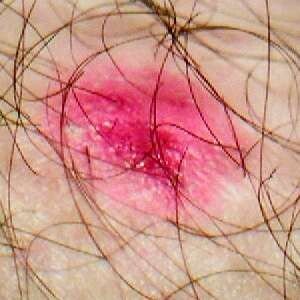
A small eczema patch
The bottom line: If a “red dot” does not go away, then consult with a dermatologist to make sure it’s nothing concerning.
Angiomas will not disappear, but it’s important to know how to recognize these.
Dr. Lauring is former chief of dermatology at Mercy Medical Center. Lauring Dermatology provides medical and cosmetic services including for skin cancer, acne, psoriasis, hair and nail problems, and skin rejuvenation.
Lorra Garrick has been covering medical, health and personal security topics for many years, having written thousands of feature articles for a variety of print magazines and websites. She is also a former ACE-certified personal trainer.
Top image: Shutterstock/Ocskay Bence
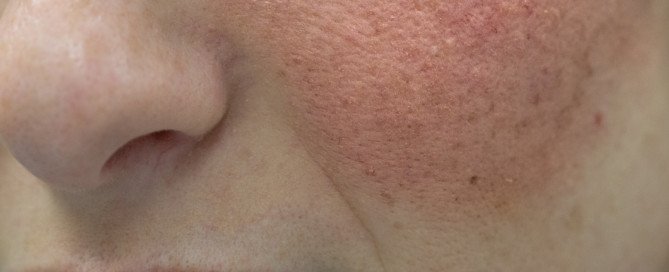
Rough Red Patch on Nose or Cheek: What This Might Be
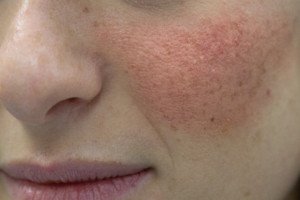
Concerned or worried about that rough red patch on your nose or cheek?
Perhaps you also have some scaly reddish or pink patches on your forehead, maybe between your eyebrows or even beneath your eyebrows.
Do the rough, red areas on your nose or cheeks come and go?
Or do they persist?
Here’s a better question:
What are the chances that the rough, red patch on your cheek or nose could be skin cancer?
If you have rough red areas on your cheeks or nose, it’s smart to keep an eye on them.
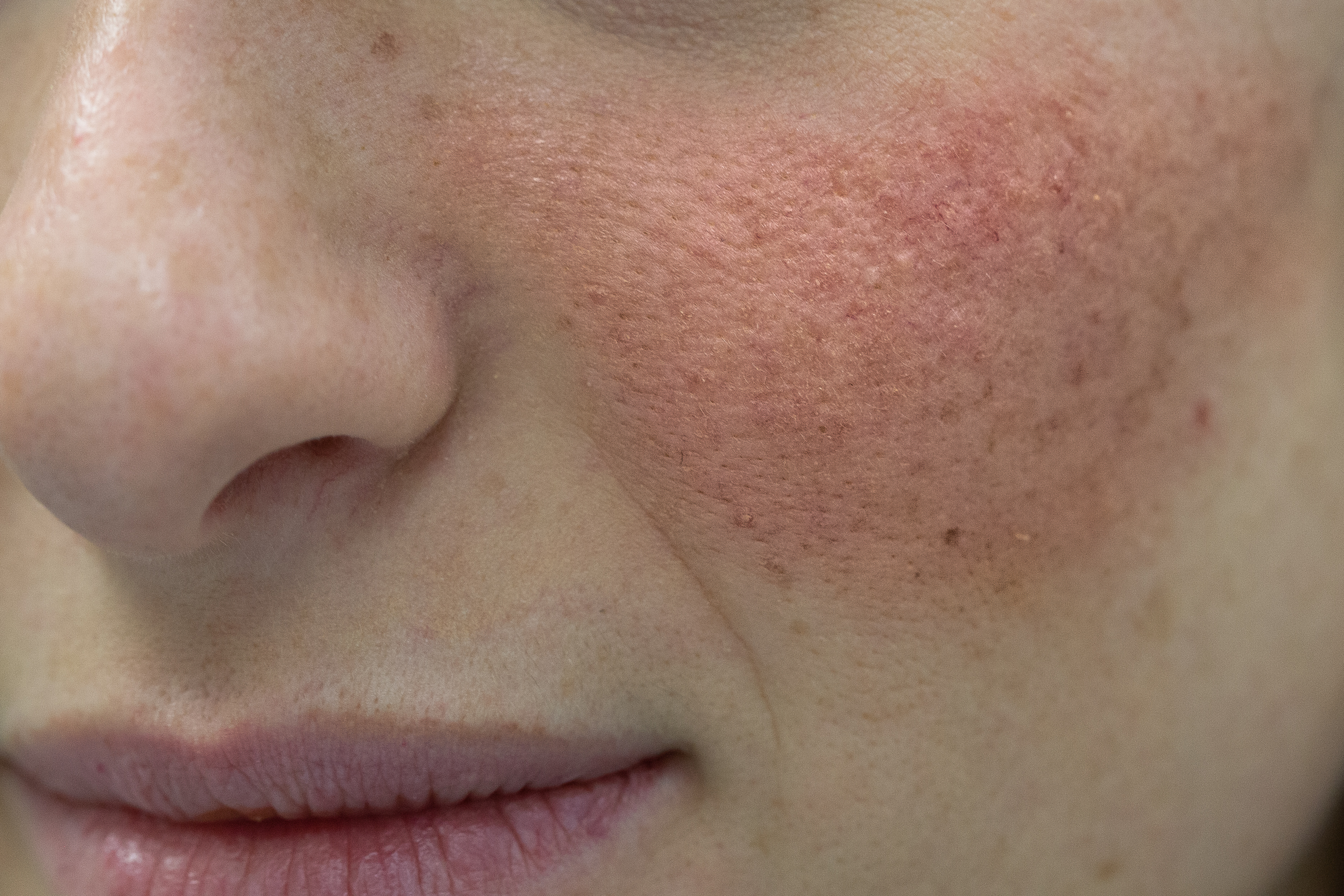
This is because based on the generic description of “rough, reddish patch” or “dry, scaly pink or red area” on the nose or cheek, this can actually describe a type of skin cancer called squamous cell carcinoma.
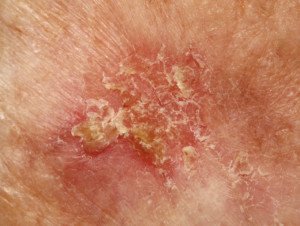
Squamous cell carcinoma. Shutterstock/Dermatology11
But don’t panic – because this description can also very well fit a few benign skin conditions.
There are two benign skin conditions that classically present as rough and red patches:
Seborrheic dermatitis (top-most image)
Actinic keratosis
“Seborrheic dermatitis is a rash on the face that is pink with scale,” says Dr. Monica Halem, MD, a dermatologic surgeon who specializes in skin cancer surgery, laser and cosmetic surgery.
“This is usually present on the laugh lines, and between the eyebrows. It is usually present on both sides of the face.”
I have seborrheic dermatitis, and I can easily understand how the layman can mistake this as skin cancer.
After all, many descriptions of skin cancer are similar to that of seborrheic dermatitis:
“Rough, red patch on the nose or cheek.”
Or, “Rough, scaly dry red or pink patch on the skin.”
This is a generic description of how non-melanoma skin cancer can present, but it also fits the description of seborrheic dermatitis.
A more detailed description of seborrheic dermatitis is as follows:
Often accompanied by flaking, especially on the nose
May have a very subtle orange tinge to the “red” or pink color
May crust where the nose meets the top of the “laugh line” area
May itch and slightly sting.
Another hallmark sign of seborrheic dermatitis is that it comes and goes. It can appear virtually overnight.
Seborrheic dermatitis can never morph into skin cancer.
Actinic keratosis can also be described, generically, as rough red or pink patches or areas on the skin, particularly the nose and cheeks. It’s also called solar keratosis or “sun damage.”
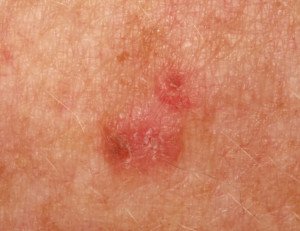
Actinic keratosis. Shutterstock/Dermatology11
Dr. Halem says, “Actinic keratosis is usually much redder with thinner scale, and is in sun-exposed areas: top of the nose, sides of the cheeks, and forehead.”
For all practical purposes, actinic keratosis will NOT go away once it develops, even though medical literature cites that in rare instances, it can spontaneously disappear.
Actinic keratosis is when the keratocyte cells of the epidermis morph from typical to atypical.
The result is the classic rough, reddish patches that you one day discover on your nose, cheek or other part of the face.
Sometimes, the actinic keratosis can’t really be seen, but it can be felt; it has a distinct roughness to the fingers, kind of like sandpaper.
Dermatologists typically make a visible diagnosis that includes feeling the rough, red patches of skin with their fingertips.
If you’ve been diagnosed with actinic keratosis, don’t be alarmed, because your dermatologist will give you the other name that this skin condition commonly goes by: precancerous lesion.
Hearing this will trip a lot of people up, because their next thought will be, “Oh God, I’m gonna get skin cancer!”
However, the reason actinic keratosis is called a precancerous lesion is because its atypical cells are more likely to ever become cancerous, than are the typical cells right next door to the rough, reddish patch. That’s all that precancerous means.
Precancerous lesion does NOT mean predestined to become cancer.
It simply identifies that an atypical cell, more than a typical cell, is more likely to ever become malignant.
If actinic keratosis is left untreated, there is a 5-10 percent chance that it will morph into squamous cell carcinoma.
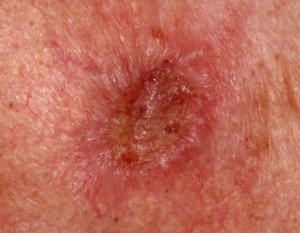
Squamous cell carcinoma. Shutterstock/Dermatology11
“Nobody really knows the time span for an AK to turn into an SCC,” says Dr. Halem.
“It can take anywhere from 2-10 years. It really depends on how much sun exposure you have had.
“More importantly to know is that 2 percent of all AK’s will turn into an SCC and there is no way of knowing which ones will do this.”
SCC skin cancer can metastasize, and kills about 3,500 to 10,000 Americans yearly.
However, in order for actinic keratosis to turn into the skin cancer, it must be left untreated.
And, believe it or not, there are people who ignore those rough, red patches or lesions on their face, chalking them up to age, harmless sun damage, stress, or who knows what.
Another reason that an actinic keratosis can go untreated is that a person can easily not even know they have these very gradually developing, red, rough patches on their skin — the skin on the top of their bald head, for instance.
This is a common site for actinic keratosis: A man’s bald head gets a lot of sun.
Finally, with 46 million Americans with no medical insurance, it’s easy to see why a person would not go to a doctor to have painless, rough red patches on their face checked out.
Actinic keratosis is very easily treated (removed) with a gentle spraying of liquid nitrogen; or the application of prescription creams.
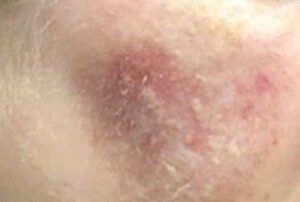
Actinic keratosis on the cheek after a daily application of the topical cream Efudex for two weeks. The drug causes an inflammatory response that reddens the lesion before causing it to fall off. ©Lorra Garrick
Get it treated and keep an eye on your skin for the development of any new rough, red patches, and you won’t have to worry about squamous cell carcinoma.
 Dr. Halem, Founder and Medical Director of The New York Dermatologic Surgery Cosmetic Laser Center, has devoted a decade to clinical research, conducting trials that have advanced cosmetic and surgical dermatology.
Lorra Garrick has been covering medical, health and personal security topics for many years, having written thousands of feature articles for a variety of print magazines and websites. She is also a former ACE-certified personal trainer.