Pain in One Testicle During Coughing: Sign of Cancer?

When you cough, do you feel pain in one of your testicles?
What’s alarming about this is that testicular cancer typically occurs in only one testicle.
So when a new symptom occurs on one side of the body, it is especially worrisome to the individual.
Testicular cancer is not common, affecting over 9,000 U.S. men (most are between 20 and 35, but this disease can strike at any age) per year. (more…)

Excess Sweating Behind the Ears: Causes & Solutions

Excess sweating behind the ears is annoying, but can it mean a serious illness?
There is a life threatening condition that might lead to excess sweating of the head: thyroid disease. (more…)

Using Accutane on Vacation: Doctor Guidelines for Stopping

Going on vacation soon and wondering how this might affect your use of Accutane?
Here are doctor guidelines for Accutane while you are enjoying your vacation. (more…)

That Pimple Thing on Your Upper Lip Could Be Cancer

That stubborn thing on your upper lip may not be a pimple at all, but might be cancer if it’s been hanging there for a while.
The good news is that the top of your lips are not only extremely easy to inspect, but are typically viewed at least a few times a day. (more…)

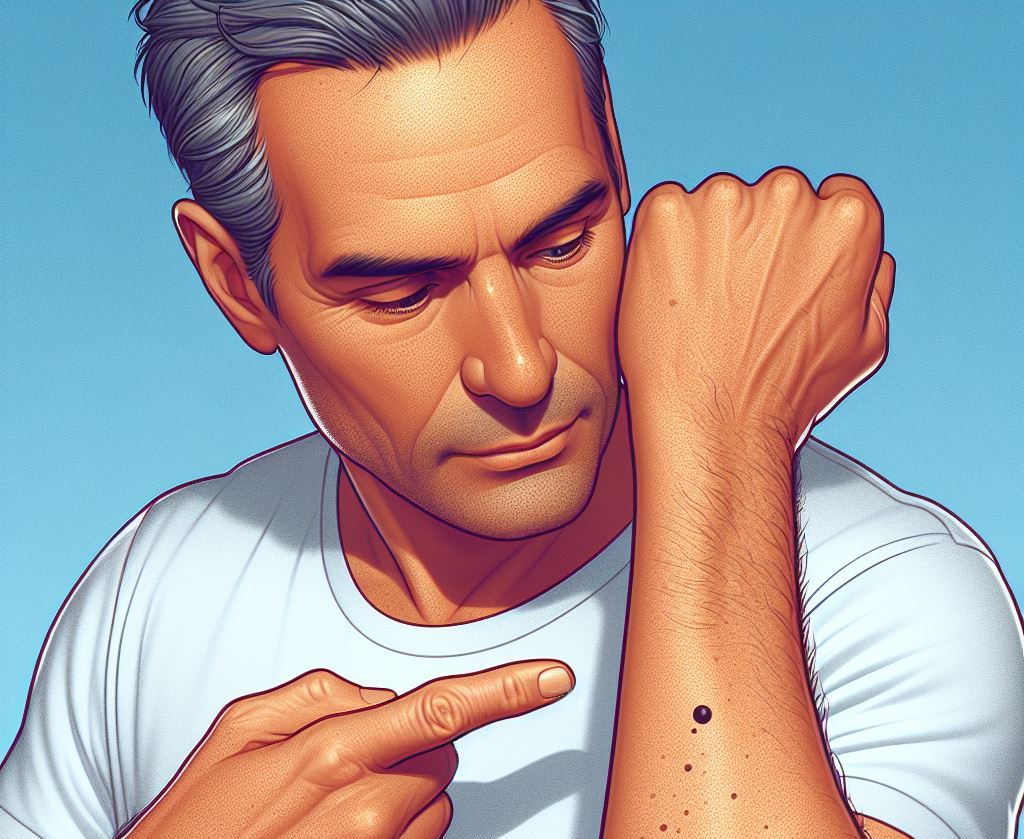
Can Teens Get Melanoma from Moles They’ve Had for Life?

If you’re a teen, it’s not too early to check your lifelong moles every month for signs of melanoma—especially if you’ve spent a lot of time over the years in the sun without sunscreen.
You may also have “built-in” risk factors for melanoma, and being a teenager does not make you immune to this deadliest of all skin cancers.
For example, if you have a lot of moles, this is a risk factor.
Another risk factor is if many of these moles look odd or funny and have asymmetry.
A third risk factor is your natural coloring: red or blonde hair, light eyes, pale or “peaches and cream” skin – the kind that can’t tan well, if at all.
Teens have also been known to frequent tanning beds.
One-third of melanomas overall arise from pre-existing moles. However, in many cases an adult (especially an older adult) has no idea how long they had a mole that began evolving into cancer.
It may have been there all their life, since birth or since very early childhood. Or, it could have developed in their 20s or 30s or older.
Teens often do not know if a particular mole has “always been there,” especially if it’s in an obscure location.
When new moles form in locations that are seen nearly every day, it’s easy to tell if they’re new.
“Although very rare, there is always a chance that melanoma can occur from moles that are present since birth,” in teenagers, says Dr. Tess Mauricio, MD, FAAD, a leading board certified dermatologist from Stanford University Medical School and CEO of MBeautyClinic.com.
Dr. Mauricio explains, “This is the reason to watch for dynamic changes in symmetry, color, shape, size and symptomatology. Any old mole that starts changing in appearance, hurting, itching or bleeding needs to be evaluated and biopsied to be safe.”
Though teens should be vigilant with monthly skin exams (early stage melanoma is highly curable), this doesn’t mean you should worry about this disease! Live your life and have fun—but USE SUNSCREEN.

You should do more worrying about other things that are far more likely to kill you, such as careless driving (by your or a friend), taking illegal drugs, alcohol intoxication poisoning, mixing drugs with alcohol and attempting dangerous stunts like riding on top of cars. Even texting while walking can get you killed by an inattentive driver.
Take inventory of your moles.
Take particular note of those you can view easily such as the ones on your face, shoulders, arms, abdomen and front of your legs. Get to know their features, shapes, sizes, color variations, etc.
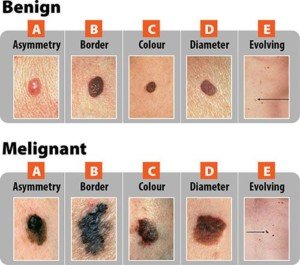
Have a dermatologist examine all of them to establish a baseline. Then inspect them every month.
This way if there are any changes in the future, you will easily detect them.
 Dr. Mauricio is an internationally recognized cosmetic surgeon and the youngest woman to hold the position of President of The San Diego Society for Dermatologic Surgery.
 Lorra Garrick has been covering medical, fitness and cybersecurity topics for many years, having written thousands of articles for print magazines and websites, including as a ghostwriter. She’s also a former ACE-certified personal trainer.
.
Top image: ©Lorra Garrick

Skin Reaction Around Mole Removal Area: What’s Normal & Not
When a mole is removed, there may be a reaction around the area.
Do you know how to tell if the reaction is normal or if it means a visit to the doctor?
You have to realize that when a mole is removed, a section of skin is scooped out. (more…)

Precancerous Mole Removed and Growing Back: What this Means?

Is the precancerous mole that you had removed now growing back?
When this happens, the biggest fear is that what’s growing back is melanoma skin cancer.
What would cause the precancerous mole to “grow back”?
The reason is that not every pigment cell was removed. To avoid this problem, the removal should be done with the punch biopsy technique.
A punch biopsy will remove every last melanocyte (pigment cell). However, a punch biopsy will leave more of a scar and requires a few stitches.
The scar will become less noticeable over time, and it’s not even that noticeable in the first place.
These last two points are off-putting to some patients, but the reward is that the precancerous mole will not grow back.
Can a melanoma grow where a precancerous mole was removed?
Of course it can, but this wouldn’t be a growing back of what was removed, but rather, a coincidence that a melanoma was arising in that spot.
“When a biopsy-proven precancerous mole grows back, the decision will be whether to leave it alone or to remove it to ensure clear margins,” says Dr. Tess Mauricio, MD, FAAD, a leading board certified dermatologist from Stanford University Medical School and CEO of MBeautyClinic.com.
“The decision depends on the pathologic diagnosis. If it is a completely benign mole [that has grown back], it is not necessary to remove when it recurs.
“If it is truly precancerous, my recommendation is to remove the rest and ensure margins are clear.”
When Checking Your Skin Every Month for Melanoma…
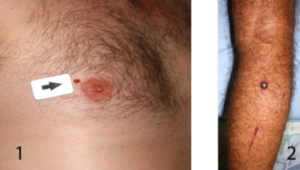
- Check anywhere that your eyes can see: ear lobes, behind the ears, inside the ear folds, eyelids, belly button, palms, soles of the feet, between the toes, nipples — anywhere where skin is.
- Precancerous moles are also known as “atypical.” If you have many of these, you may want to consider serial digital dermoscopy for annual surveillance for melanoma signs.
Dr. Mauricio is an internationally recognized cosmetic surgeon and the youngest woman to hold the position of President of The San Diego Society for Dermatologic Surgery.
Lorra Garrick has been covering medical, fitness and cybersecurity topics for many years, having written thousands of articles for print magazines and websites, including as a ghostwriter. She’s also a former ACE-certified personal trainer.
.
Top image: BruceBlaus/CC
How Many Moles Are Too Many? How to Tell?
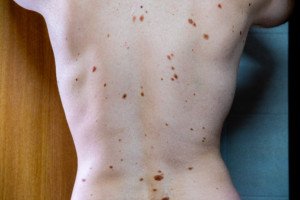
There is a rule of thumb for determining if you have too many moles – which of course, should be inspected monthly for any suspicious signs of melanoma, which is highly curable when caught early.
How to Tell if You Have too Many Moles
“My rule for having ‘too many moles’ is when the patient cannot remember all the moles that they have, and they need to rely on photos of the body parts to check the moles for changes,” explains Dr. Tess Mauricio, MD, FAAD, a leading board certified dermatologist from Stanford University Medical School and CEO of MBeautyClinic.com.
Many Normal Looking Moles
The protocol for melanoma-surveillance for a person with a bunch of normal and similar moles is not as strict as is the protocol for someone with the same number of naturally funny looking moles (dysplastic nevi).
A nevus (“knee-vus”) is a mole. “Nevi” (rhymes with “Levi”) is the plural.
A person may have many dysplastic nevi, also known as atypical moles. Many of these will net a diagnosis of atypical mole syndrome.
If you use a gym’s locker room a lot, you’ve certainly seen people with this condition.
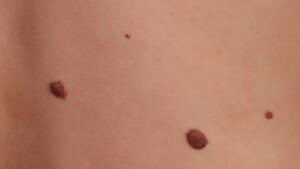
The pencil eraser sized (and larger) moles are splattered all over their back, and instead of being mostly circular or oval, they look erratic.
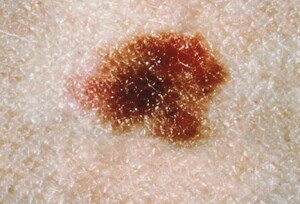
Dysplastic mole. Cancer.gov
Dr. Mauricio explains, “Those with a family history of atypical mole syndrome or dysplastic nevus syndrome have to be even more careful,” when it comes to monthly self-exams.
“My threshold to biopsy moles in these individuals is very low. Better to err on the side of giving patients scars from the biopsy than to miss a melanoma.”
• Get to know your moles, up close and personal.
• If you have illustrative talent, draw the ones you can easily inspect – scaling them up many sizes and replicating their shape and relative darkness and lightness variations.
• Use reading glasses if your up-close vision is blurry.
• Take pictures.
• There are apps for mole surveillance, but these are NOT diagnostic tools for melanoma. They are only alerts for detected changes over time.
Professional Mole Mapping
Home mole mapping if you have way too many moles to keep track of is laborious, tedious and anxiety-provoking.
Let a dermatologist, nurse and computer do all the work for you: serial digital dermoscopy!
Your insurance may cover this if your dermatologist diagnoses you with dysplastic nevi.
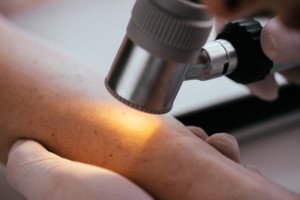
Serial digital dermoscopy is state-of-the-art technology that compares recent images of your moles to past images and identifies changes.
The technology also assigns a rating for each mole: ranging from completely normal to suspicious enough to recommend a biopsy.
Here’s more on serial digital dermoscopy.
Dr. Mauricio is an internationally recognized cosmetic surgeon and the youngest woman to hold the position of President of The San Diego Society for Dermatologic Surgery.
Lorra Garrick has been covering medical, fitness and cybersecurity topics for many years, having written thousands of articles for print magazines and websites, including as a ghostwriter. She’s also a former ACE-certified personal trainer.
.
Top image: Shutterstock/Mikel Ugarte Gil

Can You Get Melanoma by Removing a Mole Yourself?

If you’re hell-bent on removing a mole by yourself, you’d better think twice—because self mole removal may increase your risk of melanoma.
All over the Internet are articles on how to perform a self mole removal at home, particularly with garlic. (more…)
Can a Melanoma Mole Spontaneously Disappear or Regress?