Is an Autistic Interest Obsessive if No Money Can Be Made?

Have you noticed that when money can be made off an intense interest, it’s usually not considered an obsession, but in autism, when money can’t be made, it’s an “obsession”?

Neurotypicals (NTs) study sharks for a living. They tag them, view them underwater from metal cages, dissect them in a lab and send up drones to observe them.

In fact, Keith Poe has tagged over 5,000 mako sharks alone — and apparently, he’s NT.

But heaven forbid if a 12-year-old clips newspaper articles about sharks, draws them and wants to talk about them all the time.

It’s no secret that those on the Autism Spectrum tend to develop “obsessive” interests.

These can come in the form of intense focus (hyperfixation) on “normal” topics, or, a strong or intense interest in unusual topics that neurotypicals would find incredibly boring or strange.

An example would be a 10-year-old autistic girl who’s transfixed by canals. Every project she gets in school, she somehow, someway, works canals into it.

Many people all over the world are fascinated by sharks — a normal topic. We just can’t get enough of sharks, right?

The short video on Emma the Tiger Shark has garnered 995K views at the time of this posting. 

Look no further than the views to shark-themed YouTube videos for proof of this fascination among NTs.

Though we can certainly safely assume that many of those views are from Autistics.

An interest in a “normal” or popular topic among neurotypicals can also cross into the realm of hyperfixation or what NTs would call an obsession or infatuation.

Few people all over the world are intrigued by the different colors that twistie ties come in.

 Thus, an interest in this — even to a normal or even mild degree — would be considered odd or peculiar.

When I was in grade school, at some point I became intrigued by different-color twistie ties.

Few kids are fascinated by phone number exchanges (the next three numbers after the area code). But I had been when in grade school.

Thus, a normal or even mild level of interest in unusual topics or mundane items would still be considered weird.

If a child keeps asking family members — in reference to the ends of car trunks, “Why does the trunk curve up?” and the family members have become aware that this child gets a bit excited upon seeing very curved-up trunks — it’ll be considered an obsession, simply due to the object of interest: the ends of car trunks!

But this same level of interest, if directed to different clothes that could be put on a Barbie doll, different kinds of flowers or different breeds of dogs, would go well-below the radar of “obsession.”

That’s because there’s nothing unusual about having an interest in these three topics.

Dollar Signs

What becomes clear is that what NTs declare an obsession seems to be determined by whether or not the individual makes money off of it.

I know of an autistic man who has written about his intense fascination with land boundaries.

This is considered peculiar, as long as the individual doesn’t make money with this hyperfixation.

But wouldn’t a professional map maker (cartographer) be equally or almost equally fascinated by boundaries?

Otherwise why would anyone go into map making? It’s not as though it’s an easy way to make a lot of money.

If an autistic child is fascinated by tires and spends two hours a day playing with and examining toy tires, inspecting real tires and when inside a tire shop, acts like it’s a candy store — this is considered an obsession or infatuation.

But dayum, what about the neurotypical adults whose line of work focuses on tire track analysis to solve crimes? What about the guys who work in tire shops?

Okay, so we can’t find a line of paid work that correlates to a fascination with the color of twistie ties, but we CAN find one that correlates quite well with the curve-ups of car trunks: auto design!

But the designers of those cool curve-ups (most prominent on sports cars) aren’t regarded as obsessed or as having a “weird” interest. Why? Because they earn a living designing automobiles!

What is YOUR neurodivergent fixation?

Would it be a fixation if you got paid for it?

One of my many hyperfixations is big, fat ponytails. I don’t earn a dime with this other than the ad revenue money I’ve made writing about it.

I keep this interest to myself (other than having shared it with some autistic people) in that I never talk about it other than when complimenting someone on their kickass ponytail or talking about my own long poofy ponytail.

But what if I designed and created clip-in ponytails and sold them online? Suddenly, my hyperfixation would be a passion or skill.

What if I had several YouTube tutorials going about how to add volume to a ponytail? It’s now a monetization of knowledge rather than a quirky autistic obsession.

If a child loves looking at the window shades of the houses that she passes by while in her mother’s car, and wishes so much that she could go inside those homes and pull down and up and down those shades, this would be considered a very strange interest for that little girl.

She knew she’d never have the opportunity to go inside strangers’ homes to admire shades (and the really big ones got her attention the most), so all she could do is just stare at them with great interest upon looking out the window of the car going down residential streets.

She wishes all the windows in her own home had shades. She’s obsessed.

But WAIT — what about the “normal” adults who make shades for a living? 

Someone out there is designing shades for all sizes of windows, creating stylish pulling mechanisms and selling them!

Well, nine-year-old girls aren’t supposed to be interested in window shades.

They’re supposed to be interested in toy kitchen sets, puzzles, story books, coloring, hopscotch, stuffed animals, rainbows, beads, etc.

Unless one makes money and especially earns a full-fledged income off of an intense interest, it’s considered something of an obsession. How very intriguing, indeed!

Now, some preoccupations truly ARE obsessions when they begin interfering with a person’s day-to-day living.

So if an adult’s interest in, say, COVID-19 tracking data is so time-consuming that it causes them to be late for work, miss dental and other appointments, miss their kids’ ballgames, neglect household chores and turn every social conversation into the latest COVID-19 metrics — then yes, we can say that this person is obsessed.

But if their fascination with the tracking doesn’t cross any of those boundaries, it would still be considered an “obsession” by NTs — unless he or she was somehow earning money from it — such as with a blog dedicated to COVID-19 data.

“Obsessed” with hurricanes? Not if you work for the National Hurricane Center!

Obsessed with trains? Not if you’re a train engineer!

Nevertheless, special interests in autism are real. But this reality has a spectrum all in itself.

I’ve also noticed that sometimes when asking Autistics what their special interest is, they’ll name more generic, mainstream topics such as books, photography, art or gardening.

Perhaps they’ve been led to believe that ANY interest that an Autist has is automatically an obsession.

But that’s not true. I love true crime and can talk about it at length, but it’s not a special interest because I’m not hyperfixated on it. 

At any rate, if you’re on the Spectrum and have been told by NTs that you have several obsessions, then see if you can make money off of them. This will confuse the daylights out of those NTs!

Lorra Garrick has been covering medical and fitness topics for many years, having written thousands of articles for print magazines and websites, including as a ghostwriter. She’s also a former ACE-certified personal trainer. In 2022 she received a diagnosis of Level 1 Autism Spectrum Disorder. 

Can a Completely Nonverbal Autistic Give Eye Contact?

Is an autistic adult who’s 100% nonverbal capable of giving, let alone holding, eye contact? Let’s take a look at this fascinating topic.

(more…)

Why Are Nearly All Autistic Kids Who Elope Nonverbal?

Is this because an intellectual disability contributes to nonverbal status, and ID alongside autism would be why they’re more prone to eloping?

(more…)

Exercise Isn’t Punishment: It’s Anti-Aging, Youth Preserving

You need not view exercise as “punishment” for eating habits; see it for what it actually is: a formidable force against aging.

Who wouldn’t want that?

Yet more research supports that exercise is the best anti-aging “drug.”

When people exercise with passion, it isn’t always about burning calories or building a “calorie bank” for an upcoming vacation.

It’s not always about body image insecurities or wanting to get thinner and thinner.

Let’s face it: Nobody likes the idea of getting old — or feeling old.

Must-Read Research

Research, published in the journal Aging (2025), and led by Takuji Kawamura from Tohoku University, shows that consistent workouts and building fitness may even reverse certain markers of aging.

Scientists measure aging basically two ways.

  • Chronological age: number of birthdays you’ve had
  • Biological age: how healthy your cells and tissues are.

We can even add a third way: functional age, which would be how well your body moves throughout the day, particularly during certain tasks.

For instance, can you deftly leap over puddles?

Can you trot down flights of stairs with the nimbleness of a ballerina?

Can you load heavy bags into a big garbage can with little effort?

How about briskly walking across a parking lot that’s slightly uphill, while holding a heavy bag in each hand?

Biological Age

Biological age is measured with “epigenetic clocks,” tools that study chemical changes on your DNA called methylation.

These changes can switch genes on or off and are strongly tied to how quickly your body is aging inside.

The research paper makes it clear that all movement is good, but structured exercise — like thrice-weekly workouts at the gym, or consistent dedicated days for jogging or fitness classes — does far more to slow down this molecular aging process.

The overly generic “get moving” is good advice for couch potatoes to get them launched, but is far from being the be-all, end-all, for combating the aging process.

Fitness levels, especially cardiovascular endurance, are closely linked to a younger biological age.

Studies

In animal experiments, mice that did structured workouts had healthier muscles at a cellular level.

In humans, even short-term exercise programs showed impressive results.

One study found that sedentary middle-age women were able to turn back the clock by two years after just eight weeks of combined cardio and strength training.

Another study revealed that older men with higher oxygen uptake levels, which is a measure of cardiovascular health, were biologically much younger than their peers.

Organs, not just Muscles

Exercise seems to slow aging in multiple organs, including the heart, liver, fat tissue and even the gut.

Olympic athletes, for example, show slower biological aging than non-athletes, suggesting that long-term, consistent training has lasting benefits.

Nevertheless, what’s not known is what specific types of workouts have the biggest anti-aging effects.

Some people insist it’s intense weightlifting, while others insist it’s trail running.

There are those who’ll put yoga at the top of the list, while others believe it’s hard-style martial arts, Zumba or CrossFit.

Exercise Is Not Punishment: Crazy Idea!

Freepik

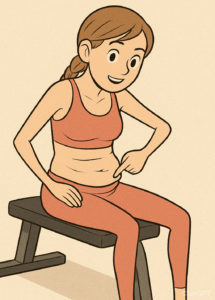
Whoever on earth came up with the notion that exercise is a form of punishment related to eating habits, body weight or body image?

It’s really very unfortunate that some influencers on Instagram and TikTok have been spreading the idea that exercise = punishing oneself for feeling insecure about how their body looks.

But even if you work out in the name of keeping your weight controlled or feeling self-conscious about your inner thighs, upper arms or tummy, those chemical changes on your DNA called methylation will still slow down!

This means a slowed-down molecular process that results in slower aging.

The paper points out, though, that ultimately, it’s a personalized workout plan that would be the best.

Someone with a bum knee shouldn’t be running in the mountains, while not everyone would enjoy a kick-butt martial arts class.

The bottom line? Staying active isn’t just about feeling fit today — it’s one of the best ways we know to keep your body younger on the inside, adding not just years to your life, but life (high functionality) to your years – whether or not you get hit by a meteor jogging to the gym.

Lorra Garrick is a former personal trainer certified by the American Council on Exercise. At Bally Total Fitness, where she was also a group fitness instructor, she trained clients of all ages and abilities for fat loss and maintaining it, muscle and strength building, fitness, and improved cardiovascular and overall health. 

.

Top image: Freepik/karlyukav