

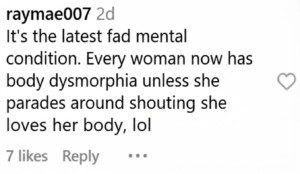
Gee, if you think your thick thighs are thick or your thick waist is thick, then you have body dysmorphia. Every woman these days has body dysmorphia.
It’s gotten to a point where if a woman expresses any kind of body dissatisfaction or desire to “change” something about her body, the court of social media diagnoses her with body dysmorphia.
If a woman is 5’9 and weighs 170, she won’t have thin thighs. But she won’t have heavy thighs, either if she exercises and has tone.
However, if she wishes her thighs to have a sleeker, slimmer look, this doesn’t mean she has body dysmorphia.
Otherwise, shall we diagnose all men who want to replace their beer gut with a tight flat middle with body dysmorphia?
How about the ones who are sick and tired of having chicken legs and furiously do squats and leg presses at the gym to build some mass?
Funny how this labeling never seems to get tossed around onto men.
Many years ago I read an article about body dysmorphia. I remember one case in particular: a woman who despised her nose.
Now, many people hate their nose. This is why a nose job (aka rhinoplasty) is among the most common of plastic surgeries.
I myself had a nose job in my late 20s. I hated my nose.
This didn’t mean I had body dysmorphia. I rarely thought about it. I didn’t think it was ruining my life, nor did I think anyone ever stared at it.
The upper part of my nose was crooked, and the tip was slightly bulbous.
One day my mother suggested I get a nose job and offered to pay for it. I would’ve been whacko to turn down this offer.
An exam revealed a deviated septum and a healed fracture (either from karate and/or a volleyball spike). Insurance covered half, since these were considered medical issues.
All those before-and-after photos of nose jobs typically show a hook-type or bulbous nose before the surgery. Would anyone call these patients body dysmorphic?
But if a woman wants liposuction or cool sculpting for her plump middle or saddlebags, then BAM, she’s automatically body dysmorphic. What the devil’s going on here?
Are women who use spray tanners body dysmorphic? Why not?
But some of those women who spray a chemical on their skin to darken it think any woman who wants a smaller waist has body dysmorphia. Go figure.
The case I had read about was that of a woman with a fairly typical looking nose. But her case went beyond merely being dissatisfied with it.
Whenever she rode the subway to and from work, she was convinced everyone on the train was staring at her nose and even whispering to each other about it.
She believed it was the first and pretty much only thing that people ever noticed about her.
She thought it was hideous and ruining her life.
THIS is body dysmorphia! Do you see the difference between her and the average woman who wants a flatter tummy, slimmer arms or an overall weight loss of 15 pounds?
Perhaps the line is wide and blurred between true body dysmorphia (as it pertains to physique) and someone hating their saddlebags – or flabby loose inner thighs or flappy upper arms.
When I was a personal trainer, I had many female clients who wanted better looking legs, smaller waistlines and flatter tummies.
Their goals were normal. For example, Errin had expressed multiple times that she hated the way her thighs were shaped. I could easily see why. She DID have a disproportionate amount of fat at the upper parts of her outer thighs. She was not irrational about wanting to trim it down.
Some influencers out there would’ve quickly diagnosed Errin with body dysmorphia.
But they’d NEVER diagnose Chuck with this disorder, even though he was not satisfied with his physique and wanted to add muscle.
Why the double standard?
Why are so many influencers and their followers so quick to diagnose body dysmorphia in women but not in men who’d like to alter their bodies?
Is it because (without them realizing it) they believe that women are too mentally frail to think rationally when it comes to their body?
Is it because (without them realizing it) they think that men are more capable in the mental department and thus, any change they’d like in their body surely has to be reasonable rather than the product of brainwashing from societal beauty standards?
Damn, HOW INSULTING.
This commentary isn’t about women (and men) with anorexia nervosa.
It’s about individuals who want to change something about their body or who wish a body aspect looked different.
There’s a difference between Errin’s goal, and say, a 105 pound woman who thinks her legs are heavy and wants to lose 10 pounds.
Would these over-the-top influencers label me as body dysmorphic because I wish my natural complexion was the same color as it’d be with a deep tan?
Did I have a body image disorder during the years I put every shade of red and auburn in my hair?
I wish my feet were one size smaller so they wouldn’t look big. Am I disordered in my thinking?
I’m sure none of those women and their followers would think so.
But if I kept working on my waist to make it smaller, they’d jump on that nutty bandwagon and diagnose me with body dysmorphia – all while they put dyes and extensions in their hair, wear false eyelashes and fake fingernails, paint freckles on their cheeks, draw on eyebrows, and lie in a radiation-filled booth to darken their skin.

Lorra Garrick is a former personal trainer certified by the American Council on Exercise. At Bally Total Fitness, where she was also a group fitness instructor, she trained clients of all ages and abilities for fat loss and maintaining it, muscle and strength building, fitness, and improved cardiovascular and overall health. She has a late diagnosis of Autism Spectrum Disorder.
Top image: pexels/angela-roma
Related Posts

Why Thin Bodies Are More Realistic than Fat Bodies

Non-Doctors Telling Fat Women They Don’t Need to Shrink
Is the Biggest Goal in Your Life to Wear a Bikini to the Beach?
Should Plus Size Women Feel Pressure to Wear a Bikini?

Why So Many Body Image Mental Health Influencers in Therapy?