
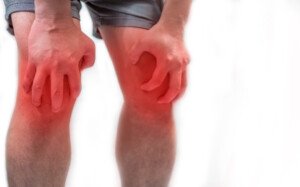
Has pushing off the armrests of a chair when rising become a habit due to stiff knee joints?
With age, the cartilage and lubricating fluid inside your joints gradually decrease.
That can leave joints less protected and make movement more uncomfortable.
This phenomenon comes on gradually, such that you can’t even remember the last time you were able to effortlessly spring out of a chair without your hands touching the armrests.
This doesn’t mean, however, that exercise should be avoided. In fact, staying active is one of the best ways to keep aging joints working well.
The ends of your bones are covered with articular cartilage, a smooth, specialized tissue that cushions the joint and allows the bones to move easily.
Joints also contain synovial fluid. This thick liquid helps reduce friction and provides cartilage with nutrients.
The problem is that cartilage has a limited ability to repair itself because it doesn’t have its own blood supply.
Over time, cartilage can break down, contributing to osteoarthritis. This occurs in the shoulders, hips, spine and knees, but the knees are the most commonly afflicted.
You Need to Exercise
Movement helps circulate synovial fluid throughout the joint, allowing nutrients to reach the cartilage.
Exercise also strengthens the muscles surrounding your joints. Those muscles help absorb some of the force that would otherwise be placed directly on the joints.
Strength training is a godsend for the knees, particularly movements that strengthen the quadriceps muscles.
Even if you already have stiff or tweaky knees, strength training is perhaps the best thing you can do for them.
What about low back pain? Exercise is practically a miracle worker for deconditioned low back structures.
However, make sure your physician gives the green light, since sometimes, chronic back pain can be due to structural pathology such as a bulging disc.
Research has found that exercise can reduce pain and improve physical function in people with knee osteoarthritis as well as chronic back pain.
In some cases, its benefits can be comparable to anti-inflammatory medications without the same potential side effects.
Low Impact Exercise for Aging Joints
If traditional cardio exercise is too painful for your knees, this doesn’t mean you should be sedentary.
Pedaling machines are always an option, as well as propulsion-type swimming.
Tai chi can also be effective. Its slow movements and controlled breathing can improve strength, balance and movement.
Yoga is another possibility because it can strengthen muscles around the joints while improving flexibility.
Don’t Overlook Walking
Walking on surfaces such as grass, gravel or trails can provide a greater balance challenge than walking exclusively on smooth pavement.
This is called “rough walking,” and you should do it as much as possible, even if the rough area is very small, such as stony or grassy sections of parking lots that most people walk around.
Research has also found that exercises designed to improve balance can significantly reduce fall risk.
