
Walking can become slower and more tiring as we get older, and new Australian research may help explain why.
Researchers from Flinders University and the University of Canberra found that aging appears to change the way the body handles walking.
Instead of focusing as heavily on speed and efficiency, the body seems to place more emphasis on staying stable.
The researchers describe this as a kind of “safety-first” strategy. It may help older adults remain upright, but it can also make walking require more effort and potentially increase fatigue.
The study included 107 healthy adults ranging from 26 to 86.
Researchers examined how their bodies moved during walking and found age-related differences in the ankle and surrounding muscles.
Ankle Changes Can Affect Walking
The ankle plays an important role in both balance and forward movement.
According to lead researcher Dr. Cody Lindsay, the body gradually begins prioritizing stability as people age.
One important change involves muscle co-contraction. This happens when opposing muscles around the ankle contract at the same time.
That extra muscle activity can make the ankle joint stiffer. While that added stiffness can provide greater stability when the foot hits the ground, it also requires the muscles to work harder.
The tradeoff is less efficient movement.
Older adults in the study also produced less power during the push-off portion of each step.
With less push-off, their strides became shorter and their walking speed decreased.
Why Walking Gets More Difficult With Age
Associate Professor Maarten Immink says the findings suggest that the nervous system changes its movement strategy over time.
Rather than taking the same approach to walking throughout life, the body appears to compensate for age-related changes by putting greater emphasis on stability.
That can be helpful when balance is a concern, but it has disadvantages.
More muscle activity and less efficient movement can contribute to fatigue, particularly when walking longer distances.
The changes may also make it harder to recover quickly after a trip or slip, which is important because difficulty recovering from a loss of balance can contribute to falls.
Even relatively small changes can affect everyday life. Someone might notice that they become tired sooner, feel less confident walking or have more difficulty on uneven surfaces.
Exercise Helps Maintain Mobility
In addition to strength training, the study advises that exercise should also address balance, coordination and how muscles work together during movement.
- Stepping drills, such as using the bottom step of a staircase
- Yoga
- Tai chi
- Karate
- Side to side walking
- Catching a ball that’s tossed off-center
- Clock lunges (see below)
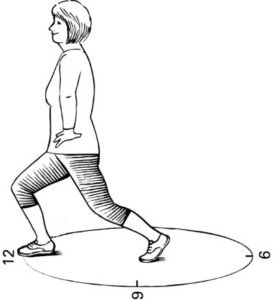
The clock lunge
Correct Use of a Treadmill
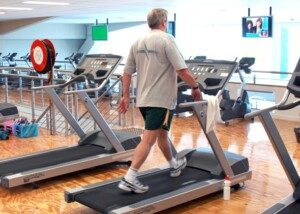
Many older people take to their local gym’s treadmill. However, most make a huge mistake: holding on.
This UNDOES any balance capabilities that are remaining in their aging bodies.
The rails and front bar are there for occasional balance checks.
But outside of that periodic check such as when changing the setting, the user should swing their arms: a natural gait, not a fake gait that reduces walking efficacy once they’re off the machine.
If you walked into the gym without an assistive device, you can walk on a treadmill without holding on. 1) Start slow. Many seniors set the speed too fast. 2) Don’t get over-eager with the incline by setting it way high.
Find the settings that allow you to walk without feeling that you can’t keep up with the moving tread.
