
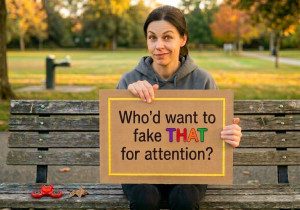
Skeptics accuse “normal” people of faking autism for attention, but they fail to back up this claim; they just blow a lot of hot air.
It’s not just the who and why, but how would someone fake ASD?
The naysayers’ line of defense for their skepticism is that these days it’s “cool” to be autistic.
What they fail to realize is that the coolness is among other Autistics. I’ve never observed an Autistic getting accolades from neurotypicals for disclosing their autism.
Furthermore, when a celebrity reveals an autism diagnosis, the alleged trendiness isn’t quite relatable to common folk who aren’t famous entertainers, actors or recording artists.
I’ve been to numerous events for autistic adults, and among us it IS cool to be on the Spectrum!
But I don’t see any neurotypicals getting involved in this.
Faking Autism to Get Benefits
What benefits? Being first to board a plane? Big deal. You have the same assigned seat whether you’re in the first group to board a plane or among the last people. There’s always room for overhead baggage.
What about getting sympathy? I can’t speak for all Autistics, but I certainly do not want sympathy. Who’d want this unless they’re trapped under a truck tire.
I don’t want people feeling sorry for me. I’d imagine that most real Autistics wouldn’t want this.
Why would a neurotypical (NT) want sympathy for no good reason? Yes, they exist, but they often go to extremes to get it such as faking a cancer diagnosis or poisoning their child (Munchausen by proxy syndrome), rather than just going around telling people they’re autistic.
Quite frankly, a claim of autism by an adult isn’t exactly a good way to get sympathy, being that anyone who’d make up this diagnosis would certainly know that they’d be presenting as “high functioning.”
If someone truly wants sympathy but isn’t deranged enough to fake a terminal illness, don’t you think they’d fake something like substance abuse, depression, anxiety or chronic back pain?
Often, when people fake symptoms such as pain, depression and anxiety, it’s for monetary gain, not sympathy.
I’ve proofread personal injury deposition transcripts for many years, and sometimes it’s obvious when the plaintiff is faking a claim for financial gain.
But to fake autism for sympathy alone? Come on. This just isn’t realistic. Well – almost not realistic. I can see where pretending to be on the Spectrum could get a new employee a pass at making errors.
But STILL – once they say “I’m autistic” (when they’re not), this label sticks with them. Who’d do this just to get more patience the first few weeks on a job they plan on having for a while? Well, I suppose anything’s possible.
Apparently (from what I’ve heard) there are websites that make it easy for Autistics to get medical appointments.
I’m with Kaiser Permanente. KP makes it super easy to make appointments online.
If I feel like doing it by phone, this is straightforward; I know the exact number; the menu selection includes “to make an appointment.” How much easier can you get? I also have the numbers to specific departments.
Now maybe other health plans are a bear to deal with, but I’ve never heard of a major plan offering some special, faster route for Autistics to make appointments.
I’ll tell you what would be a great perk for those on the Spectrum (and every other human being): a way to quickly get connected to a human for Comcast/Xfinity, GEICO and the IRS. To date, no such service for autistic people exists.
What about how a doctor interacts when they know (or believe) a patient has autism? Wouldn’t all people want a more patient doctor, and hence, perhaps some NTs might fake autism to improve a physician’s bedside manner?
Hey, if a doctor is crusty, knowing their patient is autistic ain’t gonna change that.
Prior to realizing I’m autistic (I eventually got a clinical diagnosis – and NOT for perks or sympathy!), I’ve had some pretty dynamite doctors who were happy to answer my questions.
If anything, I’d think that telling a doctor you’re autistic (whether faked or real) could lead to that doctor holding back information to avoid upsetting you, and/or being frugal with details with the idea that too much information could overwhelm you.
I’ve always wanted all the details and have always had many questions for doctors (I’ve always been fascinated by medicine, so this is one reason I’m driven to know all I can about anything relevant to my body).
Nevertheless, fakers wouldn’t consider that disclosing an autism diagnosis could backfire.
In the end, I just find it too incredulous to believe there are NTs out there pretending to be autistic to get better medical care.
I’d think that an NT would still realize that masquerading as autistic would backfire in business settings, e.g., not being taken seriously.
It’s a Myth that People Fake Autism
Remember, anything’s possible. This means that somewhere out there is a person who has faked an ASD diagnosis.
The people who actually believe that faking autism is a wide-sweeping trend have submitted to a myth.
They mistakenly believe that pretending to have autism brings on loads of benefits. Like … tell me, what are they, so I can get them!
Even though I’m actually autistic, I never disclose this in the business world because I know it wouldn’t get me faster or better business. It just wouldn’t.
In fact, it could backfire, in that a shady company could cut corners with service, figuring I wouldn’t notice (ironically, my superb attention to detail would have the opposite effect).
If you ask a skeptic what advantages there’d be to faking autism, they’ll fail to give a convincing answer. They’ll likely be tongue tied.
Keep in mind that there’s a big difference between pretending to have autism and being misdiagnosed with autism by a mental health professional.
In that latter case, we’d have someone who believes they’re autistic but actually has a different condition.
However, a misdiagnosis of autism is rare. It’s usually the other way around: being autistic but getting a different diagnosis (ADHD, social anxiety disorder, bipolar disorder, borderline personality disorder). Note: One can have autism along with any of these other conditions.
Faking Autism Would Be Really Hard
What would actually be faked is the diagnosis. But acting autistic in a convincing manner, and remembering to do this whenever you’re around the people you lied to that you’re autistic, would be a very difficult commitment.
No, it wouldn’t be as easy as remembering to talk about trains or life on Mars. There’s much more to it than that.
It also wouldn’t be about pulling out your fidget spinner during a business meeting or suddenly spinning in your chair.
Also, many authentic Autistics don’t present in a way that reveals their neurodivergence. This depends on how much they’re faking being neurotypical (masking), the context of the situation and its duration.
So at my niece’s wedding rehearsal, where I wasn’t masking, it would’ve been fairly obvious that I was different.
But when I’m dealing with an inept business service, I come off more like an Alpha wolf than an Autist.
Those daft naysayers who think faking autism is the latest fad don’t realize that pulling this off would be an enormous task, as difficult as, or even more difficult, than an Autistic faking being neurotypical.
This “reverse masking” would eventually prove exhausting. Again, a false claim of autism would be the diagnosis rather than “acting autistic.”
Anyone who persistently “acts” autistic without burning out would have to be very familiar with how Level 1 Autism presents, and perhaps has family members in this category whom they can mimic.
It can be more easily faked in short-term situations in which the fraudster knows they’ll never be in again, such as at a restaurant.
But long-term? This reverse masking wouldn’t hold up well unless the person’s foolery is limited only to saying, “I’m autistic.”
The Verdict
There is, and never was, a rampant fad of pretending to have Autism Spectrum Disorder.
There’s never even been anything close to it. At most, it’d be on a case-by-case basis and most likely involving a one-and-done event such as boarding a plane early, getting preferred seating at a restaurant or having music turned down.
