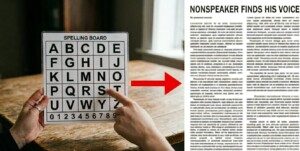
Why do autistic nonspeakers who write via pointing to letters on a card always have advanced writing skills? The sophistication never matches their background.
This is one of the many red flags for assisted spelling, aka rapid prompting method, a form of facilitated communication.
Most people lack sophisticated, flowery writing skills.
So how is it that, by crazy insane chance, every time a nonspeaking person with autism, who “finally found their voice” by pointing to an alphabet sheet that’s always held by someone (usually a parent), just happens to possess highly academic and embellished literary skills when they get quoted or published somewhere?
The latest composition was allegedly written (via poking at letters on a card held by his mother) by a 17-year-old.
Here are excerpts, taken from nonspeaking, autistic Noah Simmons’ commentary from washingtonpost.com.
He begins by saying he’d been interviewed recently for a KFF Health News article pertaining to the debate over assisted spelling. Check out the second paragraph that follows.
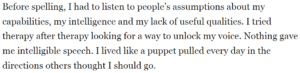
Certainly, there are typical 17-year-olds who have this level of writing skill. But it gets increasingly suspicious for actual authorship. Here’s the next paragraph.
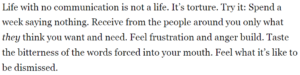
Now come on, what 17-year-old writes like this? We all knew who the “literature brains” were in our junior and senior years of high school.
One day the English teacher at my school asked what one possession we’d want, if we were stranded on an island.
Some kids said a book on how to build a boat. Some kids said the Bible. One girl said the complete volume of Shakespeare’s works.
But even SHE couldn’t write like Noah. This is professional level commentary writing. The odds that any given 17-year-old can compose this way are pretty small.
But for Noah, it’s impossible. And how do I know? Because in an article at conexiant.com it says, in a caption showing Noah pointing, the following:
Noah Simmons has spent two years learning to spell and type.
How does one acquire his writing skill after only two years learning to spell?
Two Years of Spelling Lessons = Advanced Writing Composition???
Let’s say we take an adult with normal intelligence and full spoken language, who’s been living in the jungle all his life and hence, never learned literacy, and move him to the U.S. for literacy tutoring several hours/week.
After two years, he would NOT be able to produce advanced academic writing, nuanced stylistic control or sophisticated syntax — even if he fully understands spoken words.
At best he’d be writing at fifth grade level.
Despite normal intelligence, only up to fifth grade level would be attained because adult first-time literacy learners are effectively building a new cognitive system rather than acquiring a simple skill.
Writing (regardless of means, such as pen to paper, touch typing or letter pointing) involves matching spoken words to written letters, learning rules that don’t come naturally, and building up automatic skills so you don’t have to think through every word.
It also means learning how written language is structured differently from how people speak.
It’s 100% not believable that a teenager could master prose in only two years of spelling instruction!
Research in Journal of Learning Disabilities (Cutting et al.) and Reading Research Quarterly (David Share) shows that advanced writing develops slowly over years, with decoding and fluency becoming increasingly efficient only through extended practice and exposure. Two years won’t cut it.
As an Autistic myself, I’d like to believe that this teen really wrote the commentary. But come ON.
After two years, an illiterate adult of normal intelligence might be capable of penning:
“I go to climbing gym this morning. I climbed many routes. I got to top on all routes. I am good. I love climbing.”
But here’s how 17-year-old Noah, just two years in on learning how to spell/write, says it:

But something else jumps out that screams suspicion: He claims to lead-climb 5.12 routes.
I used to do a lot of indoor climbing. A 5.12 route is considered “expert” level. There are basically four levels: beginner, intermediate, expert and elite.
Lead-climbing is significantly more difficult than top roping. If a severely (nonspeaking) autistic teen is lead-climbing 5.12s, this would make news somewhere.
If a nonverbal Autistic has the easiest position on a mainstream cheerleading squad, or runs on his schools’ track team but always finishes last, stories like this will often make the news somewhere as feel-good stories.
So I’d like to know then, why is Noah’s extraordinary accomplishmente as a 5.12 lead-climber (yes, this would be extraordinary for a severely autistic teen) is not anywhere to be found online?
I even checked YouTube. You’d think there’d be video footage of him ascending a 5.12 route. It’s nowhere. Nada.
Go ahead, search for it. If you find any video of such a climbing feat for a teen with severe autism, give me the link in the comments section below.
Same if you find an article about his climbing skills — other than the recycled variations of the one pertaining to the KFF Health News article.
Why isn’t this kid in climbing competitions? Is it believable he has no interest at all if he can lead at 5.12?
Believe me, if an autistic teen was competing in the expert division, even if he didn’t place, this would make local news like nobody’s business.
I’ve seen nonverbal autistic young men and teens climbing indoors (I was part of an adaptive climbing program). All were in the beginning range, including one who’d been climbing for several years.
This whole climbing thing with Noah Simmons adds to the non-credibility that he actually composed that commentary. It continues below:
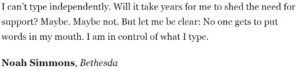
So for good measure, the real author of this commentary tossed in, “I can’t type independently,” etc.
Funny how, despite the author’s eloquent and advanced writing skill, he or she didn’t think to add in WHY “I can’t type independently.’
But you can climb a 5.12? A 5.12 route is full of handholds that look impossible to hold and use to move your body in vertical space.
A 5.12 route is EXPERT level. Go to a climbing gym and view one for yourself.
See if you can even get off the floor (using climbing shoes). As an intermediate climber, I was never able to do this, because the handholds are, essentially, nubs.
Some are the size of a cookie. They’re thin “crimpers” for the strongest fingers or little “slopers” that can’t be grasped.
They’re sometimes smooth and there’s no way to latch onto them. Or they’re finger holds with a hole that only one or two fingers can fit into to pull yourself upward.
You telling me that Noah Simmons can climb (let alone lead-climb) but can’t hold a piece of cardboard in one hand and point to it with the other? I’m calling bullshit.
Lead-climbing involves fine motor skills to “make clips.” So Noah can make clips but can’t hold a card in one hand and point to it with the other? BS.
Expert-level lead-climbing demands significant fine motor control of the hands and fingers. Full stop.
Noah Simmons’ Story just as Unbelievable As Woody Brown’s
I want video proof that Noah can spell and create sentence structures at post-college level with only two years of spelling instruction. How can anyone think that a commentary in the Washington Post is convincing enough? You may as well write you saw Big Foot.
Video proof would NOT a close-up shot of Noah randomly tapping gibberish and at empty spaces, as is the case with Woody Brown.
Video proof is a close-up shot of him spelling actual sentences in answers to questions, where his finger is clearly viewed, where the footage originally starts out showing his entire body so that we know that it’s still him in the zoom-in: NO CUTS.
The cows will come home long before such a video is ever released.