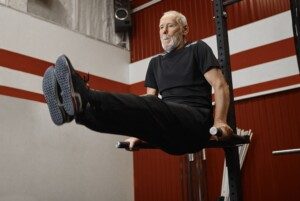
A study shows alarming results regarding the age the body begins declining in physical fitness; it’s younger than you may think.
Do you know any 50-year-olds who are in remarkable physical condition? Maybe you yourself think you “still got it” and feel as fit as anyone half your age.
But a study that spanned almost five decades has enlightening news that some fitness enthusiasts will find demoralizing.
And that’s the answer to the following question: Just what age, on average, does the human body begin going downhill in physical abilities?
Swedish Study Tracks Fitness Over Nearly Five Decades
A long-running study in Sweden has followed people for 47 years to see how fitness, strength and muscle endurance change during adulthood.
The research shows that physical performance starts to decline around age 35. Yes, 35.
This seems to contradict the phenomenon of people who take up a sport for the first time in their late 30s or even early 40s — and excel — smashing the competition among younger competitors.
It also seems contrary to the fact that many elite athletes over 35, who’ve been competing in their sport since childhood or teen-hood, have outperformed opponents in their 20s.
The sports commonly associated with these situations include marathon running, powerlifting, basketball and track and field events.
There’ve even been Grand Slam tennis champions over 35, not to mention quite a few Olympic athletes 35+ making the U.S. team in a variety of sports (e.g., bobsled, sprinting) — and even taking home medals.
But these situations are highly atypical and will be explained shortly.
The research is part of the Swedish Physical Activity and Fitness study (SPAF). It tracked several hundred randomly selected men and women between 16 and 63.
Unlike most earlier studies, which compared different age groups at a single point in time, SPAF repeatedly measured the same participants over decades.
That makes it one of the most detailed long-term looks at how physical capacity changes as we age.
When Fitness and Strength Begin to Decline
Results show that both fitness and strength begin to decrease as early as age 35, no matter how much a person trained earlier in life.
From there, the decline is gradual at first but tends to accelerate with age.
Despite this trend, the study also found that exercise remains valuable at any stage — hence that old saying: The only people who don’t benefit from exercise are dead.
Adults who started being physically active during the study improved their physical capacity by 5 to 10 percent.
What about those exceptions?
Yes, what’s going on with people who wildly excel in a sport that they took up at 35+, such as powerlifter Tamara Walcott?
She began powerlifting at 35 — that age at which the body is supposed to start declining in strength.
After only four years of training she broke the world record for the heaviest raw (no belt or straps) powerlifting point total. This is insane.
But with these exceptions, there’s a few things to consider.
How do we know that, in Tamara’s case, as well as other athletes who took up their sport at 35+ and crushed the competition, that had they taken up that sport much earlier in life — they would’ve performed even better?
Tamara’s personal best in competition for deadlift is 655 pounds. What would it be had she begun powerlifting at 25? Hmmm.
So in a parallel universe, she begins training at 25, and at 29, hits 655. Two years later at 31, she’s at 690. At 35, all she could pull is 655.
So for all we know, Tamara’s 655 lb. deadlift is her decline at 35 — in that parallel universe — but what appears to be an ever-increasing load in this universe.
However, don’t be surprised if in a year or two, she pulls around 690.
But even then, the parallel universe scenario is tempting as an explanation for why, at 35, she has exponentially increased her unreal strength and can bench press 380 pounds.
Another point to consider with these outstanding “late in life” athletes is that physiologically, they’ve been blessed with attributes that gave them a giant headstart — so huge — that taking up the sport later in life didn’t stop them from winning at elite levels.
Those attributes include longer tendon insertions into bone, and nearly all muscle fiber types being that of fast twitch: These are designed for explosive power (or in the case of marathon runners who continue placing in major events past 35, slow twitch fiber, designed for stamina).
Body proportions also play a role, as well as speed of lactic acid clearance, lung volume and other factors.
Again, these athletes are extreme exceptions.
It’s Never Too Late to Take up Exercise
Systematic workouts will slow aging and decline in performance. This has been proven time and time again.
The team now hopes to understand why peak performance tends to occur around age 35 and why exercise can slow, but not fully prevent, performance loss.
The study is ongoing. Next year (2027), the participants will be examined again at 68.
Researchers want to explore how changes in physical performance relate to lifestyle, overall health and biological processes. The study was published in the Journal of Cachexia, Sarcopenia and Muscle.