If you have low support needs autism, just how can you have the same diagnosis as someone who’s nonverbal and needs help with the most basic tasks?
I came across a striking comment on a popular discussion site, posted by a man with low-support-needs or “mild” autism. He questioned the validity of his diagnosis because he was living a fully independent life – a pretty typical life, actually.
He questioned that he could have the same condition as someone who needs help with basic tasks and will never talk.
This comparison isn’t unique to this gentleman. It pops up on a regular basis in comments sections to articles about the rise of autism diagnoses among adults who have college degrees, live on their own, work in professional capacities, are married and even raising children. See below.
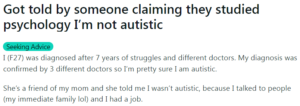
Though Level 1 Autism Spectrum Disorder is noted by the DSM-V as requiring “minimal support needs,” many people – including adults with professional careers newly diagnosed with autism – have a very fair question:
“How could all these adults getting diagnosed with autism — who drive to work every day and run households — have the same condition as my brother whom we can’t let out of sight in public and can’t put on socks and has never spoken a single word?”
I was diagnosed with autism at 59. I have the same condition as your brother who can’t even make a PB&J sandwich for himself.
Even though my level of independence much more resembles that of the typical neurotypical adult, my brain is still wired in an autistic way.
We need to zoom out a little and look at level of independence.
Level of independence is not a criterion for ASD, but it is a yardstick by which to classify what level someone’s autism is: 1, 2 or 3.
Of course, I’m at a level 1. This was previously known as Asperger’s syndrome.
People getting diagnosed in adulthood, especially later adulthood, almost always get the Level 1 classification.
It’s obvious why: They have a condition that has minimal support needs. This means most have gone through the school system without requiring any “special” modifications.
But that doesn’t mean there weren’t struggles. For example, autism self-advocate pioneer, Temple Grandin, struggled all throughout school with fitting in and navigating social norms, and was ridiculed.
THAT IS NOT NORMAL EXPERIENCE no matter how independently she functioned throughout the school day, no matter how good her grades were or how verbal she was.
Going through life struggling to fit in is a dreadful experience, but it’s consistently downplayed by neurotypicals who breezed through social navigation growing up and continue to kill it in adulthood.
Those who are skeptical of the existence of “high functioning” autism are quick to make comparisons to Rain Man and their cousin who wasn’t toilet trained until eight.
These naysayers don’t grasp the concept of levels, degrees or grades, which are commonly used for other conditions in the DSM-V (the handbook of diagnostics for mental health professionals by the American Psychiatric Association).
Varying categories are also commonly used in physical medicine (e.g., mild osteoarthritis vs. bone-on-bone requiring a walker).
A Great Analogy: Obesity
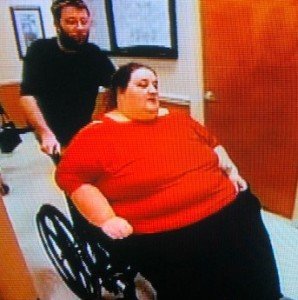
Two people could have a diagnosis of obesity yet also have extremely different levels of independence — as depicted below.

Someone at the low end of obesity may be capable of an all-day hike in the backcountry and leading four Zumba classes a week.
Someone with super morbid obesity could find it difficult just rising out of bed and feel beaten just walking to the end of their drive to get the mail and then back up its slight incline — and may even have to pause before getting to the front door.
Yet both these people have the same diagnosis: obesity.
Nobody says, “You can’t be obese because the guy down the street weighs 500 and can barely go up three steps to his door.”
Nobody ever says, “Your doctor was wrong to diagnose you with obesity because my sister has a BMI of 58 and must sit down for 20 minutes after just a few minutes of walking.”
Nobody ever claims, “You can’t have mild IBS because my cousin has it and she spends half the day on the toilet.”
- So why are people applying this lack of logic to autism?
- It blows my mind.
However, I’d be lying if I said I never once subscribed to a total misunderstanding of what autism can be or how it can present.
But that was so many years ago, prior to the big increases in autism awareness over the ensuing years. Nowadays, there’s plenty of opportunity to read about the lived autism experiences of those diagnosed late in life.
If skeptics took the time to read these experiences, they wouldn’t be so quick to accuse psychologists of giving everyone and their brother an autism diagnosis “to make money.”
From the outside, I present as way more “functioning” than the vast majority of even those without autism.
I’m a former personal trainer who’s been completely on her own since 22 — not even a roommate or live-in partner — who has a four-year college degree and will be that person in a stuck elevator who can hold it together instead of crumble in panic.
But when I lived in the university dormitory, I had no idea how to figure out eye contact as I was approaching someone I knew who was walking towards me in the long corridor. THIS IS AUTISM. A neurotypical wouldn’t have this problem.
I hated it so much I often took the staircase to avoid the long walk to the elevator and thus the chance of encountering someone and having to figure out eye contact nuances – even though my floor was seven stories up.
If a skeptic knew this, they’d label me as really weird or having mental health challenges.
The irony is that they’d give me these overt labels but deny I could possibly be autistic simply because I’ve been living independently, was an editor for 12 years for a print magazine in which I remotely managed a pool of writers (gee, how can an autistic person do that?!) and can be in crowds without having a meltdown.
- So then, if I’m autistic, why don’t I have meltdowns?
- If I’m autistic, why don’t I mind if different foods touch on my plate?
- If I have autism, why am I assertive and Alpha?
- And how come one late-diagnosed Autistic might have severe social anxiety, while another is a car salesman?
Holy moly – you’d think autism was a spectrum!
Internal vs. External Experiences
So back to how my life, on the outside, more closely resembles that of a common neurotypical than of the stereotypical Rain Man or Tommy Westphall (the severely autistic boy in the “St. Elsewhere” TV show).
But inside is a whole different universe, and any Level 1 Autistic will concur.
Without going into too much detail, just take my word for it: My internal experiences are full-on autism.
And the stimming (repetitive behaviors) that I do at home, where nobody sees, is also full-on autism.
Many adults with late diagnoses have been masking for years: concealing the traits that either got them into trouble or invited ridicule, and/or acting neurotypical – which doesn’t come naturally at all. Over time this can lead to burnout.
Many late diagnosed Autistics have also never been good at masking, and were often thought of as odd, strange, too analytical, and even – as in my case at times – “She’s an artist; artists think differently.”
For years I bought into this. I have art and music skills – so I’ve always believed that my “differentness” came with this terrritory.
The Big Takeaway
There IS a such thing as a form of autism (you’d think it was a spectrum!) in which the individual can lead a perfectly independent life and be in demanding careers such as aerospace engineering, IT, medicine, teaching, the police force, mental health counseling, social work and even sales!
And that list is far from complete. The spectrum of autism is not a linear model. It’s a pie chart with many slices.
Not all Autists have every single slice. That’s why “If you’ve met one autistic person you’ve met one autistic person.”
In fact, if you’ve met one autistic person … you should meet more; we’re fabulous!