I don’t believe in blessing people when they sneeze. First off, I don’t have the power to bless anyone.
“God bless you” is no longer used; it’s been “bless you” for ages now. Leaving out the “God,” from a grammatical standpoint, means that the speaker is the one doing the blessing.
Well, I’m not so special that I can bless anyone. Furthermore, people who sneeze don’t need to be blessed, period.
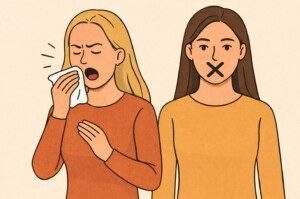
It’s funny how nearby people feel a need to say “bless you,” even when a stranger lets out a sneeze. But if someone coughs, even loudly, nobody says a word.
The irony is that a cough is much more likely than a sneeze to signal a medical condition; you’d think that a cougher would get a blessing rather than a sneezer. Just weird.
I’m sure there are neurotypical people who feel as I do about the nonsense of saying “bless you” when anyone – and I mean anyone – sneezes.
But I’m inclined to believe that my refusal is more common in autistic individuals, such as myself.
Autistics tend not to subscribe to or at least believe in societal norms. We tend to challenge pop culture and the behaviors that people mindlessly conduct as part of a herd mentality.
However, I’ve heard Autistics blessing sneezers. I myself may have been blessed when my deliberately muffled sneeze was heard by an Autistic.
I assume that when a person with Autism Spectrum blesses someone who sneezes, it’s done either automatically, like on autopilot (like it is for most neurotypicals), or, it’s done very consciously as part of their efforts to quietly blend in with “normal” people.
However, even the automatic reflex of saying “bless you” may be part of masking in the Autist: trying to do everything to appear neurotypical – and blessing sneezers definitely comes across as an NT thing to do.
- Autistic people tend to be logic oriented, and blessing someone who sneezes defies logic.
- Not only that, but blessing someone creates the possibility of a social connection that the Autistic wouldn’t want.
Some with ASD hardly speak to anyone at all, though they are highly verbal, and thus, saying “bless you” could set them up for feeling they must verbally interact if the sneezer then makes a comment after being blessed such as, “Thank you! Oh, I’ve been sneezing all day; something must be going around!”
Or, more simply, the Autistic just doesn’t want to have to say the obligatory “you’re welcome” when the sneezer thanks them for the blessing.
I do all I can to muffle my sneezes (which doctors say you shouldn’t do) to avoid getting blessed – not just by nearby people who know me but also by strangers. Like, how awkward.
I realize that some neurotypicals relish the blessings including from strangers. And these same people probably eagerly and loudly blurt the blessings.
But this shouldn’t be a societal expectation that runs across the board.
People shouldn’t be branded as odd or antisocial or lacking manners if they don’t bless a sneezer, especially if the sneezer is a stranger.
There are actually people who expect strangers to bless them. This is why you’ll note that the loudest sneezes are typically done near many people.
The loudest sneezes are typically done near many people.
I am not going to bless you if you sneeze. Deal.
I think it’s ridiculous and plus, I don’t want the potential interactive expectation that could arise.
If I want to chitchat with a stranger, I’ll already know, prior to any sneeze, that I want to do this, and will have likely already initiated small talk (Autistics are humans, not robots).
Often, when an autistic person initiates small talk, it’s motivated by a special interest.
For example, I complimented the employee at Home Depot’s returns area on her thick long ponytail.
We got to talking about her hair, and she told me when she was in third or fourth grade, her stepmother got tired of taking care of her coiled long hair and shaved her bald, sending her to school that way.
And when the hair grew back in, the coils never returned.
I assured her that the coils probably would’ve eventually turned straight anyways, and that her straight hair was still kickass (she’s middle age).
So that’s the kind of social interaction I might initiate – based on a sincere interest, not some social obligation to say “bless you” when someone’s nose wants to expel a foreign particle.