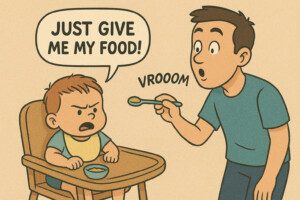
A humorous look at a strange phenomenon where dads hover a spoon of food before a hungry baby pretending it’s an airplane, when all the baby wants is to just get fed!
When one of my nieces was two and a half, I was present when my brother was feeding her as she sat hungry in her high chair.
He’d collect the food in a spoon, and rather than just bringing it to her eager mouth, he’d hang it high and make a “Whirrrrr” type of noise, wavering the spoon above her like it was an airplane that had just lost a wing.
He’d take his time descending it towards her mouth, then finally feed her.
At the time, I realized that I had seen this scenario elsewhere, but couldn’t place it.
But it bugged me, though I said nothing. The toddler seemed well-taken care of and responsibly tended to, so I figured, why bother bringing this up? Just bear with it.
He kept doing it. I couldn’t help but wonder if the toddler was growing frustrated and, in some internal toddler language, was thinking, “Quit the nonsense; just give me the food!”
There is no way I could ever believe that my brother’s feeding approach is unique.
I’m sure many dads – and even mothers – do this, especially if the baby or toddler is a boy.
It’s a fair question: If babies and toddlers were capable of verbally articulating, “Why do you keep doing that? Just put the spoon to my mouth!” would they?
A toddler could be making complete sentences and still not be able to verbally express disapproval to this approach. They might just hit their palms to the high chair as a way of saying, “Enough already! I’m hungry!”
The parent won’t interpret the palm-hitting as impatience or thinking the game needs to stop.
Instead they’ll just see it as normal toddler behavior when being fed.
My niece was not talking at this point, so for sure, had no way of speaking out against this ritual. But I’m sure she was smart enough to wonder why her father was behaving the way he was.
Babies and Toddlers Don’t Know You’re Imitating a Plane
There’s no way a toddler or baby could possibly know that the parent is pretending the spoon is an aircraft or that the “Whirrrr” sound coming from their mouths is supposed to be an engine.
An older child would surely know that the parent is make-believing the spoon is an airplane.
A child of even five might be able to figure this out. By the age of five, kids have already seen and heard plenty of planes in the sky, and could connect the dots that Dad is pretending the spoon is a plane to entertain the younger sibling.
But the baby or two-year-old being fed can’t possibly know what’s going on other than Dad is taking forever to get the food to my mouth.
A child this young wouldn’t be able to comprehend that the weird noise coming from the parent’s mouth is a mimic of a plane engine – even if that child has flown several times.
That’s because their very young brain takes things more literally than would, say, the five-year-old who can clearly conclude that Dad is imitating a plane engine (though poorly).
The baby also wouldn’t be capable of associating Dad’s air path with the spoon as a comparison to an aircraft.
Come on now, how would an 18-month-old brain, even 24 month, be able to do this, unless they’ve spent recent time near an airport watching planes land. And even then, it just doesn’t seem likely they’d be able to formulate an association.
After all, in their minds, a spoon of food and the hand and arm controlling it looks NOTHING like the planes they saw taking off last week.
All my niece, and many toddlers for that matter, was really familiar with was her playroom full of colorful toys and stuffed animals.
Entertainment for the Dad, Not the Baby
Seems to me that the make-believe is done for the parent’s benefit. My brother was entertaining himself more than his daughter, likely without realizing it.
Maybe it made him feel more interactive with his daughter; less like a robot just sitting there quietly raising a spoon in the shortest path possible to her mouth.
This may sound really great from that viewpoint.
But what about the viewpoint of a speechless baby or a toddler who can’t articulate, “I’m hungry; just give me the food!”?
Adult Being Slowly Fed
Imagine you’re somehow rendered incapable of feeding yourself. Maybe both arms were broken in a car accident, or for whatever reason, you just can’t lift your arms.
Someone must feed you – literally – raising a fork or spoon to your mouth.
This happens all the time in healthcare settings with adult patients who’ve suffered a stroke or other brain injury.
Imagine also that you’re hungry and you’re excited about the food that’s been placed before you.
Your caregiver – be they staff at the healthcare center, a home provider, a family member or a spouse – sits beside you and collects the buttery mashed potatoes in a spoon.
You’re watching the spoon, anticipating what’s going to happen next.
Instead, the spoon veers away from you, way into the air, as your caregiver makes swooping motions with it. You’re thinking, “WTF.” You then speak, “What are you doing?”
If your injury prevents speech, you grow extra frustrated and wonder what the devil is this person doing with your spoon.
The caretaker then goes, “Whirrrrr!” while they continue swooping the spoon around.
“What the fudge! GIVE ME MY FOOD!”
It’d be unthinkable for an adult to perform this game with another adult who can’t feed themselves. In fact, they wouldn’t even do it with any kid over five, perhaps.
Or maybe they would if the older child had a cognitive disability.
But even with a cognitive impairment – whether in a child or adult – this behavior needs to be challenged.
Would YOU want someone doing this if you needed to be fed by someone else? Heaven forbid if this is being done in nursing homes.
How do you normally feed yourself? Yes, some people take a while between mouthfuls, particularly if they’re trying to lose weight or in the midst of prolonged conversation.
But most people, especially when alone, don’t wait as long as it takes to pretend a spoon or fork is an airplane to repeatedly put food to their mouths.
I’ve fed babies when I babysat as a tween. I simply just fed them. No game playing. They were hungry.
I simply acted as their arm and hand and in a no-nonsense way raised the utensil to their mouths.
It never even occurred to me to pretend the utensil was a jet and try to make sounds like an aircraft engine. Good Lord.
You’d never want someone to delay each spoonful if you couldn’t feed yourself. Why would you impose this on a baby? Geez.