

Had I been a D1 college athlete in volleyball, my mental health would’ve relished the experience; I would’ve flourished as a libero and loved every moment.
D1 college athletes are the most privileged of college students. I question the idea that mental health issues run rampant among this population.
- Access to elite coaches, strength trainers, nutritionists and sports psychologists.
- Games televised on major networks (ESPN, CBS, etc.).
- Athletic scholarships or full or partial scholarships covering tuition, housing, meals and books.
- Some athletes receive stipends for personal expenses (known as “cost of attendance”).
- Early class course signups to accommodate training and game schedules.
- Access to academic advisors, personal tutors and athlete-only study centers.
- Special athlete dining halls with chef-prepared meals.
During my actual years at an NCAA Division I university, the position of libero had not yet been developed.
At 5’8, I would’ve been either a setter or outside hitter. I would’ve thrived on the “pressure.”
At 15 I entered my junior year at a new high school and joined the volleyball team as a JV player.
I stunk. But at the time, I had the insight to know that this strongly reflected 1) a bad coach, and 2) lack of experience; the other juniors had the preceding two years under their belt.
And yes, “Miss Young” was a terrible coach. A good coach doesn’t let practices go to pot just because it’s Friday.
But every Friday practice was a joke, in which the girls goofed off and horsed around, and she was perfectly okay with this.
I hated it and wanted training and drills instead.
By the end of senior year season, I was still afraid to fall to my knees for a dig.
I grew up in a home where academics – and only academics – was emphasized.
Thus, when I learned that a teammate would be spending one week at an away-camp for volleyball during the summer prior to my senior year, I didn’t even bother asking my parents if I could go too.
D1 University Volleyball Team

Freepik/viarprodesign
You’d think that D1 female athletes were a doomed bunch, what with the way some influencers and their followers speak of the mental health problems that these privileged athletes allegedly suffer from.
My take? ENVY for their lot in college. Oh God, I envied those athletes so much at my college.
Thanks to the daft coaching of Miss Young, whose full-time job had been guidance counselor for the high school, I never had a chance.
I lifted weights at the college gym usually at the same time the university’s volleyball team trained.
Their training gymnasium was literally across the corridor from the weightlifting area.
I was never able to watch them train longer than for several moments because it was just unbearable to watch these young women participate in a venue that I could only dream of, that I had felt cheated from attaining due to Miss Young’s inept coaching and my parents’ solitary emphasis on academics.
It was really a wrenching point with me, because I was never able to shake the belief that I could’ve been good enough to play on that D1 team – if only I’d had the right support system in place.
- To this day, I know I would’ve thrived during the kickass training drills and grueling workouts of D1 college athletics.
- I would’ve been like “Bring it ON, Coach!” instead of crying in the locker room during breaks over some perceived pressure.
The next best thing to being on a D1 volleyball team was that of playing in the college’s “Power Volleyball Club.”
I Began Getting Good at Volleyball
The club met twice a week from 11 pm to 1 am. It wasn’t long before I realized, Hey, I’m getting pretty good!
At some point, perhaps in my freshman year there, I suddenly found myself dropping to my knees for a dig.
I was stunned at how easy this was. I couldn’t believe I’d been scared to do it in high school. That damn coach.
I couldn’t understand why I had never been aggressive at the net during high school, because I had damn well learned this art – at a men’s height net – through this marvelous club.
Come senior year, I felt good enough to integrate with the college team.
But I figured it was just too late to approach the head coach — so I canned that idea.
Collage NON-Athletes and Mental Health
What was rancid for my mental health was that I’d been cheated during high school, and that I could never get those years back to play using the skills I had now as a college senior.
- It’s one thing when you simply lack the physicality to excel in volleyball – such as a medical condition.
- It’s a whole new ballgame when you damn well know that your poor high school skills were due to incompetent coaching.
- My improvement had nothing to do with a change in my body; I was about the same height my junior/senior year in high school as I was as a college senior.
Moved to Chicago, a Volleyball Mecca, Kept Getting Better
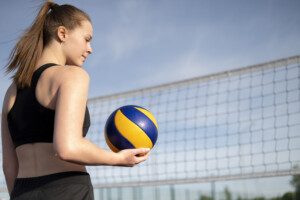
Freepik
For a long time I was averaging around 20 hours a week of pickup volleyball.
And wherever I played, the net was always at men’s height. And I got good. DAMN GOOD.
I eventually developed the skill to “stuff it,” that is, slam a spike through two pairs of men’s blocking hands.
I was quite aggressive with net play no matter how tall the opposing men were, and, to this day, can’t believe this never came to me during high school.
I became adept at setting from any location on the court, and this includes backwards.
I got very proficient at dinking, and placing third passes in empty spots, plus deftly passing rocket serves to setters.
I COULD EVEN DO PANCAKES!
Personality First, Skills Second
Nobody ever asked me to be on their team for leagues (AA, A and even BB).
In pickup volleyball, it was very common for people to actively recruit players for a league. I was never the recipient of this recruitment.
I wondered if there was more to this agonizing reality beyond just “volleyball is very political.”
I tried to get on teams, hung around a lot of really good players, “put myself out there” by being a continuous presence in Chicago’s volleyball community. But, no luck.
(Eventually I cracked the mystery: Decades later I’d be diagnosed with autism.)
One Saturday I was at a recruitment fair for leagues. For the first time since high school, I was at a woman’s net.
I put my hand to the top of the net and couldn’t believe how LOW it was.
I thought, “Was THIS the net I couldn’t play at to save my life in high school?! Holy shit.”
It really was a pitchfork in my side that I could have been this good in high school.
Nothing was different about my body post-college when compared to later high school. Yeah, I said that already.
The variable was TRAINING and OPPORTUNITY.
Why I Never Opted for Lower Level Team Play
One might argue that players in less competitive leagues might’ve welcomed me – because it’s a common belief that less bloodthirsty athletes are not clique-minded.
But why would I ever have wanted to play at a lower level? That would defeat the entire purpose of my volleyball endeavors.
However, every so often, I had ended up in a setting of mostly sub-B-level players.
They were actually more social than were the BB, A and AA players. This was problematic for me.
So whether I was surrounded by A/AA, B/BB or C/recreational, I was screwed.
Lower level players also goofed off in between plays, a throwback to the high school Friday nonsense.
Eventually I just quit this sport altogether, but will never stop wishing that I’d been on a D1 college volleyball team. And I’d be praising this experience, not slamming it like those influencers.
- My generation had grit.
- Today’s generation is as soft as warm butter.
Mental Health of Student-Athletes
Nearly ALL college students are under pressure — be they standout volleyball players or couch potatoes who’ve never set foot inside a gym.
Pressure can result from any number of variables — such as parents threatening to cut off tuition assistance if their child fails to maintain a 3.5 GPA.
Many non-athletes undergo tremendous pressure leading to depression and anxiety during college.
Many non-athletes undergo tremendous pressure leading to depression and anxiety during college.
This includes those who must work full-time to pay tuition because either their parents don’t have the money or, they do have the money but won’t contribute a single dime.
- Such students have the added burden on their mental health of keeping a job amid a full-time coarseload — which may be a grueling and thankless type of job in a hostile work environment.
- It’s mind blowing how there could exist rhetoric that those pampered student-athletes are put through a meat grinder.
Let’s not dismiss that many non-athlete college students across the U.S. struggle too — with adapting to dormitory life, handling coursework load, sticking to a rigid academic schedule, coping with being away from their family — just all sorts of dang things that can trample their mental health. And minus all those D1 athletic privileges!
On the campus I met many kinds of individuals: the physically disabled, those recovering from drug addiction or alcoholism, or from broken or abusive homes, or so needy they wore the same secondhand clothes all the time.
But these “common” students got through each day like warriors and didn’t go around bawling over every unexpected nuance or unforeseen curveball.
Back in the day, college students were more self-accountable and didn’t stick the label of “trauma” on every willy nilly thing in life to get out of being accountable.
OF NOTE: It can be enormously stressful knowing that your college education rides on an athletic scholarship; this can lead to performance anxiety if you keep missing shots.
But some D1 athletes are walk-ons, meaning, they don’t have a scholarship.
A fair question is: If a walk-on feels overwhelmed by it all, why not just walk away? There’ll always be long lines of students eager to take their place.
Why not just quit? Fear of parental wrath sounds like a good reason.
 Lorra Garrick is a former personal trainer certified by the American Council on Exercise. At Bally Total Fitness, where she was also a group fitness instructor, she trained clients of all ages for fat loss and maintaining it, muscle and strength building, fitness, and improved cardiovascular and overall health. She has a clinical diagnosis of ASD.
.