

Deltoid Muscle Keeps Twitching: Benign or Disease?

You’ve been lifting weights for some time now, but suddenly your deltoid muscle has begun twitching after workouts.
This has never happened before.
What’s even scarier is if you have not changed your shoulder routine. (more…)

How Often Does Non-Inflammatory Breast Cancer Cause Pain?

Brief sharp pains or ongoing duller pain in a breast will put the fear of cancer in many women.
Inflammatory breast cancer is much more associated with pain than is the “regular kind” of breast cancer (non-inflammatory).
How often does the more typical kind of breast cancer cause pain?
“Quite rarely; most are picked up by screening imaging, as lesions would need to be quite large or located near the chest wall or armpit to cause discomfort,” says Mark Levandovsky, MD, Founder and Medical Director of Preventive Medicine and Cancer Care. Dr. Levandovsky is a board certified internist and oncologist/hematologist in practice for 25+ years.
So if regular breast cancer “rarely” causes pain in a breast, this means that there are cases in which the patient experiences pain.
There are certainly women who, prior to their BC diagnosis, were having unexplained pain in the breast where the tumor was eventually found.
In inflammatory BC, the skin of the breast appears inflamed, reddish and may resemble the skin of an orange.
Pain from Non-Inflammatory Breast Cancer: Location Matters, What It Feels Like
“Pain would be a function of location,” says Dr. Levandovsky. “If closer to the armpit, it can be referred to the shoulder or arm/neck.”
If you’ve been having unexplained shoulder pain lately that is not triggered by exercise, other movement or position, and you’re due for your annual mammogram, you should schedule the mammogram.
If you’re a younger woman for whom screening mammograms are not recommended, at least have your gynecologist give you a clinical breast exam.
Various things can cause pain in the breast.
• A tight bra is one cause.
• A strained chest muscle is another.
• Sleeping on one’s side can also cause discomfort in that area.
• A pulled muscle in the back can refer pain to where it seems as though it’s originating in the breast.
These kinds of pain, with their benign causes, can range from very brief sharp sensations to a more medium level persistent pain to a dull ache.
But when breast cancer causes pain, what does this feel like?
Dr. Levandovsky says that it’s “throbbing or electricity-like (neuropathic, if [the tumor is] pushing on nerve endings). Similarly if close to the chest wall, although in that case it’d be more likely dull and deep.”
Now if the tumor is pressing on the nerve endings in the rib cage, Dr. Levandovsky says that the sensation could be that of “neuropathic (tingling) characteristics almost like shingles.
“Lesions [tumors] deep in the breast rarely cause pain, unless there’s some accidental trauma to the breast, such that bruising, dull or even sharp pain can persist longer than normally expected after an everyday bump”
“It has to do with architectural distortion of the breast (usually lesions >5cm), compromised lymphatic drainage and blood pooling.”
Speaking of getting bumped in the breast, even slugged there during a karate class, this will NOT increase the risk of cancer development.
A malignancy originates from a mutation in the DNA. Getting hit in the breast does not cause DNA to mutate.
The takeaway is that if your breasts appear normal and you do not feel any lumps, but you’ve been having pain in one lately, chances are that the cause is not related to cancer.
However, to play safe, you should have a doctor perform a clinical exam.

Dr. Levandovsky provides personalized care to health conscious individuals as well as cancer patients and survivors, focusing on an integration of genetic/molecular risk assessments, prevention, education, nutrition and psycho-oncology.
 Lorra Garrick has been covering medical, fitness and cybersecurity topics for many years, having written thousands of articles for print magazines and websites, including as a ghostwriter. She’s also a former ACE-certified personal trainer.
.
Top image: Shutterstock/tugol





Heartburn vs. Acid Reflux: Knowing the Difference

There IS a difference between “heartburn” and acid reflux.
Though these words are sometimes used interchangeably, they do have different meanings. (more…)

Sudden Nausea Before a Bowel Movement: Causes & Solutions

You aren’t supposed to have nausea before a bowel movement. This is not normal.
Though the fecal contents may be causing mechanical pressure resulting in the biting pain of “having to go really bad,” there still should not be any nausea with it.
“Nausea is a very nonspecific symptom which may or may not be indicative of an abnormality with the gastrointestinal tract,” says Dr. Neil Sengupta, MD, a general gastroenterologist and assistant professor at the University of Chicago, and GI Research Foundation Scholars Award Recipient.
“If the nausea is associated with abdominal cramping or pain, and if these symptoms are relieved after a bowel movement, this may be consistent with irritable bowel syndrome.
“This is particularly true if there is a significant alteration in bowel movements.”
- In IBS, sometimes there is just diarrhea for most bowel movements.
- In other patients it’s a problem of primarily constipation.
- Others suffer from diarrhea alternating with constipation.
Another Possible Culprit
There is another disorder that can cause nausea right before a bowel movement – and it is frequently misdiagnosed as IBS: microscopic colitis.
The symptoms overlap, but the treatments are different. IBS that has not responded to treatment is suspicious for microscopic colitis – unless that patient has already had a colonoscopy to rule out microscopic colitis.
Microscopic colitis is diagnosed only via a colonoscopy.
This benign inflammatory bowel disease can be persistent or have a come-and-go nature – sometimes flaring up only very occasionally in some patients.
This condition is characterized by sudden urges of diarrhea that come out of the blue.
This may be preceded by mild nausea (and often cramps) that vanish once the voiding of the messy diarrhea is complete.
Unlike IBS, the urgency of MC’s diarrhea can occur in the middle of the night, such as at 2 am or 5 am.
What to Do
If you have recurring nausea preceding your pooping, this isn’t always either IBS or MC.
Nor is it caused by diet, smoking, drinking, obesity or lack of exercise. In short, there is no quick fix like a change in diet or taking nutritional supplements.
Dr. Sengupta explains, “Nausea associated with upper abdominal discomfort may be consistent with pathology in the upper gastrointestinal tract, including conditions such as ulcer disease or dyspepsia [acid reflux].”
If the nausea occurs only rarely, and there are no other worrisome symptoms, you may have IBS, microscopic colitis (if you’re having a lot of watery painless diarrhea), or perhaps your stomach “isn’t agreeing” with something you ate earlier.
Whether you also have cramping, you should see a gastroenterologist to learn why you’re having the nausea.
If this article provided you with helpful information or reassurance, please consider supporting my work through Ko-fi. Donations help me continue writing detailed medical content that’s easy to understand.
 Dr. Sengupta’s research interests involve optimizing the care and outcomes of patients hospitalized with gastrointestinal bleeding. Specific interests include GERD, colon cancer screening and fatty liver disease.
Lorra Garrick has been covering medical, fitness and cybersecurity topics for many years, having written thousands of articles for print magazines and websites, including as a ghostwriter. She’s also a former ACE-certified personal trainer.
.
Top image: ©Lorra Garrick

How Long It Takes Colon Cancer to Go from Stage 1 to 4

Stage 1 colon cancer has a very good prognosis, and stage 4 is pretty much a death sentence.
How long does it take to go from stage 1 to stage 4?
“The process of advancing from polyps to cancer can take many years,” says Dr. Neil Sengupta, MD, a general gastroenterologist and assistant professor at the University of Chicago, and GI Research Foundation Scholars Award Recipient.
“Once a polyp has turned into early stage cancer, it can also be several years before the cancer advances further into stage 4 or metastatic disease,” continues Dr. Sengupta.
“However, there are certain medical conditions such as Lynch syndrome [a genetic condition that, though symptomless, increases the risk of certain cancers], where the process can be accelerated significantly.
“Typically speaking, colon cancer screening (via colonoscopy) can prevent colon cancer by removing polyps before they turn into early colon cancer.
“In addition, colonoscopy can detect cancers early (when they are early stage) and more amenable to curative treatment.”
• So why do about 140,000 U.S. people get diagnosed with this disease every year?
• And why do about 40,000 die from it?
The answer is simple:
About 30 percent of U.S. adults who should be getting screening colonoscopies are avoiding this procedure, says the Centers for Disease Control and Prevention.
This is why a stage 1 colon cancer tumor can seemingly zip in no time to stage 4 – though, as Dr. Sengupta mentioned, it typically takes years, barring Lynch syndrome.
Though millions of Americans do not have medical insurance and don’t want to pay out of pocket for the procedure, many more who are insured are just plain afraid of it.
The idea of someone “poking around in their gut” scares them.
They may also fear an accidental intestinal rupture by the instrument.
Serious complications of a colonoscopy are rare, and are no excuse for avoiding the procedure.
• For the typical adult, screening should begin at age 45 and then repeated every 10 years.
• For those at higher than average risk, a discussion with their doctor is warranted to determine screening frequency. Check out the data below.*
• Average age of diagnosis is 67.
• 6.2 percent of U.S. cases are in people under age 45.
• 15 percent are in people 45 to 54.
*NCI Surveillance, Epidemiology and End Results Program
No matter how healthy you feel or how well you take care of your body, you should get regular colon cancer screenings.
Then you won’t have to worry about how long it takes this killer to progress from stage 1 to stage 4. You are never too old for a colonoscopy.
Dr. Sengupta’s research interests involve optimizing the care and outcomes of patients hospitalized with gastrointestinal bleeding. Specific interests include GERD, colon cancer screening and fatty liver disease.
Lorra Garrick has been covering medical, fitness and cybersecurity topics for many years, having written thousands of articles for print magazines and websites, including as a ghostwriter. She’s also a former ACE-certified personal trainer.
.
Top image: Shutterstock/Syda Productions

Gurgling in Upper Stomach, Chest: Causes Include Cancer

If you’ve been hearing or feeling gurgling in your upper stomach or chest, cancer as a cause is not impossible.
But the odds of this being benign in nature are piled in your favor – even if you’re over 50.
We all have gurgling from time to time in our stomach, but usually it’s in the lower or middle portion.
Gurgling that’s higher up, especially at chest level, is more unusual and hence, more worrisome.
After all, the heart is in the chest. Could an imminent heart attack be causing gurgling noises in the chest? Or what about clogged coronary arteries?
The good news is that heart problems do not cause gurgling sounds.
Most Likely Causes of a Gurgling Feeling or Noise in the Upper Stomach or Chest
“Gurgling usually indicates movement of fluid and gas in the intestine,” says Dr. Neil Sengupta, MD, a general gastroenterologist and assistant professor at the University of Chicago, and and GI Research Foundation Scholars Award Recipient.
“This can occur in the beginning of the stomach or small bowel, which can manifest in the upper abdomen,” continues Dr. Sengupta. “Bowel sounds are normal.
“However, certain gastrointestinal diseases can be associated with exaggerated bowel sounds, particularly when the patient has additional symptoms such as diarrhea or significant abdominal pain or swelling.”
This includes irritable bowel syndrome and inflammatory bowel disease.
“Certain common conditions such as lactose intolerance can lead to exaggerated gurgling or bowel sounds,” adds Dr. Sengupta.
“Gurgling or sounds in the chest can also indicate movement of gas or fluid in the esophagus to the stomach or vice versa. Some element of this can be normal.”
Serious Causes of Gurgling in the Upper Stomach or Chest Area
“However, when this is associated with significant pain or heartburn, this can indicate abnormality or pathology in the esophagus.”
There are three serious conditions that are potentially involved with this symptom.
• Esophageal (peptic) ulcer – usually caused by an infection but could also be caused by acid reflux.
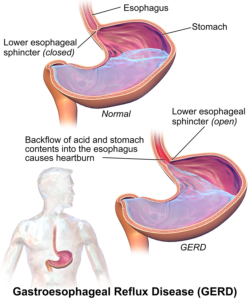
Source: BruceBlaus
• Barrett’s esophagus – caused by acid reflux, this is a risk factor for esophageal cancer.
• Esophageal cancer – other risk factors include smoking, drinking, obesity, frequent intake of hot beverages, and low intake of fruits and vegetables.
The first two of these serious conditions are more likely. An ulcer would also usually cause bloating, nausea/vomiting, appetite suppression, pain when swallowing and a dry cough.
Barrett’s esophagus would typically cause frequent heartburn, trouble swallowing food and (not as commonly) chest pain.
Esophageal Cancer
- Symptoms are difficulty swallowing, heartburn, chest pain or pressure, coughing, hoarseness and unintentional weight loss.
- Mortality rate is exceptionally high.
- Cancer of the esophagus is uncommon, with about 17,200 new diagnoses every year in the U.S., according to the National Cancer Institute Surveillance, Epidemiology and End Results Program.
- Average age at diagnosis is 68, and incidence rises sharply after age 55.
- Only 12.3 percent of diagnoses are in people 35 to 54.
With all of that said, it should be clear that hearing gurgling sounds or feeling this sensation coming from your chest or upper stomach – in the absence of worrisome symptoms – very most likely means just run-of-the-mill functions of your digestive tract.
Dr. Sengupta’s research interests involve optimizing the care and outcomes of patients hospitalized with gastrointestinal bleeding. Specific interests include GERD, colon cancer screening and fatty liver disease.
Lorra Garrick has been covering medical, fitness and cybersecurity topics for many years, having written thousands of articles for print magazines and websites, including as a ghostwriter. She’s also a former ACE-certified personal trainer.
.
Top image: Shutterstock/Andrey_Popov

Discomfort Behind Breast when Swallowing: Cancer May Be Cause

Discomfort behind the breast upon swallowing has different possible causes including cancer – but not breast cancer.
Furthermore, a heart problem may be a possible cause that occurs to the person experiencing pain in this area. (more…)

Can Breast Cancer Cause a Tiny Hard Red Lump on the Skin?











Usually, a lump caused by breast cancer cannot be seen simply by looking at one’s breasts.
But it’s not impossible for a tiny hard red lump on the skin over one’s breast to be caused by breast cancer. (more…)