

Four minutes a day of daily exercise can actually improve health in older adults — when done in a way that brings benefits to an aging body.
A study led by Penn State College of Medicine found that just four minutes of daily exercise can improve physical abilities in people 65+.
Published in PLOS One, the research found measurable improvements after 12 weeks.
Falls are also a major concern. The Centers for Disease Control and Prevention identifies unintentional injuries, including falls, as a leading cause of death among adults aged 65 and older.
These injuries are linked to a decline in fitness, health, mobility and balance.
However, many older adults assume they need lengthy, demanding workouts to make a difference.
But the paper says that even a few repetitions of an exercise can produce substantial improvements when performed regularly.
It’s important to think about the activities they want to continue doing as they age and train to maintain those abilities. An example would be that of getting up from a chair without a struggle.
Short Exercise Sessions
Training against resistance will improve muscle strength within a few months — and even sooner, depending on the individual and the exercise.
Very brief sessions can make a difference. The researchers had already explored this approach in an earlier study called FAST-1.
Twenty-four older adults performed 30 seconds of squats daily. You need not go down all the way (deep) to do a squat. See below.
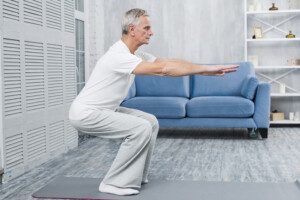
Bodyweight squat. Credit: Freepik
After six months, participants had improved their ability to perform squats.
Other research has also found that a few weekly exercise sessions can produce strength gains similar to those from longer workouts.
These results encouraged the researchers to test an even shorter daily routine.
How the Four-Minute Exercise Program Worked
The new study, called FAST-2, included 97 adults with an average age of 74.
Participants were randomly assigned to either an exercise group or a control group that received no intervention.
Before the study, participants reported exercising only about 18 minutes per week on average.
This was well below the recommendation of 150 minutes of moderate activity or 75 minutes of vigorous activity each week.
The FAST-2 program included four exercises:
-
Pushups to strengthen the upper body. Pushups can be done against a kitchen countertop, or with knees on the floor.
-
Chair stands to work the legs. This means rising up and down out of a chair.
-
Two-arm rows using resistance to strengthen the upper body.
-
Stair stepping to improve leg strength and functional mobility.
Each movement lasted 30 seconds, followed by 30 seconds of rest. Completing all four exercises took just four minutes.
Participants received resistance bands, an adjustable stepper and written instructions.
Researchers also provided easier versions of the exercises for lower-conditioned people.
For example, those who struggled with chair stands could use their hands on their knees for support.
As participants became stronger, they were encouraged to increase the difficulty of their exercises. This could mean upgrading a countertop pushup to a floor pushup with knees on the floor.
It could also mean doing the stair stepping a little faster, or adjusting it to a higher height.
How Researchers Measured Strength and Balance
Researchers assessed participants at the beginning, middle and end of the 12-week study.
They measured how many times participants could stand from a chair in 30 seconds, how long they could balance on one leg and how quickly they could complete a sit-to-stand assessment.
These tests reflect physical abilities people use every day. They can also help identify potential mobility problems, fall risk and the need for additional care.
Four Minutes a Day Produced Measurable Results
After 12 weeks, participants following the FAST-2 program showed significant improvements in physical performance.
They achieved the following gains:
-
4.2 additional chair stands in 30 seconds.
-
3.6 more seconds of standing balance on one leg.
-
A 2.3-second reduction in the time needed to complete the sit-to-stand assessment.
Getting out of a chair, climbing stairs and walking all depend on the same physical abilities measured in the study.
Don’t Make this Mistake
Many people assume that they already have a built-in exercise regiment in the form of housework.
At one point there was something of a craze going around, claiming that housework is the only exercise anyone, of any age, ever needed.
Older people have been doing housework for decades — yet those who have not been dedicating any time to structured workouts are the ones with the most declines in basic physical abilities — such as getting in and out of cars, getting up from low or deep chairs, going up and down a single flight of stairs, walking efficiently on uneven ground, and other daily activities that they had once taken for granted.

Lorra Garrick is a former personal trainer certified by the American Council on Exercise. At Bally Total Fitness, where she was also a group fitness instructor, she trained clients of all ages and abilities for fat loss and maintaining it, muscle and strength building, fitness, and improved cardiovascular and overall health.
Top image: Magnific
Related Posts

Falls in People 65+: Harbinger for Doom in the Near Future

How Fast Should Senior Age People Walk Outdoors for Fitness?

Should a Weak Elderly Person Lift Weights or Just Walk?

Safety Guidelines for Seniors and Strength Training Equipment

Best Strength Training Exercises for People over 90