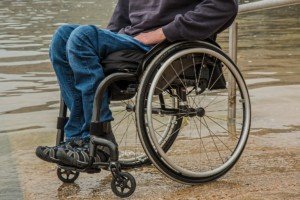
One’s spinal cord is severed from injury, paralyzing and numbing him from that point down.
When it’s reattached he’s still paralyzed and numb. Why?
A barefoot giant is standing still. He is so tall that a standard rocket, in vertical position, reaches up only to the top of his big toe.
That rocket is launched full force from its position at his foot — at the exact moment a big feather brushes his toe and triggers an electro-chemical impulse.
By the time the nerve signal reaches his brain where it’ll be interpreted as a tickling, the rocket will have only reached the top of his ankle.
This is an analogy of how fast nerve impulses travel in our body.
Many people with spinal cord injuries lose the ability to move their arms or legs, even though the nerves in those limbs are still healthy and the brain itself is working normally.
The problem is communication. Damage to the spinal cord blocks signals traveling between the brain and the body.
The brain sends the message to move, but it never reaches the muscles.
Speed of Those Signals
Motor nerve impulses in adults travel 165-395 feet per second. The distance from the motor cortex in the brain to a leg muscle is about three to five feet.
At those speeds, the signal itself takes about 10-30 milliseconds to reach the muscle.
The longer end of that time range is the shorter end of the time lapse between when a vehicle’s impact sensor detects rapid deceleration from a collision, to full inflation of an airbag.
If you’ve ever seen in real-time a test dummy crash showing airbag deployment, the human eye can’t detect the deployment; only the end result — it’s like the airbag magically appears out of thin air, as though blinked there by a genie. That’s 30-50 milliseconds.
So that all puts into context just how fast nerve impulses travel from brain to muscle or from skin sensory cell to brain.
But we left out a part: The intention to move that muscle. The time lapse between intention and when the impulse leaves the motor cortex is 50 to 100 milliseconds.
The whole entire process — intention to flex your foot while seated to the actual flexion is 150-200 milliseconds!
Repairing a Damaged Spinal Cord
Researchers for decades have been looking for ways to restore that communication without having to repair the spinal cord directly.
Why can’t simply reattaching the severed ends allow nerve impulse signals to get through? Well, imagine snipping your phone charger in half. The signal will be lost.
Now tape the cut ends back together — press the ends into each other as tightly as you can — then tape them.
It still won’t work, because even though the broken ends are physically touching each other, those ends are still damaged.
Using Brain Signals to Bypass the Injury
A study published in APL Bioengineering (2026) explored whether brain signals could be captured and redirected to help restore movement.
The focus was on electroencephalography, or EEG, a noninvasive method of recording brain activity using electrodes placed on the scalp.
When a person tries to move a paralyzed limb, the brain still produces electrical signals linked to that movement.
If those signals can be detected and interpreted correctly, they could potentially be sent to a spinal cord stimulator that activates the nerves controlling the limb.
This was actually the storyline in an episode of “The Six Million Dollar Man” (1970s TV series) called “The Bionic Boy.”
The teen’s spinal cord had been severed; the tiny stimulator was implanted at the point of transection, making signals from his brain “jump” to the other side of his spinal cord and down to his legs.
But the result was superhuman strength, not just restoration of normal movement. Many earlier studies relied on surgically implanted electrodes to record movement signals directly from the brain.
These systems have shown promising results, but they come with serious drawbacks. Implants require surgery and carry risks such as infection and long-term complications.
The researchers wanted to know whether EEG could offer a safer alternative.
EEG systems are worn like caps and don’t involve surgery, making them far less invasive even though they can look complicated at first glance.
The Limits of Reading the Brain from the Scalp
Because the electrodes sit on the surface of the head, they have trouble picking up signals that come from deeper areas of the brain.
This makes a difference depending on the type of movement. Signals controlling arm and hand movements come from areas closer to the outer surface of the brain and are easier to detect.
Signals for leg and foot movements come from more central brain regions, which makes them harder to read using EEG.
How Machine Learning Helps Decode Intent
To make sense of the EEG data, the research team used a machine learning algorithm designed to handle small and complex datasets.
During the study, patients wore EEG caps while attempting simple movements. The system recorded their brain activity and learned to sort the signals into categories.
The algorithm was able to tell when patients were trying to move versus when they were resting.
However, it struggled to reliably distinguish between different types of movements.
What Needs to Improve Next
The researchers believe the system can get better with further refinement. Their goal is to train the algorithm to recognize specific actions, such as standing up, walking or climbing stairs.
They also want to explore how these decoded brain signals could be used in real-world rehabilitation, including triggering implanted spinal stimulators.
Research from numerous teams all over is always ongoing regarding finding an effective cure for mobility impairment or paralysis from spinal cord injury.
If you’ve ever heard about a person with a spinal cord injury, initially paralyzed, who regained the ability to walk, that person’s spinal cord had not been severed or transected.
There may be cases where the initial diagnosis is “severed,” but then it turns out that the separation is incomplete, or, the cord has been compressed.
Rehab and healing can allow signals to get through eventually in these cases. Bu nobody with complete anatomical transection has ever regained mobility. Read the full study.