
A layer of protection against eloping autistic kids or adults is to train your body to RUN, to bolt after that individual.
This skill is essential in managing autistic family members who are at risk of “taking off” or “running off.” I’m on the Autism Spectrum, and I’m a former personal trainer.
So I have some very crucial information to give any parent or provider who’s worried about elopement.
I was inspired to write this after reading yet another article about an autistic individual (this time an adult) who has gotten away twice within about a month.
The first time, his mother reported that he “took off” while they were in a parking lot.
This suggests she was not able to bolt after him. Since it occurred in a parking lot where they were apparently headed towards her car, she would’ve easily seen him run off.
After a month he was found, but then several days later, the 29-year-old disappeared again – but the reports are not clear on the circumstances, e.g., was he unattended; did it happen in a parking lot again?
Since this man is 29, his mother is middle age.
You might be thinking how unreasonable it is to expect a woman who’s likely in her mid-50s (she could be in her late 40s; she could be in her 60s) to dash after a much younger male.
However, there are several variables to consider.
Body Weight of Parent or Provider
In this particular case, the body weight of mom is not an impediment to speed; I’ve seen her image. Her son, as well, has a normal body weight. I point weight out because the ability to move fast is hampered by significant body weight.
So it seems as though we can pit gender and age against each other and claim that no matter what, mom will never be able to catch her son, who is semi-verbal and apparently (news reports give conflicting information) has high support needs.
But wait now – there’s something that many people who are detached from the autism community may not know: Autistic individuals with high support needs are far more likely to be in poor physical condition than are their same-age, low support needs autistic counterparts, and of course, as well as their non-autistic counterparts.
Not only have I observed this since my diagnosis of ASD in 2022, but it’s been documented in medical literature.
Though it’s a well-established fact that adults with profound or severe autism, even a lower-support-needs form of autism, are much more likely to be obese when compared to the general population – the issue of fitness isn’t limited to obesity.
In fact, it stands to reason that autistic children and adults with significant obesity, even more moderate obesity, are less likely to literally run, let alone sprint, away from their provider.
Now, they may elope secretly, for sure, when nobody is watching them, such as overnight and sneaking out of the house.
But there’s more to this yet. How do I say what I’m about to say in a gracious way?
Well, I’ll be blunt: Very few autistic adults with very substantial support needs can deftly run.
Vast Majority of Autistic Adults with High Support Needs Have Low Level of Fitness
Many studies report that autistic adults commonly have low levels of physical fitness and routinely fail to meet recommended activity or cardiorespiratory fitness targets (Bishop et al, Heliyon, 2022; Cha et al, Journal of Exercise Rehabilitation, 2020).
Systematic reviews and intervention studies also show consistent fitness deficits in autistic populations (Sowa et al, Research in Autism Spectrum Disorders, 2012).
Poor fitness is evident by visible body composition, and this applies to even those individuals who are not, by scale weight, overweight. They have a high ratio of body fat to lean muscle mass despite not looking “thick” or “plump.”
Many have a sluggish or awkward gait, which wouldn’t seem to correlate to the ability to take off in a mad-dash.
I’ve been to many events, since my autism diagnosis, where I’ve gotten to know quite a few adults with ASD of very substantial support needs (Level 3).
Nearly every single one of them appeared incapable of swiftly bolting and especially maintaining fast speed for long enough to disappear from sight.
Now before you say, “You can’t judge a person’s fitness by their visible body composition,” we need to understand that even if this were true (it’s totally not) – this begs the $$$ question:
If they’re able to run mad fast – where did they acquire this ability?
It’s a fact, and a very unfortunate one, that FEW profoundly and severely autistic adults participate in fitness programs where running is part of the routine.
If you check out the handful of YouTubes showcasing fitness programs for autistic adults, you’ll clearly see that severely autistic participants don’t ambulate with speed and agility.
Perhaps this 29-year-old is an anomaly and, for all we know, has been using a treadmill at home for years.
But as a logical thinker, my brain is trained on what’s far more likely: That he’s a slow and somewhat clumsy or off-balance runner – and that his mother is too deconditioned to give chase.
I’m 62 and I can give chase. Can I chase down a non-autistic 30-year-old man whose workout regimen includes fast running? NO.
But I can accelerate fast enough to keep up with the average autistic male adult and follow him to his destination – because, again, this population receives little to no encouragement to run for fitness.
To keep swift, I do HIIT: high intensity interval training, on a treadmill, which mixes brief periods of speed with longer but still brief segments of recovery pacing. I also do HIIT outside at night in empty parking lots and streets.
What also carries over to speed is jumping and stepping exercise, which I do an assortment of, at home: no gym required.
Hard work begets a fit body. Weight management and avoiding smoking will also factor in.
There Are Exceptions
I know a nonverbal, intellectually disabled young autistic man who could probably cover 50 meters in six seconds. He has exquisite body composition and climbs at an indoor gym (with supervision).
He didn’t get his fit body out of thin air. He works for it using weights – with prompts and supervision.
I don’t know if his workout regimen includes running, but just based on his slender buff body and speedy climbing of easy routes, he could probably burst into a fast run and maintain it for a hundred meters.
I worked briefly with a nonverbal 17-year-old with severe ASD who can bound from one end of an indoor trampoline park to the other at lightning speed. If he wanted to, he could sprint outdoors easily.
But these cases are extreme exceptions.
We have to get away from assuming that the eloping Autist is a gifted sprinter and instead focus on the parents’ lack of running skill due to never running for exercise.
Medical Conditions that Prevent Efficient Running
Now of course, some parents of elopement-prone autistic kids and adults have medical conditions that prevent being able to bolt like a jaguar after their child.
- But what about those who don’t have knee osteoarthritis or peripheral vascular disease?
- What about those who aren’t morbidly obese?
- What about younger parents (whose autistic kids are teens or elementary age) without medical conditions that would hamper running ability?
I have actually read of parents claiming they can barely keep up with their elementary age autistic child when they “take off.”
I wonder how well these parents would do on a treadmill set to 8 mph, which really isn’t that fast – but to an out of shape person, it’ll knock them out within 10 seconds.
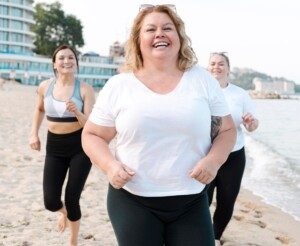
Parents of autistic kids and adults NEED TO TRAIN TO RUN.
When is it too late to train?
Freepik
If someone is 50 and has always been sedentary, never any sports, nothing at all, they’ll likely have a hard time learning to run fast enough to catch an eloping autistic individual – even if that individual moves awkwardly and isn’t all that fast.
When I was a trainer I had clients who were fairly new to exercise and even the younger ones struggled with a 7 mph run on a treadmill.
I had one woman, in her 20s and of normal weight, who struggled to run around the gym’s track. She had an awkward gait and just couldn’t pick up speed (she was neurotypical).
So yes, not everyone is born to run like The Flash, but — diligent training goes a tremendously long way, especially when your motivation is to always be faster than your autistic child!
So if you’re older, it’s NOT too late to improve your running skills.
What can you do right now to be a more efficient chaser?
- If you smoke, quit.
- Buy running shoes (no, they don’t have to be Hoka$ or Nike Vaporfly)
- And damn, just start running.
I’m not talking long distance; I’m talking brief but swift dashes. That’s how to get started.
You can do this from one room in your home to the other.
You can do it in your yard. You can do it from your front door to your mailbox – collect the mail and get your breath – then race back to the door.
Pretend a skunk is chasing you; do whatever it takes to get hopping fast.
Use any moment that comes your way – and never mind what strangers might think of some middle age (or younger) person suddenly tearing across Walmart’s parking lot.
Wear athletic shoes when you’re conducting errands in the community so that you can practice some short but speedy runs when the moment arises.
If you’re already a gym member, then do dashes or wind sprints in the basketball court if one is available.
Or use their parking lot if you don’t care for a treadmill.
If you use a treadmill, don’t hold on, because if you ever must give chase to your autistic child – you’ll have nothing to hold onto!
You may want to consider hiring a trainer, but even if you can’t afford this, you can still apply the other protocols mentioned here to vastly improve your ability to give chase — or at least maintain a slower jog for long enough to see where your child went.
If your autistic child is still quite young, don’t put off training your body to run hard.
The time to start is NOW, regardless of your age or your child’s age.