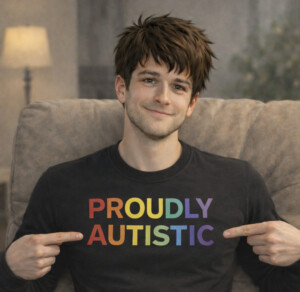
It’s quite possible that the highest functioning of Autistics have it the roughest.
That’s because typically, we’re seen as just plain weird, strange, odd, rude or in some other negative light.
But someone with more pronounced Autism Spectrum Disorder will be immediately viewed as disabled – rather than being thoughtless, lacking empathy, too blunt or having some sort of personality disorder.
Over more recent years there’s been a push to bring acceptance to autism rather than awareness.
This is rooted in the premise that autism isn’t something to be fixed or cured, that autistic people aren’t broken, defective or diseased.
Rather, ASD is a different way of thinking and seeing the world; it’s a neurotype.
Those who have kids with severe and especially profound autism are the most likely to disagree that autism isn’t something to be cured or eradicated from the gene pool.
But there’s a big chunk of Autistics out there who are the so-called high functioning or Level 1.
Among Autistics who are Level 1 (minimal support needs), there’s actually a subspectrum.
Some Autistics who are “high functioning” may still need a lot of assistance, despite attending college or holding a full-time job.
Others who are high functioning or Level 1 may have always been self-sufficient, independent and with a take-charge identity – but also with a history of floundering socially, never being able to navigate social rules and expectations – along with sensory issues and other features of autism that affect quality of life.
Autistic people can be in any line of work, from hustling shopping carts at Walmart to combat medic to aerospace engineer to police officer to master chef to high school science teacher to architect to nurse to lawyer to psychiatrist.
People with “milder forms” of autism face challenges in a way that’s much greater than does the woman who can’t speak and must have her hand held in public.
Level 1 Autistics are expected to be normal. Those with high support needs aren’t given this scrutiny.
The barely verbal teen boy, who’s perpetually swinging around a shoe lace and making odd gestures, is going to get more patience and understanding than is the mildly autistic teen whom the whole class has no idea is autistic and instead just thinks he’s an oddball.
The semi-verbal student may get invites to join typical kids at their lunch table, while the “weirdo” quickly snarfs down his lunch in a bathroom stall because nobody will eat lunch with him.
Life can be quite hard for someone who doesn’t “look autistic enough” to be autistic, but is atypical enough to be perceived as odd, strange and rude. Let’s normalize ALL autism!
Autism Acceptance: Normalizing ALL Autism
In the end, autism acceptance can’t just apply to the versions of autism that are easiest for people to recognize.
When someone has very visible support needs, most people instinctively understand that accommodations and patience are needed.
But when someone is mildly autistic — able to speak fluently, hold a job or live independently — the struggles are often invisible.
The same traits that would be understood as part of a disability in one person get labeled as “rude,” “awkward” or “antisocial” in another.
That double standard leaves a lot of autistic people stuck in the middle: struggling with real neurological differences while being treated as if they’re simply choosing to behave badly.
Real acceptance means widening the lens. It means recognizing that autism doesn’t come in one obvious package and that support, patience and understanding shouldn’t depend on how visible someone’s challenges are.
While some autistic people need round-the-clock care, others just need a little extra patience in conversations, social settings or sensory-heavy environments.
But all of it is autism. If we’re serious about inclusion, then the goal shouldn’t be accepting only the forms that are easiest to understand.
It should be accepting the whole spectrum — even the parts that don’t look the way people expect.