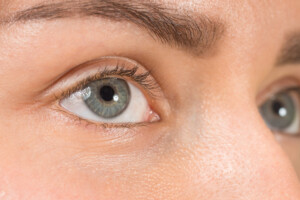
The autistic man doesn’t look at the letter board as he allegedly spells. Mom explains this away by saying he needs to look elsewhere to maintain focus.
One of the fiercest criticisms of S2C or RPM (rapid prompting method) is that the speller rarely keeps his eyes on the letter board.
In standard keyboard touch typing, the user (such as myself) never has to look at the keys. That’s why it’s called touch typing. I know which letters to tap strictly by feel.
Keyboard letters are elevated enough that the user can feel where they are, similar to how a pianist can play without looking at the keys.
However, a “letter board” that’s used for S2C or RPM is perfectly flat.
There is no way to feel where any letter is. Instead, the user must keep their eyes trained smack on that board the entire time they’re spelling.
The human eye is not designed for detailed peripheral vision, even at a slight angle.
I recently read yet another story of an autistic man who communicates through a letter board, and like all the rest of these questionable stories, he possesses the verbiage skills of a professional journalist or someone with a master’s degree in English.
In these stories, the speller never has average or mediocre word useage. The words that are supposedly spelled out by these individuals — every single time — have the composition of someone with very advanced literary skills.
And, as always, someone holds the letter board before them, which opens a wide door to the possibility of the ideomotor effect: The assistant subconsciously moves the board so that the user taps the letter that the assistant thinks they’re about to tap.
It also kicks open the door to a deliberate hoax, in which the assistant (usually a parent) willfully positions the letter board so that the user’s finger or stylus strikes the letter that the aide wants.
Clever Explanation for Son’s Wandering Eyes During S2C and RPM
So this particular individual’s mother has devised an ingenious explanation for why her son never keeps his eyes on the letter board, which she holds before him (but conveniently doesn’t explain why the board can’t be fastened to a small support prop to replicate the positioning or why it can’t just be set on a table or his own lap without her touching it).
The mom wants people to believe that her son spells out the complex verbiage, and that all she does is hold the board.
In one of his messages, he states that he can’t keep his eyes on the board and instead must look at two computer screens beside him, alternating his eyes between those screens, the board and even elsewhere.
His reason is because otherwise, to keep his eyes on the letter board, he’d become overwhelmed and wouldn’t be able to communicate.
This is not believable because, as already explained, the human eye can’t process details via peripheral vision.
And tapping letters on a board held before oneself requires detailed visual processing that can’t possibly be attained while looking even 10 degrees away.
If you’re a “hunt and peck” typist, give it a try: Hunt and peck out a simple sentence while keeping your eyes fixed just 10 degrees off to the side – even a few degrees.
If your excuse for failing to see the letters is because they’re not as big as those on a letter board, then create a letter board and give it a try. Put a dab of ketchup on your index finger so you know where you tapped. Good luck spelling even “C-A-T.”
Also, in a photo that accompanies the story, the mom his holding a small letter board, not the typical big ones we’ve seen. So how in the devil is he seeing the letters while looking away?
The real speller in this man’s case is his mother, whose explanation for the wandering eyes is actually rather crafty. I can see how it can get past some readers of her son’s story.
But it doesn’t get past ME. And I’m sure, many other readers, who’d be thinking, “Yeah, right; nice try, Mom. Not buying it.”
Other Suspicious Features of Her Son’s Story
So Mom says her son wrote a novel. The article about this was written by a journalist. It’s a very lengthy, hyper-detailed article.
Yet for some reason, the author left out important details, such as why the mother holds the letter board instead of it being on his lap or he himself holding it, and why she had to be alongside him for every minute during his college classes (he has a bachelor’s and master’s degree).
Let’s assume that this guy is actually spelling out such incredibly advanced, eloquent narrative, ripe with amazing similes, metaphors and other complex syntax.
If his brain has this capacity, why would he need his mother to sit beside him in all his college classes (where she also said he’d have his two screens going to prevent over-stimulation while simultaneously listening to professors).
Spoken language is not necessary to take a college class. At my college there were students with cerebral palsy who couldn’t utter a single word. Two immediately come to mind: Patti and Jimmy.
An article about Patti in the university’s newspaper said she wanted to be a writer. She typed on a standard typewriter to communicate, using a stylus that was attached to a special headband – as she had no control of her fingers.
Jimmy was working on his master’s in biochemistry. He’d often be seen scooting around on campus in his electric wheelchair. He used a rudimentary device that sounded out basic words (this was many years ago before the development of today’s sophisticated AAC devices).
Neither Patti nor Jimmy had aides with them in their classes.
So why was this Autistic man, fully able-bodied, needing his mother in every single class?
Something tells me SHE’S the one who got the bachelor’s and master’s.
This Just Isn’t Believable
Mom is a college English graduate plus worked for many years as a story analyst in the film industry.
Holy moley off the bat, this answers the question of where her son’s ultra-advanced narrative comes from.
While the story’s author was interviewing, he was seated across from Mom and her son who were sitting side by side.
Thus, the author was not able to see where the man was tapping. Instead, all he could do was listen to his mother recite what he was supposedly spelling.
And the quoted recitations — quite a few of them in large chunks — were grand essay style. It just didn’t ring true — not even for an autistic person — to answer a reporter’s questions with such overly formal diction.
It just came across as so … promotional – because this man is being touted as the first “nonspeaking” autistic person to author a published novel. (He actually has speech, but very limited and mostly in the form of repeating words from the TV.)
Mom said that when he was three, she took him to see a woman who claimed she taught her nonverbal son to type.
Why would a woman feel this desperate when her son was only three?
When my nephew was three, he still wasn’t talking. His mother enrolled him in speech therapy. I mean, come on, bringing a three-year-old to a stranger to see if he could learn to type? Not sure if I should believe that. However, anything’s possible, right?
The mom claims the mother of the typing son wrote letters on pieces of paper and placed them, jumbled up, before the three-year-old. The typing son’s mom then told the preschooler to spell “cat.” He lined up the correct pieces of paper.
You might be wondering where this three-year-old learned to spell (the article conveniently omits this).
But the thing that jumped out at me was that a woman with an English degree and 20 years’ experience as a story analyst didn’t think to try this experiment with her child, and instead, brought the child to a stranger to provide ideas.
Seems to me that anyone with an English degree would easily think to put Scrabble tiles before their preschooler for this experiment, or at least print letters on pieces of paper off a notepad.
How could this idea escape an English graduate who’s a story analyst?
I’ll tell you how: Because much of this story comes across as made up. It seems to be all a guise to promote her son’s novel, which I believe SHE authored, not him.
Why didn’t the reporter sit at the man’s side to watch where he “tapped”?
Why didn’t the reporter sit at the man’s side to watch where he “tapped”?
If I had been the interviewer, I would’ve mandated sitting right beside the young man to watch which letters he pokes at – or no story, Mom.
I’m still waiting for that opportunity to interview a nonverbal or minimally speaking autistic individual, to see with my very own eyes, that they’re poking at letters to form sentences — without anyone holding the damn board.
Now of course, I truly believe that some nonverbal or semi-verbal Autistics actually do this independently, but their verbiage is simple, may even be only phrases such as “WANT PIZZA” or “WHERE IS DAD.”
But paragraph after paragraph of literary affectation? I need to witness this to believe it, rather than taking as the truth from whatever comes out of the parent’s “reading” mouth from across the table.
Anyone who can spew out reams and reams of ornate narrative via letter board would, you’d think, be capable of learning to hunt-peck type to a computer screen, which would take less time.
The American Speech-Language-Hearing Association does not recognize S2C, RPM or FC as proven forms of independent communication. Clinical studies have failed to validate these modes.
I’ve provided more than enough information in this article for you to smoke out the identities of mother and son online. You be the judge.