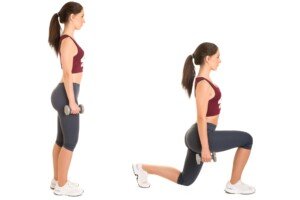
There’s no reason a morbidly obese woman should be doing walking dumbbell lunges.
I saw a significantly overweight woman struggling with dumbbell walking lunges. Why was she doing this exercise? It was probably because she thought it would help her lose weight.
Otherwise, why put herself through all the struggle? Her back was rounded and she was hunched over; nowhere near the upright spine one is supposed to have with this exercise.
Due to the obesity (she appeared to be at least 100 pounds overweight), she was not able to lower very much with each step.
She also appeared to be unstable and wobbly.
The dumbbells were about the size of 20-pounders; I wasn’t close enough to see for sure, but they definitely weren’t little dumbbells.
Even if weight loss was the last thing on her mind; even if her only goal was to just get fitter – she should not be doing an exercise for which bad form and instability could lead to a pulled low back muscle or strain to the knee joints.
That she couldn’t even lower that much was very telling: She should not be doing walking lunges, let alone with weights.
There are so many other ways to build lean muscle, get fitter and stronger, and rev up the metabolism as far as leg workouts.
Doesn’t practice make perfect?
We all have to begin somewhere, of course. But when your form is really bad with walking lunges, you shouldn’t be holding dumbbells or any weights at all.
At her size, the most she should ever do, when it comes to the walking lunge, is bodyweight-only – no dumbbells, not even five-pounders.
She already has enough weight naturally to provide resistance. She should work on establishing proper, safe form and range of motion before she even thinks of holding dumbbells.
However, due to the substantial overweight, achieving correct form is probably beyond her reach.
Thus, she should avoid this exercise altogether and focus on more practical movements such as the leg press and bodyweight-only squats — whatever range of motion she can do with correct form, as long as her thighs don’t go past parallel to the floor.
In fact, I had also seen her doing squats — holding a weight to her chest, but she had way too much of a forward lean as she struggled to lower to parallel. Too much forward lean can strain the lower back.
Too much forward lean can strain the lower back.
If she’s to do any squats, they should be minus weight, with the goal on proper form, avoiding the excessive forward lean.
This can be accomplished with practice and lightly placing a hand on something for support at first.
Replacement Exercises for the Walking Dumbbell Lunge if You’re Morbidly Obese
At her weight, simply walking fast enough on a treadmill to force hard heavy breathing would be sufficient to build heart fitness. Ironically, she was on the treadmill prior to the lunges – but she was gripping the front bar hard and moving about 3 mph.
At this speed, her hips were visibly over-rotating due to locking up her upper body with the tight grip. This over-rotation can lead to repetitive stress injury involving the hips.
Walking without holding on, at her weight (my estimate is 250; she was about 5’3), would provide a good aerobic workout.
Replacements for lopsided, off-balance walking lunges:
- Bodyweight half squat (or at least a quarter squat if mobility is limited)
- Leg press, leg extension, seated leg curl
- Walking (treadmill, outdoors)
- Various cardio machines
- Aerobics classes
Moving around a 250 pound body on a 5’3 frame is a continuous action against resistance, and thus, there’s no need to do “fancier” or more complex exercises.
She should just keep it simple but also work out hard. She was also using the hip adductor machine at one point.
Before I go on any further, you might be wondering how I was tracking her routine.
It was easy to notice her on the treadmill because I was nearby working my upper body. It was easy to see her doing the walking lunges because the treadmill I was on was facing that direction.
I couldn’t help but notice her on the hip adduction machine because this equipment is on the other side of the kettlebell rack – where I was using the kettlebells.
So it just turns out that she was in my line of sight through several exercises.
Hip Adduction Machine: Inner Thighs
Many women use the “inner thigh machine” thinking it’ll shrink their inner thighs. This won’t happen. Here’s why hip adduction won’t trim the inner thighs.
The woman was aggressively using this equipment, and I can only surmise it’s because she thought it’d help slim down her thighs, which had substantial levels of fat.
Hip adduction can firm inner thigh muscles, but this exercise will not burn excess fat out of this area.