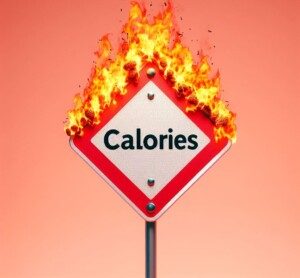
Understanding calories can feel confusing, especially with all the mixed messages around dieting and weight loss.
One moment someone tells you calories are the enemy. The next moment, someone else says they don’t matter at all. So, what’s the truth?
To start, it helps to understand what a calorie actually is and how your body uses them every single day.
What Calories Actually Are
A calorie is simply a unit of energy. It’s not a chemical, a nutrient or something your body stores like fat. It’s just a way of measuring how much energy food provides.
Of course, too much of that energy intake will result in storage of that energy — in the form of excess fat.
Calories are burned — or the energy is used up — by breathing, singing, thinking, digesting food and even sleeping, and of course, exercise.
Your heart beating right now is burning calories. So in a way, calories keep you alive.
- From a science standpoint, a calorie is the amount of energy it takes to raise the temperature of one gram of water by 1 degree Celsius.
- In reference to food, one calorie = the amount of energy required to raise the temperature of one kilogram of water by 1 degree Celsius.
But we needn’t memorize these definitions; we just know that the more calories a food has, the more energy it packs.
So, a tablespoon of olive oil or pine nuts will deliver more energy than will a tablespoon of ketchup or raisins.
Where Calories Come From
Calories come from the three macronutrients of protein, carbohydrates and fats.
- Carbs and protein each give you four calories per gram.
- Fat gives you nine calories per gram.
Alcohol also contains calories (and carbs), though it isn’t considered a nutrient.
You can think of it this way, for context: Drinking a glass of wine is like putting a cookie in your stomach.
Different foods provide different amounts of energy, but by bedtime, they are still just calories.
Not All Calories Operate the Same
Technically, a calorie is a calorie. But how your body uses it can vary. A hundred calories of candy behaves differently in your body than do a hundred calories of grilled chicken.
Candy digests fast, spikes blood sugar and may leave you feeling hungry again soon. Protein takes more energy to break down and can keep you satiated for longer.
So calories have the same energy value, but the quality of those calories matters.
Should you be afraid of calories?
Well, another contextual thought is this: Every single one of the world’s 295 million people — who are facing extreme food shortages and who are at risk for severe malnutrition and death by starvation — would grab the next calorie coming at them.
Nevertheless, some people do indeed have a very skewered outlook on calories.
This outlook has a range or can come in degrees, from slight to so pronounced that the person willfully avoids food to the point of becoming emaciated (anorexia nervosa).
But this psychiatric disorder isn’t about calories. It has much deeper roots.
At the opposite end, enormous amounts of food — and hence, calories — can be used as a coping tool for life trauma, leading to extreme cases of obesity.
But calories aren’t villains. They are fuel. Your body needs energy to think clearly, move comfortably and function optimally.
Problems usually come not from calories themselves but from too much or too little of them.
How To Think About Calories in a Healthy Way
Instead of labeling calories as something to detest, think of them as energy that helps your body run. At the same time, be judicious in how you choose what to eat.
Make your most valiant effort to limit ultra-processed foods and to eat at least five to seven servings a day of (any combination) fresh vegetables straight from the produce section and fresh fruits.
Final Thoughts on Calories
Calories aren’t monsters hiding in your meals. They are simply units of energy that help you live your life. We don’t need to fear them.
What we need to fear are the consequences of a junk food diet — even if you’re not overweight, even if you’re on the thin side and can easily “burn everything off.”
If calories have a tendency to trip you up when it comes to weight management, you can instead approach food intake by what your eyes see: portions.
Portion control is a remarkably effective way to lose excess fat and to maintain weight loss.
And with portion control, you’ll never have to fuss around with the hassle of counting calories.