Adults with ADHD who know their strengths from this neurotype tend to have fewer mental health issues.
And that makes a lot of sense, because ADHD indeed comes with some positives such as embracing spontaneity and not feeling unsettled by sudden changes in routine.
That’s the takeaway from an international study looking at ADHD from a more positive angle.
Researchers from the University of Bath, King’s College London, and Radboud University Medical Center in the Netherlands, teamed up to run one of the first large studies aimed at identifying psychological strengths linked to attention deficit hyperactivity disorder.
What the Study Looked At
The study, published in Psychological Medicine (2025), compared 200 adults diagnosed with ADHD with 200 adults without ADHD.
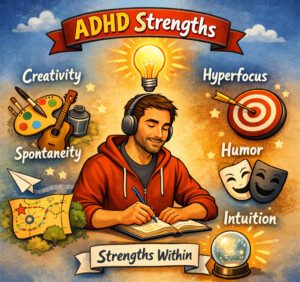
Participants were asked how much they related to 25 different positive traits, such as the following:
- Spontaneity
- Hyperfocus
- Creativity
- Humor
Historically, ADHD has been associated with “bad behavior,” being impulsive, making rash decisions, easy distractibility and forgetfulness.
This study intentionally flipped the script by asking what ADHD’ers might bring to the table instead of what holds them back.
What strengths did ADHD’ers report more often?
When the researchers compared the two groups, those with ADHD were more likely to strongly identify with 10 specific strengths.
Some of the standout ones included hyperfocus, or the ability to lock in deeply on interesting tasks, along with humor, creativity, spontaneity and strong intuition.
Being able to hyperfocus might sound contradictory to easy distractibility, but it’s actually a trait commonly found in ADHD when the individual is deeply interested in the topic or task at hand.
It’s actually a trait shared with those on the autism spectrum.
Even though people with ADHD often face real challenges at work, in relationships and with mental health, the study found something encouraging.
They were just as likely as neurotypicals to notice their strengths and use them in everyday life.
Mental Health
Across both groups — with and without ADHD — one pattern was clear. People who were more aware of their strengths and used them more often reported better outcomes overall. These included:
- Higher daily feelings of wellbeing
- A better quality of life in the areas of physical, mental and social
- Fewer symptoms related to stress, anxiety and depression
According to the researchers, this might sound obvious on the surface.
But having solid data behind it opens the door to building more effective mental health supports that focus on what people can do well, not just where they struggle.
What It All Means
The findings add support to strength based approaches in mental health care. These approaches are already more common in autism services, but they’ve been much less emphasized in ADHD care.
Potential options could include coaching, therapy or educational programs that help adults with ADHD identify their personal strengths and figure out how to use them in daily life.
Researchers say the next step is to test whether interventions that focus on recognizing and applying strengths can actually lead to measurable improvements in mental wellbeing for ADHD’ers.
Neurotypicals and Their Strengths
One of the more interesting aspects of this study is that it didn’t ask only those with ADHD about their strengths. By including adults without ADHD, the researchers could see which strengths were shared by both groups and which ones were more strongly linked to ADHD.
While many strengths showed up in both groups, some were clearly more often endorsed by people with ADHD.
Overdiagnosis of ADHD
Some conditions mimic attention deficit hyperactivity disorder in both adults and kids. Perhaps the two most outstanding of these are untreated sleep apnea, and Autism Spectrum Disorder.
Someone with unknown obstructive sleep apnea may end up being misdiagnosed with ADHD.
Someone (particularly females) with autism may end up getting an ADHD misdiagnosis.
Nevertheless, ADHD is a real condition, which is why when a true ADHD’er takes an amphetamine based medication such as Vyvanse or Adderall, the drug has the opposite effect when compared to how it would impact someone without ADHD.