How Much Does a Heparin Injection Hurt?

Anyone who’s had a heparin injection will tell you it’s no walk in the park. It hurts.
There’s just something about the heparin injection that makes it hurt more than a more typical shot that you might get, such as that for the flu or for a corticosteroid injection.
Now by “hurting,” I don’t mean any mere soreness after the shot, but the actual injection itself – which is administered to a person’s lower abdomen.
This procedure is commonplace for people after inpatient surgery.
Immediately after I received my first heparin injection for my preventive double mastectomy, I said, “It doesn’t hurt quite as bad as facial extractions on the nose.”
Then I changed my mind about that. It’s at least equal.
The nurse had never had a facial extraction so I explained them to her. They feel like a needle is being stuck deep into your skin – when it’s done on the tip or bulbous part of the nose during cosmetic extractions.
Oddly, extractions anywhere else on the face actually feel great.
An extraction is when the “black” in blackheads is squeezed out. When this procedure is done on the tip or bulbous portion of the nose, it hurts to high heaven.
Now maybe it hurts so much because multiple extractions are done in a very confined space.
But I can honestly say that a single extraction on the nose tip – single – hurts like hell.
The difference in pain between a heparin shot and an extraction on the nose is that the hep injection has a “thicker” feel, while a single extraction of a blackhead has a “thinner” feel.
Bottom line: Heparin injections hurt. But the pain is very short-lived.
Just lie there, close your eyes and let the nurse do her good work.
I can’t imagine multiple heparin injections in a confined area over a period of minutes, but then again, I can’t say it enough:
Extractions on the tip of the nose can give a heparin injection a good run for its money. Both hurt like mad!
Lorra Garrick has been covering medical, fitness and cybersecurity topics for many years, having written thousands of articles for print magazines and websites, including as a ghostwriter. She’s also a former ACE-certified personal trainer.
.
Top image: Freepik.com
You Know You Can Have a Heart Attack Any Day When…
You may have a heart attack at any time within 30 days if the following situations apply to you.
Some of these situations will surprise you, because you’d never think they could somehow foretell a heart attack coming at any time in the very near future.
In fact, “Anyone can have a heart attack at any time,” says J. Mark Anderson, MD, DABFM, of Executive Medicine of Texas and who is board certified in family medicine.
“Some heart attacks come with little to no warning signs, but there are certain symptoms that serve as a warning sign of an impending heart attack,” says Dr. Anderson.
Any Day Heart Attack Warning Signs
Dr. Anderson lists the following symptoms that an imminent heart attack can cause:
• Chest pain or shortness of breath that is worsened with exercise
• Fatigue after light exercise
• Women may experience anxiety or a sense of being unsettled
• Intermittent pain in the chest that radiates through a shoulder, arm, neck, or the chin. This may come and go.
• Morbid obesity
• Extreme or intense stress that raises blood pressure and strains the heart
• Exposure to drugs or stimulants
Study of Symptoms Women Had Shortly Before Heart Attack
The journal Circulation has a report warning that the following symptoms or signs can be a foreboding of a heart attack in women within 30 days.
A month prior to their heart attack, the 515 women in a study experienced the above symptoms but also, in addition to those, the following:
- Sleep disturbance
- Digestive problems
- Arms weak/heavy
- Changes in memory/thinking
- Appetite loss
- Cold sweats
- Dizziness
- Nausea
Though some of these symptoms seem non-worrisome, such as sleep disturbance and digestive problems, others are pretty concerning such as cold sweats and weak heavy arms.
Men, Take Notice: You Can Have a Heart Attack Any Day, Too
There’s no such thing as “only women have this, this and that symptom prior to a heart attack.”
The difference between men and women isn’t type of symptom, but likelihood or prevalence of a particular symptom.
- If you’re having any of these symptoms, can you explain them?
- For instance, does your indigestion occur ONLY after eating certain foods?
- Have you been diagnosed with strained rib cartilage that’s causing the upper chest discomfort?
- Did your sleep disturbance and anxiety begin right after you learned of some bad news and you can’t stop thinking about this bad news?
Especially if you already have risk factors for a heart attack (e.g., smoking, obesity, diabetes, sedentary lifestyle, junk food diet), you should get a full workup by a cardiologist just to be sure.
All of these symptoms can also be caused by non-cardiac conditions, such as heartburn, “silent reflux,” iron deficiency, side effects of medication, being out of shape, periomenopause or menopause and chronic fatigue syndrome – among many other non-cardiac possibilities.
At a minimum your cardiologist should have you undergo a 12-point EKG, lipid panel and echocardiogram.
The doctor should also feel the pulse in your carotid arteries and the arteries in your ankles, not just listen for it in your chest and back.
Normal results from a cardiac stress test can be very reassuring, but keep in mind that a normal stress test does not guarantee that nothing is wrong with your heart.
Stress tests (via echocardiogram) can actually miss heart disease. People can have a normal stress test, then suffer a heart attack the next day. Here is how that happens.
And don’t assume neither of your elderly parents have been diagnosed with heart disease just because they never told you.
It’s very easy to keep this a secret when the only treatment is medication. Even a stent placement for clogged arteries can be easily kept a secret.
Additional Tests to Request
- C-reactive protein, Lp(a), homocysteine and fibrinogen
- If your LDL number is high, ask for one of the following for a more refined result: LPP, NMR or cardio IQ report.
Ask your doctor about a calcium score test (which uses a CT scanner). He may discourage this due to negative findings with your other tests because it involves radiation.
However, you don’t need a physician’s referral to have your calcium score taken.
Calcium scoring is offered at various clinics for a reasonable fee and take about 15 minutes.
The gold standard for detecting coronary artery blockage is the catheter angiogram.

Catheter angioigram. Shutterstock/ MAD.vertise
This invasive procedure comes with serious risks and is never given to screen for coronary heart disease.
Rather, it’s given when a cardiologist is pretty darned sure that a patient has blocked arteries and is in imminent danger of a heart attack.

Dr. Anderson is coauthor of the award-winning book, “Stay Young: 10 Proven Steps to Ultimate Health,” and host of the nationally syndicated Staying Young Show which goes to podcast as Staying Young Show 2.0.
Lorra Garrick has been covering medical, fitness and cybersecurity topics for many years, having written thousands of articles for print magazines and websites, including as a ghostwriter. She’s also a former ACE-certified personal trainer.
Top image: Shutterstock/igorstevanovic
How to Make Vanilla Protein Powder with Water Tolerable

Here’s a very simple way to make any brand of whey vanilla protein powder highly tolerable when mixed with water and so easy to drink.
There’s no need to make a “shake” every time you want to take whey protein powder for post-workout recovery or whenever it’s time for your muscles to get another hit of absorbable protein. (more…)

How to Tell a Body Positive Woman Is Promoting Obesity

There are ways you can tell when a body positive overweight woman is promoting obesity, even when she’s rather cryptic about it. (more…)

What’s the Best Grip for Bent-Over Barbell Rows for Women ?

There is no one-size-fits-all best grip for the bent-over barbell row, whether you’re a woman or a man.
But there are guidelines for getting the most out of this back-dominant compound exercise. (more…)

Fear Twitching Muscles Mean ALS? Try Yoga for Strength Tests

Yoga is a great way to do strength tests if you’re convinced you have ALS due to twitching muscles. (more…)

You Know Your Diabetes Is Uncontrolled When …

You can live to 100 with controlled diabetes, but uncontrolled diabetes can kill you in a flash and is the leading cause of blindness and amputation in the U.S.
There is no reason for diabetes to get out of control, yet many people with this condition fail to properly manage it.
Here are signs that diabetes is out of control.
High Glucose Readings
• High blood sugar readings are not normal even for a diabetic.
• Check with your doctor about what your readings should be during key parts of the day such as awakening on an empty stomach; during intense exercise; after exercise; before bedtime, etc.
Increased Urination
• This doesn’t just mean frequency, but quantity.
• There’s more urination and total output because the body is trying to excrete excess blood sugar.

Shutterstock/Serge Vo
• The increased urination of uncontrolled diabetes is NOT from the greater fluid consumption that comes with uncontrolled diabetes’ increased thirst.
Increased Thirst
• High blood sugar induces thirst from dehydration.
• Despite drinking a “ton” of water you may still feel thirsty.

• Filling up on water is not the solution, as this condition can lead to a potentially ketoacidosis from rapid glucose spikes.
• Symptoms of ketoacidosis include nausea, dizziness, stomach pain, loss of consciousness and fruity smelling breath.
Sweet Smelling Breath
• In uncontrolled diabetes, the body breaks down fat for fuel, releasing a chemical called acetone.
• Any odd breath odor, be it sweet, fruity or like chemicals, is a warning sign that nets a prompt ER visit.
Hungrier, Eating More but No Weight Gain
• Blood sugar (glucose) is the body’s chief energy source.
• In diabetes, proper amounts of glucose fail to reach muscle cells.
• The body, desperate for a fuel source, generates hunger pangs (food is fuel).
• Increased food intake will not correct uncontrolled diabetes.
Unexplained Weight Loss
• The aforementioned problem can also be accompanied by weight loss rather than simply not gaining weight.
• Though eating more yet losing weight may be great news to anyone struggling with fat loss and dieting, it’s actually a huge red flag that something is wrong with your body.
Frequent Infections
• More skin infections than usual
• Common infections that take a long time to clear up
• Yeast infections of the genitalia
Cardiovascular Problems
• High blood pressure
• Poor cholesterol numbers
• Abnormal heart rhythm
• Chest pain

Freepik.com
Numbness or Tingling
• In addition to damaging blood vessels, uncontrolled diabetes can damage nerves.
• Don’t assume that the new-onset tingling or numbness in your fingers is carpal tunnel syndrome; could be uncontrolled diabetes.
Kidney Problems
• Urine that’s dark or the color of cola or tea
• Frothy urine
• Pain in the lower back
• Chronic urinary tract infections
• Absence of these symptoms do not always mean absence of early kidney disease.
Why So Many Diagnosed Diabetics Let Their Diabetes Get Out of Control
“What most diabetics don’t realize is that [type 2] diabetes is a choice,” says Dana S. Simpler, MD, an internal medicine physician with Mercy Medical Center in Baltimore, MD, who specializes in helping patients treat disease, obesity and diabetes with diet and exercise.
“If you have been diagnosed with type 2 diabetes — you have done it to yourself by eating the standard American diet,” explains Dr. Simpler.
“The fat in the overly processed American diet ‘clogs’ up the insulin receptors on our cells that then block the ability of our bodies to process and absorb carbohydrates and sugars.
“This leads to the high blood sugar in the bloodstream that causes heart attacks, strokes, kidney failure, blindness and poor circulation/amputations.
“The American Diabetes Association diet keeps the sugar down, but, never addresses the insulin resistance. Americans who really want to heal their bodies and get rid of diabetes must unclog their insulin receptors by eating a low fat, plant based diet.
“Even supposed ‘low fat’ animal products have too much fat and just keep people diabetic. Good health is not a given; it must be earned.”
The reason uncontrolled albeit diagnosed type 2 diabetes is so rampant is because unhealthy lifestyle habits brought on this metabolic disease in the first place.
Such an individual, having been chronically careless with their health, often continues this carelessness with the management of the disease!
It was too burdensome for them to eat cleanly and stick to an exercise regimen prior to the development of their type 2 diabetes.
Post-diagnosis, it continues to be burdensome for them to take charge of their health and keep on top of what’s going on in their bodies.
There is no reason why a person who’s been diagnosed with diabetes should allow this condition to become uncontrolled.

Dr. Simpler received her medical degree from University of Maryland School of Medicine and has been in practice for over 25 years.
Lorra Garrick has been covering medical, fitness and cybersecurity topics for many years, having written thousands of articles for print magazines and websites, including as a ghostwriter. She’s also a former ACE-certified personal trainer.
Guidelines for Heavy Weightlifting After Double Mastectomy

A former personal trainer who underwent a prophylactic double mastectomy documents her return to heavy strength training; great tips for safely regaining lost strength!
The surgeon told me to wait six weeks before resuming upper body strength training.
How long does it take a healthy woman, who’s been intensely and heavily training with weights for many years, to get back to her pre-surgery weightlifting levels following a preventive double mastectomy?
All I found online was a narrative by a woman who strength trained passionately to prepare herself for a prophylactic double mastectomy.
Though she reported that recovery was easy, she didn’t provide information about her upper body regimen postop.
Guidelines for Resuming Heavy Strength Training After Double Mastectomy

Shutterstock/sportpoint
I’m a former personal trainer and will be providing guidelines that apply to healthy patients whose double mastectomy was performed for preventive (prophylactic) reasons — WITH NO BREAST RECONSTRUCTION.
My deadlift for the last time prior to surgery.
5 x 225
3 x 235
Kettlebell Swing (to shoulder level)
13 x 72
Dumbbell Deadlift
4 x 160 (two 80-pounders)
Kettlebell Squat (held at shoulders)
8 x 70
Elevated Pushup (feet on a 24 inch stool)
5
Seated Dip (feet on 18 inch stool, hands on weightlifting bench)
8 x 70 pounds on lap
It will be intriguing to see how fast I return to my weightlifting strength of prior to the preventive double mastectomy. Stay tuned…
POSTOP UPDATE: 3 Weeks
The arm/shoulder movement issues, contrary to what the nurse had told me, have nothing to do with two weeks of inactivity.
I once had my left arm on lockdown for six weeks due to a clavicle fracture, and when I got the green light to reintegrate it into daily living, there were no mobility issues.
The mastectomy affects mobility because you’re left with less skin; the surgeon removes some of it.
It feels like the skin is being stretched too tight when I conduct certain movements. However, every day my range of motion increases.
Nine days postop the surgeon gave me the okay to resume strength training — LEGS ONLY. My legs are getting an intense workout and it feels great!
POSTOP UPDATE: 40 Days
I’m supposed to wait 42 days (six weeks), but I couldn’t help myself; I deadlifted 40 days out from my double mastectomy. But that’s all I did for upper body.
I started with just the bar and worked my way up to 135 pounds (5 x 5-8).
The nice thing about the deadlift is that it doesn’t require active chest muscle recruitment. And there’s no skin stretching due to the limited arm movement.
But pull-ups? Right now I still cannot dead hang due to the skin stretching.
Guideline #1. I have not been practicing hanging at all because I consider this a form of weightlifting — you’re opposing your body weight by clinging to a bar above your head.
And of course, upper body weightlifting is restricted for several weeks following a mastectomy.
POSTOP UPDATE: 41 Days
I deadlifted again today, just to see how high I could go before it began feeling too heavy to add more weight.
I topped out at 1 x 185 with an underhand grip. It wasn’t a struggle, but it felt as though I should not go heavier.
Guideline #2. When you’re off from lifting weights for six weeks, regardless of reason, it’s smart not to jump back in to see how strong you are. Particularly at risk is a low back overload or rotator cuff overload.
Below are my stats for 41 days post-double mastectomy, based on my approach of easing my way back in to heavy weightlifting.
Kettlebell Swing: 20 x 32.
Reverse Row (suspension straps). Surprisingly, the only hindrance was the fact that I haven’t done this for six weeks. I had anticipated a hanging issue with the skin still being tight, but this was absent.
Close Grip Lat Pull-Down. Ditto
Seated Cable Row. The only issue was the six week absence, but because it’s nearly impossible to injure yourself with this exercise with good form, I went heavy but still lighter than pre-surgical.
Dead Hang. Due to tight skin, I’m only placing my fingers around a high ledge with straight arms and simulating a hang, feet making contact with the floor.
POSTOP UPDATE: 42 Days
This was my first chest/shoulder workout since the double mastectomy. I took it very easy.
But not because of the double mastectomy. When you go six weeks without lifting weights, your trained rotator cuffs lose integrity and stability.
So for no other reason, when it’s time to resume strength training that engages the rotator cuff (chest and shoulder moves), GO LIGHT.
And “light” is relative to each individual. We don’t want to throw the rotator cuff to the sharks.
So though I felt that 15 pound dumbbells for a dumbbell press while lying on a fitness ball was ridiculously light, I limited myself to this — to prevent a rotator cuff strain.

Shutterstock/Catalin Petolea
For the same reason, I did pushups off my knees and overhead presses with 10 pound dumbbells.
Everything felt good, and next chest/shoulder session I will use heavier weights — but still within the rotator cuff protection range.
POSTOP UPDATE: 56 Days
Deadlift: 3 x 205, mixed grip.
Dumbbell Deadlift: 5 x 120
Dead Hang: 15 seconds underhand grip. For the overhand grip, I’m sensing that there’s five percent elbow flexion; so it may LOOK like a dead hang, but it doesn’t quite feel 100 percent there.
Pushup. Despite my pre-surgical ability, I’ve resumed these on my knees, due to the aforementioned rotator cuff factor. And the shoulders feel very tweaky.
On the last set of my last session, I felt a twang below a clavicle. It bothered me all evening.
But today, I had no issues with continuing my light chest and shoulder workouts, though I’m going to wait a bit before I resume pushups.
Guideline #3. You may want to consider avoiding returning to pushups UNTIL you’ve been back in the game somewhat with other chest movements.
POSTOP UPDATE: 66 Days
Deadlift at 2 x 215, mixed grip
Dumbbell Deadlift: 4 x 150
Day 76 – Deadlift: 3 x 215 and 1 x 220, mixed grip
Day 80 – Deadlift: 1 x 225, mixed grip
Day 89 – Deadlift: 3 x 220, mixed grip;
Kettlebell swing: 15 x 72.
Day 91 – Pushups with feet elevated on 18 inch stool, two reps. This advancement is very interesting because up to this point, I’d only been doing knee and then eccentric-only (lowering-only) pushups with my feet on the floor.
But on day 91, my shoulder joints felt very solid and capable. Remember, taking weeks off from upper body work means you have to be careful not to get ahead of yourself so that the rotator cuff tendons don’t get injured.
I just had a gut feeling I could do pushups off the 18 inch stool, keeping my body as straight as a board. Two reps were good enough for me.
MILESTONE!
So 97 days after my double mastectomy, I was able to deadlift 225 for three reps, three sets (mixed grip). Also, 1 x 230.
I resumed upper body strength training 40 days postop, so this means it’s taken one day short of eight weeks to regain the strength to do reps with 225.
I’m still not where I was pre-double mastectomy. Just a recap, I took six weeks off from upper body training–six weeks and three days, to be exact.
So it’s taking a lot longer to get some of my exercises back than the time I took off.
Day 101 – Deadlift: 1 x 235 (mixed grip)
Day 106 – Deadlift: 1 x 210 … overhand grip
Day 129 – Deadlift: 1 x 240 … mixed grip
With this single rep at 240, this makes me about where I was prior to my surgery.
My last bit of advice is, with these giant compound lifts, do not strain your guts out (unless you’re training for a powerlifting competition).
This is just a general good rule for strength training, whether you’ve had a double mastectomy or not. Wait until you feel good and ready before moving up in weight.
Lorra Garrick is a former personal trainer certified by the American Council on Exercise. At Bally Total Fitness she trained clients of all ages for fat loss, muscle building, fitness and improved health.
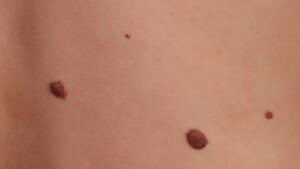
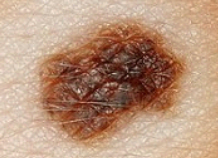
Have You Gotten 50 New Moles in Only a Month? What this Means
Over the course of just as month, about 50 new moles have appeared on your body.
This brings to mind melanoma or the possibility that out of all those moles, at least a few will develop into a melanoma. (more…)

Why Can’t You Raise Arms Overhead After Double Mastectomy

What are the actual reasons why a woman is told not to lift her arms overhead for two weeks after a double mastectomy?
Here is the answer – as it pertains to a prophylactic double mastectomy.
I’m scheduled for a prophylactic (preventive) double mastectomy after learning that my sister was diagnosed with breast cancer.

I was told that I will not be able to lift my arms over my head for the two weeks following the surgery.
But is this due to a mechanical inability or is it some kind of precaution?
After all, a preventive bilateral mastectomy does not involve cutting into any musculoskeletal or lymphatic tissue.
Here is what my breast care nurse, who is handling my case, responded when I asked her to explain why the restriction of overhead arm use for two weeks after a double mastectomy.
“Sometimes it can be difficult to raise your shoulder because it pulls on the drains…”
All patients of such a procedure must put up with drains for one to two weeks.
But pulling on drains falls under the category of discomfort rather than an inability.
However, there’s more…
The restriction is lifted after the drains are removed, said the nurse.
She also said, “I do know women who’ve had mastectomies who do feel comfortable lifting their arm above their head. Each person is kind of individual.”
However, my nurse explained that for those two weeks, even if you feel comfortable, you are not to do “long stretches over the head because it can ruin the incision, pull on the area. You can lift above your shoulder but no long stretches.”
- A long stretch would be what you’d have to do when putting on a shirt over your head and taking it off.
- A brief stretch would be, for example, while you’re seated at your computer, you raise your hand over your head to reach the switch on a lamp to put it on. That’s two seconds.
“But no long stretches; that could injure the surgical.”
This would include activity such as stocking high shelves with food or other items like linens, yoga positions, hair styling, or any other prolonged overhead motions, even if there’s intermittent lowering – such as in the case of placing several pieces of glassware in a cupboard.
So in summary, the reason you are instructed not to move your arms overhead for two weeks after a prophylactic double mastectomy is due to precaution rather than patient comfort or mechanical impairment.
However, some degree of mechanical impairment or difference will occur during recovery.
10 Percent of Women
“Poor range of motion after double mastectomy can occur in about 10 percent of women based on some small studies,” says Mylaine Riobe, MD, founder of Riobe Institute of Integrative Medicine. Dr. Riobe, who’s board certified in ob/gyn and integrative medicine, is the author of “The Answer to Cancer” and has over 15 years’ experience using integrative techniques to treat diverse patients.
Dr. Riobe explains, “Numbness and swelling were the most common symptoms [in the study].
“Some theories regarding the reason for reduced range of motion is because of the amount of skin removed during the mastectomy.
“A variation of mastectomy which is more ‘skin-sparing’ can be done which may theoretically reduce the likelihood of reduced range of motion.
“Most of the time, however, the chest area is kept as flat as possible to allow for proper fitting of a prosthesis.”
EDIT/UPDATE! I’m now 22 days postop, and I will tell you that lifting your arms straight over your head soon after a double mastectomy is problematic (but not impossible) due to the sensation that your skin is pulling so tightly that it feels that it will rip.
This is NOT related to two weeks of inactivity. It’s related to the surgery, though my muscle tissue was NOT touched.
I guess the skin was traumatized and just needs to rebound from the shock.
Anyways, at 22 days postop, I have no problem lifting my arms/hands straight over my head, but initially, the skin felt as though it was being pulled too tightly.
UPDATE 2 — Three and a half months post-double mastectomy … I can dead hang (holding onto bar above head with straight arms, feet not touching floor) for a whole minute.
- A sustained dead hang is the last thing to come back after a double mastectomy — in my opinion, anyways.
- Even a pull-up is easier because the arms are bending.
Level of physical fitness going into a double mastectomy plays a key role in how soon you’ll mechanically be able to effortlessly lift your arms/hands completely over your head.
The more strength trained or yoga trained your body is, prior to a double mastectomy, the less likely any postop doctor restrictions will stiffen your muscles and impede return to full range of motion!

Dr. Riobe has helped thousands of patients overcome difficult illnesses by addressing root causes, not just masking symptoms. The Riobe Method focuses on the prevention of disease, not the prevention of death from disease. She has 20+ years’ experience using integrative techniques to treat diverse patients.
Lorra Garrick has been covering medical, fitness and cybersecurity topics for many years, having written thousands of articles for print magazines and websites, including as a ghostwriter. She’s also a former ACE-certified personal trainer.
.