
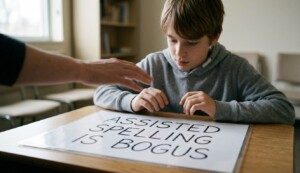
Like anything in life, there are authentic versions and there are phony or scam versions. Assisted spelling (rapid prompting method) is not exempt from this.
Today’s technology is a godsend for nonverbal autistic individuals because keyboards can sound out typed words.
The software knows when a word is complete when the user hits the space bar, places a period or taps on some other boundary such as the enter key.
The software will know not to announce “cat” after C-A-T, and instead will wait for the user to signal the word is completed: C-A-T-C-H-E-R.
This technology eliminates the use of a facilitator (rapid prompting method and spell-to-communicate are merely rebranded variations of the long-ago discredited facilitated communication).
When you see an autistic person tapping at a laminated letter card that’s being held by a facilitator, it’s extremely fair to wonder how legit this is, especially since keyboards can accommodate various challenges.
So if the nonspeaking individual is actually spelling on that plastic card that’s being held by their parent – why can’t they use a talking keyboard — on their lap or mounted securely without being held by that second person?
There are many ways to tell that facilitated spelling is fake.
Spoken Translation Is too Wordy Relative to Number of Card Taps
The parent speaks too many words, e.g., 50 letters in their narrative when it’s visibly clear that the user has tapped around only 15 times.
Words pour out of the parent’s mouth while relatively few taps are done.
Sometimes, viewers won’t realize this, while to others, the mismatch is very obvious.
Spoken Translation Is too Formal or Flowery
If the translation sounds overly sophisticated, this is a red flag.
I’m not saying that Autistics can’t be sophisticated.
As a professional writer on the Spectrum, I can compose heavily sophisticated text.
It’s easy for me to transfer this from my brain to my fingertips as a fast touch-typist.
It’s easy for me to transfer the intention in my brain to the output of my mouth, tongue and lips for spoken words.
But if all I could do, to create words, was point to letters on a piece of cardboard, there’s just no way I’d produce paragraphs of refined, complex sentences.
Rather, it’d be as simple and as straightforward as possible. That’s because pointing to one letter at a time to express one’s thoughts is a tedious process.
Imagine doing this to spell out complex sentence structures. It just doesn’t ring true, especially for a nonverbal autistic person who likely has considerable sensory issues or gets easily distracted.
So when the translator is “reading” off what the user is pointing to, and it’s packed with eloquence and formality, then by golly, this flag is as red as red can be.
Spoken Translation Has Many Filler Words
Kind of similar to the above, but the filler words are things like “May I,” “However,” “I would like to state,” and so on.
If all you could do was point to letters on a card, you’d be as economical and rudimentary as possible. It’s tedious.
You wouldn’t poke out: “I want mostly for neurotypical people to see that we have inner lives and dreams like anyone else so they are inclined to treat us like human beings.”
Yet this is precisely what Mary Brown allegedly read off as her son Woody was tapping at a letter board (that she was holding) while on the “Today Show.”
It would’ve been more believable had the pointing spelled, “I want nt people to see we have inner lives and dreams like all so they could treat us like humans.”
Go ahead, try this experiment: Make a letter board (just grab construction paper and put the alphabet on it, even QWERTY style).
Now, pointing to letters with one finger, describe to someone how your day went. It’s going to be pretty simple, short and sweet.
Spoken Translation Is Fluid and Flawless
Now imagine you’re the translator. Just how adept would you be at instantaneously reading off what someone is pointing to, especially if they’re jabbing away quickly?
In the film footage of Mary Brown translating what Woody is spelling, she doesn’t miss a beat.
This just isn’t realistic. Naïve people will insist she’s developed the skill to instantly translate as he rapidly pokes at the card she holds by having done this for years.
They might liken this to a sign language interpreter near-instantaneously translating spoken language.
You’ve seen them: People using American Sign Language to translate what someone is rapidly explaining at a press conference.
But this is NOT the same as watching someone quickly poke around on a letter card and fluidly reading it off seemingly at the same time and not missing a single beat.
The Tapping Is in the Same Area on the Card
If it’s difficult to tell where they’re tapping, then view it at 0.25 “playback speed” on YouTube.
If the footage is on TikTok or Instagram, then I don’t know how this can be slowed down.
But even at normal speed, it can be obvious that the tapping is in the same general spot.
The Speller Looks Away when Tapping
In the case of Woody Brown, whose mother claims he authored the novel, “Upward Bound,” via tapping at a letter board, footage shows him looking away while tapping.
The tapping is not done by touch, as in the standard touch-typing on a QWERTY board, where the keys are designed to be identified via tactile sensation on the fingertips and awareness of fingers in space.
A letter card doesn’t work this way. Even if the letter arrangement was QWERTY, even a touch-typist still would not be able to spell anything while looking away. That’s because the card is flat; there are no keys!
You might be able to slice an apple while looking away. But you will never be able to spell words, let alone strings of complex sentences, pointing to letters on a card unless your eyes are fastened to the card at every moment.
Try this experiment: With a letter card, point-spell what you like most or least about your job – while looking only slightly away.
Have someone watch where your fingertip goes; then have them provide feedback.
You can even conduct this experiment by yourself. Dab catsup or ink on your fingertip, then spell something simple such as house or hotdog. Then look at where the catsup is.
The Tapping Is Steady, Like a Metronome
It isn’t just Woody Brown who taps with a steady rhythm. I’ve seen this with at least one other tapper.
If I were to spell with my index finger, it’d be anything but steady with a fixed cadence.
Naïve believers in RPM such as with Woody Brown will argue that the even tempo naturally comes with practice over the years.
Well, that’s nonsense. I’ve been touch-typing at 80 wpm longer than the hills have existed, and it’s still erratic, non-uniform and irregular.
That’s because the landscape of words that I type continuously changes.
The landscape would continuously fluctuate if I were to spell with just my index finger also. There’s no way anyone, spelling with just an index finger, will have a steady cadence.
Try this experiment: On a letter card, spell out what you’d like to do on your next vacation.
Try to tap with a steady, unfluctuating tempo, like a metronome. It’ll be impossible. You’ll have better luck dribbling a football.
Vague or Obscure Filming Shots
There’s a YouTube of a man who claims his son, eight at the time, would point to letters that were tattooed onto the man’s arm to spell.
But I wasn’t convinced because at no point was footage shown of this actually occurring, other than a clip of the child spelling his name, Josh.
That’s not evidence this kid is speaking to his father through letters on his arm.
Many illiterate kids and adults can spell their name.
Why wasn’t an upclose shot shown of the boy’s finger actually spelling what his father claimed he could spell: ice cream? What about other things that would be an example?
None were shown. Instead the video shows multiple, and very brief, shots of the boy’s finger on Dad’s alphabet tattoo — but we can’t see what he’s pointing to — even when slowed down because the shots’ angle and distance prevent this.
In one scene, Dad is holding Josh’s hand while Josh points. I thought, “You’ve got to be kidding. Why are you holding his hand?!” You mean this boy can’t independently press his fingertip to a letter on your arm?
I’m not saying Dad was a scammer. He wasn’t trying to sell any books authored by Josh.
However, it seems that Dad had fallen prey to the ideomotor effect. Same with the mom of the Heath identical twins.
These young adults are seen on YouTube doing a form of assisted spelling: rapid prompting method.
But instead of using an index finger, they use a pencil to poke through letters on a stencil — which is held in the air by their mother. Seems to me that using that pencil to print on paper would be a lot faster, yet it’s not explained why this isn’t done.
The filming never allows the viewer to actually see a word being formed. So for example, in one clip, the camera films from the side.
The narration says the men want a career in medicine. Why aren’t we shown them poking through the letters to spell this out?
The Letter Board Is Held by a Second Person
Autism isn’t cerebral palsy. Why can’t the speller hold the card in one hand and point with the other?
Why can’t the card be securely mounted on their lap?
Why can’t it be on a table? How about an easle?
The Pointing Is Random; Gibberish
The producers and directors for “The Today Show,” who had on Mary and Woody Brown as guests to promote “his” novel, “Upward Bound,” didn’t think viewers would be smart enough to view the alleged spelling in slow motion.
In every scene where his finger is shown up close, nothing is ever spelled. It’s strings of gibberish. The fingertip even lands between letters or in blank areas at times.
You’ll know that assisted spelling is fake, without even the aforementioned signs, when you clearly see that the user is tapping randomly.