

Just diagnosed with ASD but don’t think you’re “autistic enough” since you don’t have the key traits? You likely do but in a way you’d never expect.
An example would by myself, when I wondered if my literal thinking was truly literal enough to be autistic-grade.
But as I’m coming up on the fourth anniversary of my ASD diagnosis, I’ve come to realize the many sneaky ways my literal thinking has abounded.
The lame example that the media typically uses is that Autistics think that “It’s raining cats and dogs” means a bunch of tabbies, Bengals, Rottweilers and Chihuahuas are falling from the sky. Come on now. Give us more credit.
However – there are many ways literal thinking can manifest – ways I had no idea until I began my autism diagnosis journey.
So though I know precisely what it means when someone says, “We’ll cross that bridge when we get to it,” and, “You really hit the nail on the head,” I’ve still found myself thinking in black-and-white terms.
Literal thinking can be nuanced, and if you just got your autism diagnosis but wonder, “But I don’t think literally,” here’s some food for thought (idiom!):
Often when I’ve had a prescription drug, the label has said, “Take every 4 to 6 hours.”
Literal-thinking me would schedule the dose at either every four hours or every six hours; or either four hours after the last dose or six hours – there was no such thing as five-hour increments.
This, people, is literal thinking! It’s sneaky indeed.
Autistic Diagnosis Imposter Syndrome
Some who are diagnosed in adulthood, especially later on, can end up doubting the diagnosis, especially after comparing themselves to other Autistics who “look more autistic.”
The “look” in this case refers to a visibility of the autism, such as peculiar mannerisms, a quirky or monotone voice or odd speech patterns, or openly stimming with their body (rocking, repeatedly tapping their face or patting their head, finger flicking).
I’ve been to many events for autistic individuals, and trust me, many don’t “look” the part.
This isn’t always due to masking. It could be just the way that person’s autism presents.
Remember: Autism is far more of an internal experience than the external behaviors that people can readily observe.
Below are classic autism traits that maybe you’re totally convinced you don’t have – making you wonder if your diagnosis is wrong. But take a good look at the following information; you might find that you do have these traits, full-on!
“But I Don’t Struggle with Change”
An Autistic may take the term struggle too literally. Someone with autism diagnosis imposter syndrome may also only think in terms of big changes such as a move or new job.
But unexpected change happens all the time, sometimes nearly every day – and your discomfort with it could easily go missed.
You could be making small adaptations to avoid change as well, not realizing that this is your autistic wiring at work.
• How would you feel if your friend just last-minute cancelled a lunch date — even before you left the house?
• What about when the gas pump you always use has an “out of order” sign on it?
• What about when someone has “taken” the locker you always use at the gym?
• Here’s a good one: The site you always use to make online payments has changed in layout.
I had always used the same entrance to the multi-level covered parking at the big medical clinic.
When I moved, the GPS guided me to the building from the opposite direction, where I spotted a different parking entrance that I had never used.
Well guess what: I wanted to use the usual entrance that I’d been so used to, so I kept on driving to get to the other side of the large building to use the familiar entrance.
It’s little blips like this that can be examples of “struggles with change.”
“But I Don’t Stim”
Are you sure about that? Even neurotypicals will stim: repetitive movements, actions or thought patterns.
With their literal thinking, a newly diagnosed Autist might think, “How could I be autistic if I don’t flap my hands, spin in circles, pace incessantly, rock my body or have any interest in fidget devices?”
Not so fast now. You could still be quite the stimmer without engaging in any of these particular repetitive actions.
And, like myself at one point, you might think you don’t officially stim because you suppress it in public and do it only at home when nobody’s around.
You might believe you never stim because it can’t be seen even if someone is with you.
Now let’s backtrack a little. There are tons of ways to engage in self-stimulatory behavior that fall outside the usual list you see in the media. For example, one of my stims is that of smelling my hair and talking out loud about it (when nobody’s around, of course!).
Remember the definition of stimming: repetitive movements, actions or thought patterns.
The definition for stimming has nothing to do with:
- How “big” the movement is
- How noticeable it is
- Whether or not it resembles common stims in neurotypicals (knee bouncing, foot shaking)
- Whether or not it’s socially acceptable (nibbling on a pencil, jingling keys, whistling)
- Whether or not it involves an external object such as a spinning device, squishy ball or “chewelry”
So if you think you never stim, you’ll want to heighten your awareness of any movements you make on a repetitive basis – especially when you’re alone when nobody can observe.
The following stims are definitely heard of in autism:
-
Teeth clicking
-
Pulling on or rubbing an area of skin
-
Rubbing one’s hands together
-
Hair twirling
-
Toe scrunching
-
Humming
-
Spending time watching spinning or fluttering objects
-
Repeatedly waving sheets of tinfoil to hear its sound
-
Enjoying the sound and feel of crumpling paper
-
Having to bounce that tennis ball all throughout the day
-
Feeling a texture over and over
-
Listening to the same song over and over
-
Saying the same things over and over in your head
-
Feeling soothed watching over and over water swirling down a drain
“I’m Not Stuck on a Routine”
There’s actually a spectrum of how needing routine can present. Yes, in some people, it can be highly rigid, and if one thing’s off in their morning sequence, their entire day could be toast.
But the need for routine can be more subtle, and this can be you without even realizing it.
- Wearing the same clothes every day around the house
- Must have your morning coffee in the same mug, same chair
- Walking through a space using the same path between objects
- Needing to do something the same way every single time even after you learned there’s a quicker way. This overlaps with feeling uncomfortable with change.
Needing routine doesn’t have to display as something dramatic or exceptionally rigid. Needing routine doesn’t mean a meltdown if you notice something on your desk is out of place.
The need for routine could be that of simply having a strong preference for sameness in your life, of having an aversion to a spontaneous day.
“I’ve Never Had a Special Interest: There’s Nothing I Know Everything About”
I recently read of an autistic boy whose aunt stated, “He can tell you everything there is to know about tornado sirens.” Well gee, if the Internet had been around when I was 12, I probably would’ve been able to answer any question about sharks.
However, during my infatuation with sharks, the opportunity to acquire knowledge about them was limited.
Knowing all there is to know about a topic is NOT a requirement for a special interest in autism!
The lack of encyclopedic knowledge could be an accessibility issue.
Sadly, it could be a parenting issue; my mother found my obsession with sharks to be quite unpalatable and would tell me to stop talking about sharks. My two older sisters looked down upon it.
This shrunk my ability to believe there was more I could do to learn more about sharks! But – what if my mother had been supportive and bought me a bunch of books on sharks (what little existed in 1975)?
Any number of variables could determine just how much knowledge someone gains on their special interest.
Sometimes, a special interest is about just staring at it for extended periods of time or creating it —see the image below reflecting a lifelong hyperfixation of mine — rather than “knowing everything there is to know.”

I am SO fascinated by racial mixes. What do you think this 14-year-old’s racial makeup is? I very carefully crafted her using AI, fine-tuning her to look exactly as I wanted: She’s three-fourths white, one-fourth black. I’ve also been playing around with varying hair color, hair texture, skin tone and eye shape to reflect other racial mix permutations. I’m not knowledgable of racial ambiguity as far as history, prevalence, famous such individuals, etc., and don’t even care to read up about it. But I can spend quite a bit of time using AI to indulge in this lifelong special interest!
Of course, these days, it’s easy to amass a serious volume of knowledge with just one’s fingertips.
Unfortunately, my special interest in sharks became downgraded to NT level long before the Internet began exploding with shark YouTubes and cable TV coming out with “Shark Week.”
A special interest also need not be lifelong or lasting years!
If you think you can’t be autistic because you’ve never had a hyperfixation, ask yourself if, past or present, there was ever a topic, event or situation that consumed a lot of mental space but fizzled out after only a few weeks?
THAT’S a special interest! I’ve had very short special interests in birds fatally crashing into windows (after a bird slammed into my living room window, spurring me into a deep dive on this subject); and in the 2010 fatal luge crash of Olympic athlete Nodar Kumaritashvili.
The “special” in special interest could also present in terms of collecting relevant items rather than amassing knowledge.
• I had cut out over 200 newspaper articles and cartoons about sharks and kept these precious clips in a shoebox — which I still have!
• I had cut out every newspaper clipping of a missing boys’ case when I was 10, and pasted them onto a giant poster board.
• I take pictures as discreetly as possible of big, “fat,” poofy voluminous ponytails in public.
I use these for my two articles on big ponytails – but the pictures serve way more than this purpose. I just get SO excited when I see a kickass ponytail – like, damn, more excited than a child in a candy store!
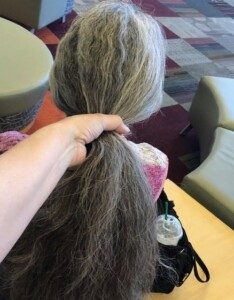
This lovely mature lady at a library allowed me to feel her glorious hair and gather it into a ponytail so I could take a picture. The sensory seeking delivered!
• Do you have an intense interest that, when the topic comes up or you encounter it somewhere, you just feel energized, even shaking your arms or hands over the thrill?
• Is there something that fascinates you yet don’t have extreme knowledge of, but once you start talking about it, you can’t stop, or you’re always seeking opportunities to inject it into a conversation?
“I’m Not a High Masker; I Can’t Be Autistic”
You may have read that many autistic people, especially women, mimic phrases and body language from TV shows to use in real life. And if you’ve never done this (I’ve never done it either), then you might be questioning your autism diagnosis.
There are many ways to mask. Before the TV was invented, just how did Autistics mask? People didn’t suddenly become autistic after the TV was invented.
Furthermore, high masking isn’t a diagnostic criterion, and if anything, skilled masking is impossible for many Autists.
I’m low masking, but not no-masking. I suppress most stims around people. I smile and nod my head when I think I should, rather than out of some innate intuition.
And I rehearse, rehearse and rehearse conversations.
If you have a habit of practicing anticipated conversations inside your head, over and over, this is a form of masking. You do NOT need to write out a flow-charted script, such as the autistic character “Patience” in the TV series “Patience,” in order to be on the Spectrum.
Remember what I said earlier: Autism is more of an internal experience than external.
Not a single person on this planet could tell I rehearse relentlessly and get stuck on past interaction loops in my head by simply looking at me.
Final Thoughts
Neurotypicals can conduct any of these behaviors. The issue boils down to intensity, degree and frequency, as well as the why, when and how.
For example, scripting and rehearsing for a job interview is common among even NTs.
And if you work out at a gym, you’ll see the stimming many people do between hard sets.
The irony is that the kind of thinking that comes with Autism Spectrum Disorder – logical, precise, literal – is the very thing that can fuel imposter syndrome over an ASD diagnosis!
