
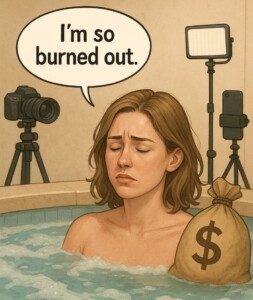
Young female influencers without kids crying of burnout despite working part-time hours and a lifestyle of luxury vacations, spa treatments, designer clothes and all the other privileges that come with making good money and especially if they’ve been born into wealth.
This can be summed up as the influencer entitlement-burnout cycle. These are influencers primarily in their 20s and early to mid 30s, often without children to worry about, yet who repeatedly claim periods of burnout from “carrying it all” nonstop like a locomotive.
I can easily imagine many single women with kids sizzling with fury upon reading the woeful posts by these privileged and childless influencers, with new sports cars and faithful husbands, who have plenty of time on their hands.
I know a woman who’s single-handedly raising a severely autistic teen in a rather cramped townhome with a single-car garage. I doubt her closet is stuffed with designer clothes, pricey shoes, upscale handbags and a box of precious jewelry.
And she works hard to bring income into the house and has barely any room to cook in her tiny kitchen while her nonverbal son must use an iPad to communicate basic needs.
But let’s remove disabled kids – even typical kids – from the equation and see what we get.
We still get these young female influencers forever griping about how tough and stressful it is living as an adult. It’s as though they never learned that adults need to work hard if they want rewards.
This has to be a product of a privileged, entitled upbringing; what else could explain why these influencers break so easily? It’s like, geez, what’s with all the crying and feelings of burnout?
Why not just soak in your Jacuzzi for an hour to recharge? You have plenty of room in your influencer schedule to fit that in.
So just where does their burnout come from?
The funny thing is that their burnout posts attract comments from everyday women with conventional jobs who also report burnout – but their burnout makes sense. They often:
• Report being single moms (unlike our privileged influencers who don’t even have a goldfish to take care of)
• Mention a stressful full-time work environment that they can’t just up and take time off from on a whim
• Financial struggles; can’t remember when they last had a vacation – while our influencers make posts about how stressful the baggage claim area was on their trip back from Bali.
• Custody battles with ex-husbands
• Battles with chronic illness while these healthy influencers get rattled when their manicurist can’t speak English well.
Holy hell, sounds like I’m jelly, right?
Well yeah, I am! I’m envious of any woman who never had to work much beginning smack out of college and who has a doting husband (who makes good $$$) and never has to worry about the cost of living. Like, who wouldn’t be jealous, right?
But I’m ANGRY when these influencers – who tell followers the secrets of great mental health despite themselves frequently crying over little things – lack the capacity to realize just how good their life actually is.
They break over the smallest things, while that single mom I know with the severely autistic teen would probably don a cape if her house got on fire.
Its Own Strange Cultural Moment
These younger-adult female influencers with no kids (and I guess we can even include the ones with typical children) crying burnout while working part-time hours and living on a steady drip of luxury vacations, spa days and designer everything is becoming its own strange cultural moment.
It’s not that stress isn’t real for them; it’s that the scale is wildly out of sync with the lives most people are living.
They have been groomed, somehow in their past during their developmental years, to over-react to every little curveball of life.
So yes, they truly do feel the pangs of stress or “doing things nonstop,” but have never developed the neural connections to brush the little things off, to choose their battles effectively, to recognize when something is worth getting uptight over vs. not worth more than a moment of consideration, to be tough like a bar of steel rather than as weak as a cooked spaghetti noodle.
When your biggest weekly pressure is filming a sponsored morning routine or keeping up with an Instagram aesthetic, it rings hollow to women juggling full-time jobs, childcare, maybe a chronic condition like migraine, mounting bills and worrying when the next big unexpected expense will come.
Many of these influencers also come from families with money, meaning they never had to grind through retail shifts, food service jobs or office politics.
Without those experiences, they genuinely don’t have the resilience that others were forced to build.
So normal levels of pressure feel catastrophic.
So normal levels of pressure feel catastrophic.
What Makes All of This Even More Jarring
What makes it even more jarring is that these same influencers often preach about wellness, balance, mental resilience and how to regulate your life — all while breaking down over deadlines they control, schedules they set and workloads that would be considered light in most fields.
It’s not malicious, but it shows a kind of bubble living: insulated, cushioned and unaware of how their complaints land outside their curated world.