This autistic woman hopes that the fad of 2 second body transformations soon goes out with the bathwater.
This fad is still well-fueled on Instagram and Tiktok. But I believe it’s now beginning to lose some steam as we head into the new year.
One day an influencer decided it’d be rad to post a “before” and “after” picture of herself – instantly losing 15 pounds by simply posing differently over a few seconds of time.
It caught on like wildfire; seemed like every influencer with a straight-size to slender body was doing this – believing that she herself was the innovator behind these “instant body transformations” – despite them popping up everywhere.
The trend is to put the “before” image on the left; the “after” on the right.
- In the before, her taut body appears perfect with spot-on posture (clad in high-waisted pants or leggings).
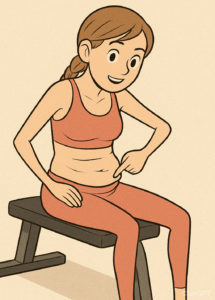
- In the after, it’s suddenly gotten puffy in select areas, often with poor posture (pants are noticeably pulled down to visibly increase the tummy’s softest areas).
- Sometimes the transformation is a video where the influencer fluidly shifts poses to make tummy rolls or cellulite instantly disappear and reappear and create other visual fluctuations.
- A common caption is, “Bodies that look like this [perfect] also look like this [flawed].”
Purpose Behind the Two Second Body Transformation
Seemingly the goal is to show women with body insecurity that everyone’s body looks unflattering off-camera.
However, there’s another reason that we can’t overlook and must seriously be considered.
The influencer herself is so insecure about her body – even though it fits the beauty standard of slimness – that she’s driven to create the before-and-after images to subdue her insecurities.
Absurdity Behind the Two Second Body Transformation
If you’ve seen enough of these before-and-afters, you’ll notice a common theme. This theme is the influencer with the prized body posing unrealistically in the image that depicts what she “really looks like.”
Sometimes they’re captioned such as, “What I really look like,” or, ironically, “When I’m not posing.”
These thinner body positive influencers will talk about how other svelte Instagram and TikTok stars will strike specific poses, using positional tricks, angles and lighting to make her body appear way more perfect than it actually is.
The influencer will call such posing unrealistic and deceptive. However, when she poses in a way she calls “naturally” and more relaxed, that’s the pose that’s unrealistic
…that’s the post that’s unrealistic!
- If she’s standing, her swimsuit bottoms, shorts or jeans are pulled below her belly button.
- If she’s seated, she has an exaggerated slouch that puffs out her middle.
- When standing she’s sticking her stomach out as much as possible.
She’s employing trickery as much as the other influencers who meticulously strategize poses to look as fit, as toned and as lean as possible.
And she believes her followers are dopey enough to fall for it. And she’s correct; many are indeed dingbat enough to.
Their trickery never escaped me, though. I’ve always been able to see right through it. No woman goes around wearing her swimsuit bottoms or shorts pulled so low.
When bottoms or pants are pulled this far down, it allows the influencer maximum space to puff out her tummy to make it appear paunchy.
The slouching looks so staged – to bring out the fake fat rolls; who really sits like that? And half the time, there’s very little fat in those areas; it’s mostly folded-over skin.
In the shots where they’re puffing out their stomach – often a profile view – they look like they’re in pain from the forced and unnatural belly distension.
But these daft two-second transformations have reeled in throngs of followers and accolades in the comments sections. Good Lord.
Offensiveness Behind the “Bodies that Look Like This Also Look Like This”
When thin, trim or straight-size women post these side-by-side photos, it can land badly with women who are actually plus-size and “look like this” every waking moment.
Obese women have clapped back by posting identical side-by-sides with the caption: “Bodies that look like this also look like this.”
What p’s off actually overweight women is that the thinner influencer claims to be real in those “This is what my body really looks like” shots. It ain’t real. It’s so obviously posed!
For plus-size women, that “after” photo is basically their default body.
And seeing it treated as a quick costume is frustrating and even infuriating.
Oddly, there’s only been a handful of bigger women who’ve shouted out about this craze among body positive thinner influencers.
It’s as though the thin ones are temporarily pretending to be bigger for more engagement, more likes, more views, more followers – and of course, to calm down their own massive body insecurities.
Thinner, more toned creators get praise for being “relatable” and “real,” while showing a body they don’t actually have all the time – not even a small amount of time.
After all, who in real life, in day to day living, walks around pushing their stomach out as much as possible?
Try that sometime. See how long you could tolerate the discomfort of keeping your belly forced out to maximal distension as you do housework, interact with your kid, mingle with a few friends, conduct shopping, walk the dog, etc.
Keep your shoulders drooped as much as possible while you’re at it. You’ll be aching in no time.
These influencers act as though they experience the same issues that very chunky or fat women do, which is really a joke.
As an Autistically-minded individual, I’m all about practicality, facts, authenticity and apple-to-apple comparisions.
I can objectively point out that fat women are subjected to experiences that non-overweight women never are – and this includes those thinner influencers who want everyone to believe they suffer as much as a 300 pounder.
- Few people comment negatively on their weight at family get-togethers, and this is pretty much non-existent for those with fashionably slim or straight-size bodies.
- Doctors are more likely to give them a thorough workup before diagnosing the cause of their new symptoms, whereas there are alarming cases of fat women who were told to “just lose weight” when ultimately, the delayed diagnosis turned out to be cancer.
- No one tells that size 8 influencer to lose weight in her comments sections.
So when a slim influencer produces pseudo fat rolls for a photo, it can feel dismissive to hefty viewers. It reduces their real struggles to a quirky optical trick.
The two second transformations shout, “See, everyone looks chubby sometimes!” when many women are thinking, “No — I look like that always.”
For someone who is actually plus-size, these side-by-sides of “Look at me five minutes later” are offensive – because that 200 pound woman’s body isn’t a pose; it’s their everyday, every minute reality.
And watching influencers “try on” that reality for clout can sting.
“But even thin women can have body insecurity too!”
There’s a saying I came across one day: “If your body fits the beauty standard and you still feel insecure about it, the problem goes way deeper than your body.”
I concur wholeheartedly. If a 200 pound woman is insecure about wearing a sleeveless shirt or a bikini, this insecurity is understandable and makes a lot of sense.
But when a straight-size or slender, and toned, woman has significant body insecurity – there’s something else going on – something buried, unrelated to her body, that needs to be excavated by either herself after some intense self analysis or by a skilled therapist who’s not afraid to probe deeply for the childhood root issue.
Instant Body Transformations Don’t Resonate with My Autistic Brain
The shots showing the “real” body are carefully posed to exaggerate or even create otherwise non-existent flaws. This gimmick of dishonesty is designed to manipulate and deceive.
My autistic brain hates misleading and deceptive information.
Hopefully, more and more neurotypicals will realize the trickery and offense behind this Instagram and TikTok fad – which has done nothing to collectively improve body image among teens and women, and has proven unsettling to heavy women who can’t instantly make belly rolls and plump thighs disappear.