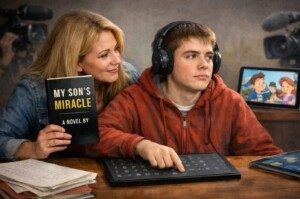
Did Woody Brown write “Upward Bound” or did mom Mary pen this novel? Why would this mom falsely claim her nonverbal, severely autistic son wrote it?
At face value, the story of a severely autistic, virtually nonspeaking man writing a novel is incredibly inspirational.
Think about it: Woody Brown patiently spelling out an entire novel letter by letter over two and a half years using the rapid prompting method (RPM).
His mother sits beside him as the facilitator, helping him “communicate,” and the finished manuscript is presented to the world as his work.
Major media outlets eat it up. It’s a ready-made human interest story.
But alas, look a little closer with just a tiny dash of scrutiny, and the story begins to fall apart. Pardon the cliché: It doesn’t hold water.
Videos of the alleged writing process show the young man tapping letters in a random-appearing way, plus while looking away from the board, staring at screens at his side.
When the videos are slowed down on YouTube, you can easily see his finger pointing only to random letters, plus even the spaces between them and above the border that surrounds the letter area!
Profile views clearly show him tapping the same spots three or four times in a row. This isn’t a secret code that only his mother knows; it’s not a secret shorthand; the letters are arranged qwerty style.
If this is all Woody can do for multiple film shots for his spot on “The Today Show,” then how do we arrive at the belief that he spun a novel? He obviously can’t even tap out, “Hi, I’m Woody Brown.”
A Closer Look at the Parents
Mary Brown holds an English degree and spent two decades working as a story analyst in film.
Supposedly her husband is an executive at Paramount Pictures. That’s a lot of word wizardry between Woody’s parents.
Their household contains at least one person with the exact professional background needed to write a novel and pitch it to the entertainment industry.
So why present “Upward Bound” as the work of a severely autistic, nonverbal son instead?
There’s multiple theories floating around out there, and perhaps more than one reason applies.
#1 Marketing Scheme
The simplest explanation may indeed be that of marketing. A novel written by an unknown writer is a hard sell.
Think of all the times you visited a major bookstore and were overwhelmed by the quantity of “new” novels – with amazing cover art and very curious titles – and author names you’ve never heard of: just TONS of them everywhere you look.
You have to wonder just how many of those books will ever be purchased – how many fantastic stories will never be read by more than just a sliver percentage of the store’s shoppers – epic tales in the realms of science fiction, period romance, mystery and … human interest (which is what “Upward Bound” could be categorized as).
However … a novel written by a nonverbal autistic man who supposedly spelled it out letter by letter despite enormous barriers? Now that’s a headline.
Media outlets love “against all odds” stories. It’s instant publicity that an ordinary debut novelist would struggle for years to get.
It’s such a feel-good idea that someone such as Woody Brown could bring to life the characters he had created in his mind, giving them unique personalities and cutting dialogue – despite his parents hearing Lord knows how many times, “Your son will never understand what’s going on around him; he will never learn to write.”
Readers are naturally drawn to stories that appear to demonstrate hidden brilliance in someone previously thought of as incapable of being successful in life.
Parents who’ve been in the film industry for years would certainly know this.
It taps directly into the public’s desire to believe that disability narratives always conceal a triumphant surprise.
Framing the book this way makes it more shareable, more interview-worthy and far more marketable. Ka-ching!
#2 The Career Angle
If the mother had written the book under her own name, it would have simply entered the crowded field of aspiring novelists.
Mary would certainly know that in this crowded field, even 20 years of analyzing film stories wouldn’t bump her much ahead in line.
She’d have to come up with something insanely unique to make people want to buy her novel.
Attach the book to a supposedly groundbreaking autistic author and suddenly it becomes a phenomenon.
Sales are flying with “Outward Bound” in a way that you doggone know would NEVER be had “Mary Brown” been the byline.
This all can open doors to speaking engagements, media appearances, advocacy platforms and potentially even movie interest.
In a family already connected to the entertainment industry, that kind of attention has obvious advantages.
Could the phony college degrees been an intended part of this plan?
One has to wonder if the fiasco of Woody getting a bachelor’s and master’s had been, all along, a highly calculated stage to set up for the future marketing of “Upward Bound.”
One has to wonder for how long his mother had been dreaming of this novel and how to “get it out there.”
Woody has already been publicly described as earning two degrees using RPM while his mother attended every class with him — and don’t forget, Thomas the Tank Engine was also ever-present on a screen that he viewed to help him absorb complex material during class!
Certainly, it’d be more believable that Woody wrote the novel if he’d already had the bachelor’s in English and master’s in creative writing.
It’s also possible that the idea for putting his byline on the novel came after the degrees.
Mary is writing a novel, and maybe halfway through gets hit with a lightbulb moment: claim that her nonverbal, severely autistic child is the author – for the reasons already explained.
And frankly, once you commit to a scheme like this, backing away becomes extremely difficult.
If the public starts questioning the authenticity of the communication method, the pressure to double down only increases.
The more interviews given and the more headlines generated, the harder it becomes to admit that the foundation of the story might not hold up.
#3 Creating the Son She Wished She Had
We can argue that no matter how much a mom loves her severely autistic child, she’ll always feel ripped off in some way.
To put it more eloquently, the parents will always find themselves pining for a more abled child.
“I wouldn’t change him for the world” may be a thing for those with mildly autistic kids. But what about kids with more profound autism?
Many parents won’t hesitate to inform you just how exhausting it is; the daily hardships, the endless struggles, the extreme anxiety over their futures.
Could creating a fictitious version of Woody have been a way for Mary (and her husband) to dampen the unforgiving reality of his impairments?
Yeah, Woody’s story in the media might come across as almost cutesy, with his obsession with Thomas the Tank Engine, his larger-than-life frame as he sits calmly and handsomely beside his mother on “The Today Show,” the many photos of him earlier in life with his room-lighting smile.
But anyone with a nonverbal autistic child who can’t even manage the most basic of daily self-care will tell you they’d trade the major deficits for mild ones in an instant.
So with that all said, it’s also possible that Mary was motivated by creating this “what would Woody have been like” version of him had he been born “normal.”
The make-believe that he’s a novelist with college degrees is a narrative that helps Mary cope with the never-ending feeling of loss, that daily kick in the ribs that comes from knowing your own son will never say, “Happy Mother’s Day” or even ask, “Hey Mom, what’s for dinner?”
At least with the charade, Mary can tell the media, “My son wrote a novel.” It helps her cope, even though this hoax may have been years in the making.
Money Spent on Woody’s Tuition vs. Money Made from Novel
It’s a giant gamble: Spending tons of money on a UCLA education; using the degrees as a gateway to the authorship deception; then hoping this will generate massive sales of the novel that will far exceed the tuition.
But as already pointed out, Mary could easily have had more than one motive to fake her autistic son’s authorship.
Secondly, maybe she really DID think that profits from the novel would far exceed the tuition.
And then there’s also, as already mentioned, the possibility that the idea for the novel came only after his (her) master’s degree.
The Verdict
None of this proves exactly what happened behind closed doors. But the incentives are obvious.
• A routine literary effort becomes a viral miracle story.
• A controversial communication technique gets a showcase success.
• A family connected to storytelling gains an extraordinary narrative to present to the world.
Some comments about Mary’s claims, seen on various platforms, have called her mentally ill and have even speculated that she suffers from Munchausen syndrome by proxy.
This mental illness is when a caregiver – usually the mother – purposely causes physical or psychological symptoms in their child to gain attention, sympathy, financial donations or to come across as heroic for the claimed caregiving.
But in Woody’s case, Mary has not willfully harmed him. She may, in fact, believe her sham is harmless, especially if she believes her son’s pronounced autism (which likely comes with co-occurring severe intellectual impairment) prevents him from grasping what’s been going on.
In Munchausen, the caregiver has full-on intention of harming their child. Mary doesn’t present this way. But that doesn’t mean her actions can’t have harmful consequences.
For example, all that time Woody spent in college classes could’ve been spent learning how to use proven assistive technology to communicate – tech in which he could independently express himself, even if at a rudimentary level.
And maybe Mary had already gone this route, realizing that even the bare minimum of communication could never be attained, regardless of mode.
This would’ve been devastating beyond words – catapulting her into devising that make-believe world where her son could do what “normal” people do: go to college, get a degree, write a book.
When you look at it that way, the mystery isn’t why the claim was made. The real mystery is why anyone expected it to go unquestioned.
Is there ANY chance Woody really did write “Upward Bound”?
RPM is, essentially, a rebranding of the long-ago scientifically disproven facilitated communication. RPM is actually FC with just some minor procedural differences.
Nevertheless, some verbally-limited autistic people truly can independently express themselves with RPM.
But their output is along the lines of “I love you” and “I am sad” and “where is dad” rather than the ridiculously flowery narrative that Mary verbalizes as Woody jabs at the board that she holds 100 percent of the time.
Print articles that have picked up his story contain passages from Mary, as she allegedly reads her son’s letter-pointing, that are closer to Shakespearean prose than just a young man answering a reporter’s questions. The translations come across as artificially sophisticated, even gaudy.
View the videos slowed to 0.25 speed. You need no further evidence than that.