An autistic woman with a special interest in racial ambiguity provides analysis!
“What is she?” people might ask upon seeing Mattel’s autistic Barbie for the first time.
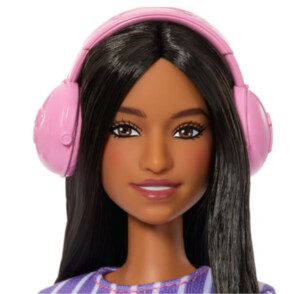
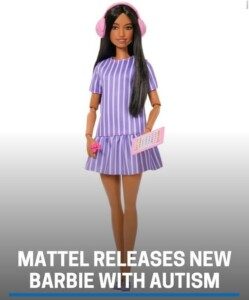
This latest Barbie, who joins Mattel’s inclusive group of Barbie versions, sports noise cancelling headphones, a functioning fidget spinner on her thumb, an AAC device in the other hand, mobile elbow and wrist joints so kids could make her stim, loose attire, simple shoes, and her eyes are shifted off-center in a subtle way.
Racial mixes and ambiguity have always fascinated me – since childhood.
It’s definitely in special interest territory. In fact, recently in a gym locker room for the swimming area, I told a woman her two young boys were beautiful.
They both had slightly tanned skin and curly dark blond hair. (Their father wasn’t there; only the mother, who appeared to be one-fourth black and three-fourths white.)
I then flat-out asked, “Are they one-fourth black, three-fourths white?” She confirmed this! Turned out she’s biracial and their father is white.
What race is the autistic Barbie?
With most of the Barbie collection, you could look at any of them and immediately know the race. But this particular Barbie – not so!
• Hair color is a soft black as opposed to raven.
• Her long hair is straight but appears “yaki” texture.
Yaki is a kind of hair extension – can be human or synthetic – that’s made to look and feel like chemically relaxed African hair.
There’s light yaki (silk pressed) and course yaki (blown out). The autistic Barbie’s texture appears to fall midway in between.
• Her doe eyes have a touch of almond to their shape.
• The color of her eyes is mostly clear brown with a tinge of green.
• Her nose is down-sloped, slightly prominent.
• Her skin tone is medium caramel.
• Her lips have moderate fullness; just the right degree.
We have quite a few possibilities here as to her racial makeup!
Analyzing Autistic Barbie’s Racial Ambiguity
#1 Hair Color. Any race can have this color, so let’s move on.
#2 Hair Texture. The yaki appearance suggests that she has some black ancestry.
It’s too easy to just say that she’s simply black with chemically straightened hair. Her collective facial features strongly suggest a mix.
If I were to choose the race that gives it the yaki look, I’d go with part African.
#3 Eye Shape. The slight suggestion of an almond shape suggests some Asian ancestry.
Though people without Asian ancestry might have eyes like this, I’m going to say that this neurodivergent Barbie has Asian in her genes (though actually, the hint of almond could also be due to Polynesian influence).
#4 Eye Color. The greenish tinge strongly suggests a European background – so definitely, she has Caucasian in her.
#5 Nose. The downward, slightly prominent shape is a really interesting feature; not common in glamour dolls.
To me it suggests some of her heritage is Middle Eastern. I’m part Lebanese myself, and I’ve noted that a more prominent nose seems to be more common in people of Mid Eastern background.
Though this nose can be present in many ethnic varieties, I’m going to say, for good measure, that she likely has some Middle Eastern in her, simply because this is a very unusual nose for a Barbie face template.
#6 Complexion. The skin tone is considered “dark,” though there’s another Barbie in the collection that makes her look pale.
On a global scale, autistic Barbie’s skin color would actually fall into the “medium” range.
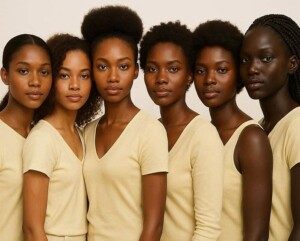
See the image below of skin tones; Barbie’s not really all that dark – but at the same time, she’s a lot darker than the typical Caucasian. The woman second to the left has a complexion that most closely matches the ASD Barbie’s.
With that said, just based on the skin color alone, she has one or more of the following “in her”:
- South Asian ( India, Sri Lanka, Bangladesh)
- African
- Samoan, Tongan or Tahitian
Now it’s possible that she can have East Indian, African and Samoan in her – all three! The East Indian could also be contributing somewhat to the overall facial features (other than eye color and shape).
#7 The Lips. Autistic Barbie’s lips are sought after by many women – those with thin lips and those who consider their lips way too plump.
Her lips don’t show any racial influence; they’re too middle-ground.
Giving Autistic Barbie an Actual Racial Makeup
There’s many possible permutations, based on the above analysis. In fact, it’s almost endless. Here are examples:
- Half East Indian, one-fourth black, one-fourth white (recall that I said that non-Asians could have an almond look to their eyes)
- Half East Indian, one-eighth black, one-eighth white, one-fourth Lebanese
- Half black, one-fourth white, one-eighth Asian, one-eighth South American
- Half Tahitian, one-fourth South American, one-fourth white
- Three-quarters black, one-eighth Asian, one-eighth white
You’ll note that the common denominator is Caucasian – to explain the clear brownish-green eyes.
However, even some traditional-appearing blacks have green eyes; I’ve seen many. And some of my pure Lebanese relatives have green eyes with their soft black hair and light olive complexion.
It’s believed, though, that somewhere in the ancestry of a black individual with green eyes is white heritage.
So regarding green eyes in black individuals, if we go with the more immediate heritage of autistic Barbie and exclude distant white background, here are some possibilities:
- Half black, half Asian (Asian influence can also explain the hair’s straightness)
- Three-fourths black, one-fourth Asian
- Half black, half Sri Lankan or East Indian
- Half East Indian, one-fourth black, one-fourth Asian
- Half East Indian, one-fourth black, one-fourth Native American
- Half black, half Middle Eastern
- Half black, one-fourth Middle Eastern, one-fourth East Indian
As you can see, there’s just no end to this.
The Final Verdict of Autistic Barbie’s Racial Background
It’s up to whomever gets one of these dolls! If a girl who’s a mix of East Indian, black and Asian gets this Barbie, she’ll naturally perceive it as the same.
If a girl is Tongan, black, Irish and Filipino, she’ll ascribe these heritages to the doll.
I’m glad Mattel made this autistic Barbie racially ambiguous, and in fact, I’m now thinking that this was a marketing move. They’re not going to come out with a bunch of autistic Barbies in different races.
Instead, they came out with just one: with features that can pass for many ethnicities and mixtures, depending on one’s imagination.
It’s a look that many people can see in themselves – even a pale skinned Caucasian child with blonde hair and green eyes can see herself in this Barbie due to the green hint to its eyes.
Or, a while little girl with dark eyes but straight long hair will like this doll’s straight long hair.
There’s something for everyone in this autistic Barbie!