Why do gym workouts with weights make bodies look strikingly different from the bodies of those who do hard physical labor such as construction and moving furniture?
I’m a former personal trainer and lifelong gym rat, and was inspired to cover this fascinating topic after reading a comment by a man online: “My work is quite physical; I don’t need to go to a gym.”
Though the classic “gym body” has a distinct appearance, this doesn’t mean that the next guy or woman you see with a buff body is only concerned about looks.
Training hard for fitness, strength and optimizing physical capability typically comes with the side effect of a V-tapered buff physique.
Workouts Make Gym Bodies Different Than Work Bodies
You might think, “My job is physical. I lift, carry, hoist, pull, push, drag, bend, reach and move all day. Why would I need a gym?”
Many people with physically demanding jobs assume their work provides all the exercise they need.
But gym bodies — also known as buff or lean and muscular — look very different from the bodies of men and women who use a lot of muscle on the job.
The Difference Between Strength and Repetition
One key reason is the type of activity. Physical labor at work often involves repetitive motions.
Lifting boxes, shoveling and digging, pushing heavy wheelbarrows, carrying sofas up a staircase — your muscles are moving, yes, but usually in the same pattern over and over.
This also seems to describe a strength training workout: the same routines, week after week after week. But there’s still a difference.
A gym workout (whether at an actual gym or in one’s home basement gym) focuses on structured strength training — with an effort level condensed into a much shorter time.
And though it may come off as repetitive (e.g., five sets of the bench press, 8-10 rep max, every Monday and Thursday), the repeated nature is very short-lived.
For example, an 8 RM deadlift set may take only 40 seconds. The key here is RM: rep max.
Physical labor on the job is not done for an RM; it’s done all throughout the day.
For example, movers will work seemingly nonstop carrying things out of a house and loading the truck, with very few rest breaks.
Landscapers will work repetitively and, again, seemingly nonstop all day.
Workplace labor is designed to be done for an entire shift. So though the work is hard, it’s not as intense as 45 seconds of an RM back squat set.
This is why weightlifting sets at RM typically last 30 to 60 seconds; and then the athlete can’t do a single rep after that max is reached.
Five sets of quick deadlifts using a weight load that makes more than 12 reps impossible, with a minute rest in between, is over in about six minutes.
That six minutes (which includes the rests) is so grueling on the individual’s body that they need do this particular routine only once a week for results (along with other deadlifting formats such as 3 x 8 RM, slower movement).
Nobody moves furniture or does roofing work for only six minutes. This impressive type of movement is stretched over many hours — though for sure, movers will pause at points on that staircase with the heaviest furniture to take a breather.
Essentially, they are working nonstop (though with breaks once they set down the furniture and get to the next piece) for hours, five days a week.
Fortunately, they get a generous rest during the truck ride, but must go at it again to furnish the new place.
Physical labor at the workplace usually isn’t explosive, such as with an 8 RM bench press set. If it were, it couldn’t be sustained — and you wouldn’t get your new roof completed!
By definition, explosive or power based movement can be sustained for only briefly.
The fitness workout engages mostly fast twitch muscle fiber, which is designed for brief bursts of high power.
Hard labor on the job calls upon slow twitch fiber (along with fast twitch). Slow twitch is designed for endurance — the ability to repeat the action all day long (and if you can’t, you’ll lose the job!).
The difference, then, is basically stamina — the workplace, whether indoor or outdoor — vs. brief bursts of power (the gym workout).
This difference is one of the reasons the bodies of workplace labor differ in appearance from those of a muscle building regimen.
- The entire gym workout may last an hour to two hours and can be quite intense, while the person on the job is working for eight hours.
- Both environments involve breaks (especially the workplace — natural breaks occur all the time), but the total time of exertion in the gym, if you were to add up the minutes, would be significantly less.
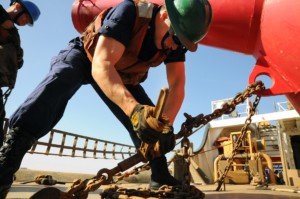
Sometimes, you’ll see people with jobs involving heavy manual labor with “gym physiques.” Chances are likely that they train with weights. This training will give them an edge in carrying out their job related labor and help reduce repetitive stress injuries and throwing out their back.
Work Builds Endurance, Gym Builds Muscle
The purpose of manual labor is to get a job done over an entire shift. The time this takes builds endurance, which is crucial for jobs such as movers, farmers and certified nursing assistants.
You might be able to lift or carry all day, but your muscles have been trained for stamina, not necessarily for size, sculpting or lifting that’s so strenuous it drains you after 45 seconds.
After a 5 RM deadlift, I don’t want to do anything for the next three minutes but slowly pace and do some stretching.
On the job, you can’t do this every time you move or carry something; your boss will not be happy.
Workplace labor is designed for longevity. Remember, it’s the slow twitch fibers that rule here.
- Slow twitch fibers don’t grow in size.
- Fast twitch fibers (used in bodybuilding and strength training) do grow in size.
Gym training often emphasizes controlled, higher intensity effort over shorter periods. This protocol calls upon the fast twitchers, which grow in size to adapt to this kind of stress.
Consistency and Progressive Overload
Progressive overload is a big one here. It means gradually increasing weights or difficulty over time. This is super key to muscle growth and shaping the physique.
Job duties usually doesn’t progressively challenge muscles in a structured way, so even if you’re lifting heavy items daily, your muscles adapt to the same load.
There’s thus no need for your muscles to grow and change shape when carrying things around on the job.
For example, loading planks of wood on shelves at the big box store is definitely hard labor, but…there’s no progressive component.
The planks don’t get heavier and heavier. The sofas that movers pick up and carry don’t get heavier; they all weigh pretty much the same.
And when something is too heavy for one person, a second person assists. Again, the goal is to get the job done, to transfer that 250 pound patient from their wheelchair to their bed.
With a structured, systematic muscle workout, if something’s too heavy, the lifter can simply reduce the resistance and push hard through that adjustment — with the goal of it eventually becoming less challenging, allowing them to progress to a heavier load — and so on and so forth. This approach changes the physique’s appearance.
The Role of Cardio and Conditioning
The 20,000 steps per shift that a nurse or CNA does are designed to get from point A to point B. There are times that medical staff must dash into a room. But over an entire shift, nearly every step is done for the purpose of getting somewhere.
Hence, there’s no push to get the heart rate up into a training zone.
When someone does aerobic training, the goal is to get the heart rate up or get into a heavy breathing zone, often where conversation would be uncomfortable.
This taxes the cardiovascular system in a way that the 15,000 steps of a restaurant server don’t do.
Gym days often include cardio routines to improve heart efficiency, lung capacity and fat burning. This contributes to the “gym body” look — more toned, less body fat.
Targeted Core and Stability Training
Another reason gym bodies differ is core and stability work. Jobs rarely focus on stabilizer muscles — the ones that improve posture, balance and functional strength.
In the gym, exercises like planks, mountain climbers, kettlebell swings and other stability work build these muscles, giving the body a more athletic appearance.
Nutrition and Recovery
Physical work burns calories, but most jobs don’t give guidance on nutrition or recovery. Gym-goers often pay attention to protein and carb intake, meal timing and rest days.
Recovery allows muscles to repair and grow. Without it, even hard physical labor won’t create the same muscle definition or strength balance.
Conclusion
Having a physically active job is great for reducing daily sitting time; the “sitting disease” has been dubbed the “new smoking” for a reason!
Walking around all day at your job is so much better for your body than sitting at a desk all shift.
You now know why gym bodies look different from the physiques of people who engage in vigorous manual labor on the job.
But there’s more: If your job provides a lot of physical activity, you still need structured, methodical exercise — simply because the work activity you do is not designed to strengthen your core, give you a bullet proof back and encourage symmetrical fitness.
On the job, your dominant side gets the brunt of hard work. Plus, the nature of the physical tasks is non-symmetrical on body position. These factors can create muscle imbalances leading to injury.
A strength training program will help reset all the imbalances, toughen up your lower back (making it far less susceptible to work related back pain) and make your core strong — all which will reduce the risk of work related repetitive stress injuries.
A sturdy gym body will also help dampen the level of injury sustained from accidents on the job and will aid in recovery from any work related sudden injuries.