
Which Body Part in Injured Teen Athletes Gets Surgery the Most?

If your teen is involved in sports, don’t be surprised if sooner or later, he or she gets injured and needs surgery.
There is one specific part of the body that when injured, requires more surgery than any other body part in high school athletes.
It is the knee.
(more…)
Can Being Religious Lead to Obesity?

How can religion lead to obesity?
Or is it that very overweight people are drawn to organized religion? What’s truly going on here?
The link between middle age obesity and religion has already been established.
What researchers wanted to know is the cause-and-effect relationship between religious involvement and obesity. So researchers from Northwestern Medicine decided to find out.
“We don’t know why frequent religious participation is associated with development of obesity, but the upshot is these findings highlight a group that could benefit from targeted efforts at obesity prevention,” says Matthew Feinstein, the study’s lead author, in the report.
The research tracked weight gain over a period of time, establishing that obesity comes after the religious involvement, not the other way around.
In the study, 2,433 women and men were tracked for 18 years. The findings in adults 20 to 32 years old was very intriguing:
If they had a high level of religious participation (at least once/week), they were 50 percent more likely to develop obesity by the time they hit middle age.
Variables of age, race, education, gender, income plus baseline body mass index (BMI) were adjusted for.
Does this mean that attending religious functions is bad for your health?
The study authors insist no. In fact, past studies show that “religious” people do tend to live longer than those who aren’t into religion – partly because faithful people tend to avoid smoking or smoke less.
“I am not familiar with this study, but personally I can see a correlation,” says Susan L. Besser, MD, with Mercy Medical Center, Baltimore; Diplomate, American Board of Obesity Medicine and board certified by the American Board of Family Medicine.
“I am a religious Jew — I attend regular synagogue services and participate in all religious events.
“These events generally include festive meals (read: more food, larger portions). So I can understand why weight gain might happen.”
Another possible explanation is that some religious or deeply faithful people are more apt to put their health in God’s hands.
Therefore, concern over diet, portions, exercise and weight wouldn’t be a high priority – hence leading to obesity.
 Dr. Besser provides comprehensive family care, treating common and acute primary conditions like diabetes and hypertension. Her ongoing approach allows her the opportunity to provide accurate and critical diagnoses of more complex conditions and disorders.
 Lorra Garrick is a former personal trainer certified through the American Council on Exercise. At Bally Total Fitness she trained women and men of all ages for fat loss, muscle building, fitness and improved health.
.
Top image: Alexisrael, CreativeCommons
Source: sciencedaily.com/releases/2011/03/110324104145.htm

Heart Disease, Depression Linked in Women Under 40

Young women shouldn’t have to worry about heart disease, right?
Well, they should definitely be aware of it, especially since it’s linked to depression in this very age group. (more…)

Causes and Prevention of Hamstring Injuries from Fast Running

When a fitness enthusiast or athlete suffers a hamstring injury, this really blows, but if you know the causes and the solutions, this will put you way ahead of the game.
Hamstring injuries can interfere with training for fitness, sports or physique competition: a hamstring injury disrupts running, and running is a heavily favored fat-burning activity for those wanting to slash body fat. (more…)

Groin Injuries: Which Sports Cause These, Risks, Treatment

Watch even just a little sports on TV, and sooner or later you’ll hear something about an athlete’s groin injury.
Sports that commonly result in groin injuries: running (or sports that require a lot of running or stop-and-go actions, like soccer, lacrosse, football, tennis and hockey.
Groin injuries can also strike inline skaters, surfers and people working their legs at the gym.
“Groin injuries are extremely common and often difficult to manage at
times,” says Peter Vitanzo, Jr., MD, sports medicine specialist at the Rothman Institute at Thomas Jefferson University Hospital, in Philadelphia.
“They can be very disabling for an individual, particularly an athlete.”
Seems as though when a professional athlete gets stricken with a groin injury, it persists and keeps the athlete out of commission for months on end.
Dr. Vitanzo explains, “These types of injuries can be a diagnostic dilemma at times, which can lead to a delay in being evaluated by a specialist and, ultimately, treating appropriately.
“This is one of the reasons these injuries can become chronic and stubborn to manage.”
What is a groin injury?
Vincent Perez, PT, with Perez Physical Therapy in NY, explains that “Groin injuries is a term typically used to describe strains/tears of several muscles: adductors and hip flexors. Those muscles are usually any of the adductors or the iliopsoas, which is the hip flexor.”
Dr. Vitanzo adds that patients may experience pain in the front of the groin area (hip flexor strain or even an iliopsoas bursitis).
Another area of pain is “deep on the inside of the groin (classic adductor strain), or even in the midline in the front of the pelvis (osteitis pubis or ‘sports hernia’).”
But no matter where the problem is, these injuries can be a real impediment to the athlete or trainee.
The muscle-tearing can result in scar tissue, and this is often the cause of recurrence.
Runners with Groin Injuries
In a way, this is a whole special group when it comes to these injuries.
According to Dr. Vitanzo, “In my experience, patients who are runners tend to present much later in their course with chronic symptoms, as opposed to other athletes whom I have dealt with who tend to present right away.

“I think a lot of this has to do with the mentality and passion of the ‘true runner’ and their unwillingness to have to stop running in order to appropriately diagnose, treat and allow these types of injuries to heal.
“This can become a problem because the longer these injuries linger, the longer and much more difficult they are to treat and manage.”
If diagnosis—and therefore treatment—are delayed, then treatment will require more time than ever away from the offending activity. This can be very difficult for the committed runner.
“Many times patients wait until the symptoms get so bad that they just can’t perform their activity anymore to the level they want to compete at.”
Treating the Groin Injury
Dr. Vitanzo says that when diagnosed promptly, these injuries can be managed without incident and the athlete can return fairly quickly to sports activities.
But if there is a delay in diagnosis—for instance, the sufferer thinks he or she can work it out without intervention—then the injury can become plain stubborn.
Perez explains, “They take a while because of the stress the area receives during aggressive sports, and the athlete’s training/rehab usually does not involve enough rotational movements with sufficient speed and intensity. Scarring obviously adds to the time.”
Cross-training should be part of treatment protocol, to prevent deconditioning.
If the injury is acute, then the usual fare of ice and anti-inflammatories is called for.
In a chronic groin problem, inflammation isn’t a key player; rather, scar tissue is—and scar tissue is much harder to treat. But there’s hope.
Dr. Vitanzo explains, “One of the newer diagnostic/treatment options includes use of musculoskeletal ultrasound which I incorporate frequently in managing these patients.
“The beauty of this type of study compared with MRI is that it gives dynamic views of an injury as opposed to static views like an MRI.
“Therefore, you can actually stress the area of concern while performing the study and really localize the injury, even subtle injuries which a ‘static’ study may miss.
“I have also utilized ultrasound guidance to inject these recalcitrant injuries with very good results and quicker return to activity times.”
Risk Factors for Groin Injuries
Perez says that insufficient warm-up and poor flexibility are at fault, along with possibly weakness.
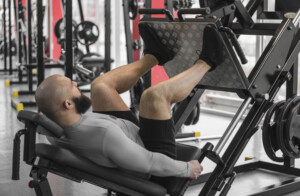
In fact, lack of flexibility can cause a groin pull or strain during a leg press motion.
If the trainee lowers the declined leg-press platform deeply, in combination with feet pointed outward (especially if feet are also far apart), then this will stress the adductor region.
Shutterstock/Motortion Films
This is a good exercise, but for people new at it, very light weights are mandatory.
Otherwise, the trainee may exit the equipment almost immediately feeling something wrong with the groin area.
Any adductor routines that combine resistance with stretching can put a person at risk for groin injuries — unless the trainee is flexible and already conditioned.
To get conditioning, the routine must be initially done gently and with light weights, if any at all.
Furthermore, aggressive stretching — perhaps by eager and impatient martial artists in an attempt to increase “splits” (both kinds) flexibility — can also injure the groin area.
Another risk is when a person engages in a sport that involves a lot of rotation in the pelvic region.
Again, stiff muscles and/or inadequate warm-up will increase risk of groin strains or tears.
Groin injuries do not need to be permanent. Full groin/adductor capabilities can be restored if:
Trainee stops making excuses and heads straight for an orthopedic specialist or physical rehab expert.
Trainee accepts the reality that he or she may need to completely avoid the offending activity for a while.
Trainee devotes time to a structured stretching and cross-training regimen that’s designed to bring back strength, increase limberness and break down scar tissue.
There is no cookie-cutter prescription for groin injury rehabilitation routines.
Groin injuries occur to different sections of soft tissue, and thus, necessitate different treatment modalities for each individual case.
In order to determine specific exercise motions, the sufferer would need a complete evaluation by an orthopedic specialist, who would then most likely make a referral to a physical therapist.
The physical therapist would then perform an evaluation of the groin injury, based upon which a set of specific routines could be designed.
 Dr. Vitanzo passed away in 2020.
 Vincent Perez has dedicated 25+ years as a licensed physical therapist to managing orthopedic and sports injuries. Perez has treated professional and amateur athletes in all sports including the New York Yankees.
Lorra Garrick is a former personal trainer certified through the American Council on Exercise. At Bally Total Fitness she trained women and men of all ages for fat loss, muscle building, fitness and improved health.
.
Top image: Shutterstock Syda Productions

Do the Inner & Outer Thigh Machines Really Burn Leg Fat?

BAD news: The adductor and abductor machines will not slim your chubby thighs or any other “fat” area of your legs and hips. (more…)

Why a Staircase in the House Doesn’t Mean Built-in Exercise

You do not have a built-in exercise regimen just because you use your home’s staircase to get from one floor to another.
This is transportation, not real exercise in the true sense.
Before I proceed with this surprise, since many people do believe that casual use of their home’s staircase counts as exercise, I must point out that this article is about just that: casual or transportation use of the stairs, as in going up the staircase to answer the call of your tween.
It is NOT about what would indeed count as real exercise:
-
- Running up and down the steps nonstop for at least five minutes
- Climbing the steps two at a time and trotting down nonstop for at least five minutes
- Bunny hopping up the steps and trotting down nonstop for at least five minutes
- Walking up and down the steps while holding dumbbells for at least five minutes.
These four examples are deliberate, continuous actions that will tax the body.
That’s a whole new article. What I’m discussing here is the intermittent, incidental use of your staircase to get from one floor to another in your house.
Do not count that as exercise, as it lasts only about eight seconds. In other articles of mine, I praise the virtues of burst training: one-minute bursts of intense movement scattered throughout the day.
Burst training can definitely include deliberate, willful use of a staircase for the bursts: bounding up the steps as fast as possible, up and down, up and down, up and down, then up — to retrieve your purse.
But there is no comparison to eight seconds of casual walking up a flight of stairs to 60 seconds of any of the following: squat jumps, lunge jumps, pike jumps, burpees, pushups, side-to-side jumps, ball-wall squats, stool jumps, kicking, medicine ball movements, etc.

Burpee. Taco Fleur/CreativeCommons
And few people are “up and down the stairs a hundred times a day.” Take a tally and you’ll likely see the total by nightfall is far less than what you’ve always thought.
The staircase is a great tool in the house for exercise sessions, as described above.
At the conclusion of this article is a video of an actual staircase workout (using a short staircase). The exercises begin at 1:45.
Again, casual use of your staircase does not excuse you from setting aside specific time slots for exercise that makes you pant.
If you’re panting at the end of a casual eight or 10 second climb, you’re in poor shape.
You need time slots for continuous exercise that taxes the body, that forces your body to adapt, that forces your cardiovascular and musculoskeletal system to become more efficient.
Eight or 10 seconds here and there throughout the day won’t cut it.
However, if you’re in poor shape or “out of shape” and commit to dashing, as fast as safely possible, up the staircase whenever you casually use it, this will have a training effect.
But this training effect, because it lasts only several seconds, and because it has mechanical limitations, will go only so far.
You’ll reach a point where you’ll stop progressing, because it’s all over in only seconds, and again, there are mechanical limitations — you can only go so fast up the staircase, even if you have the potential to sprint down the street very fast.
You can progress to dashing up two steps at a time, but this, too, has its limits, and can also put you at risk for stumbling sooner or later.
I encourage you to safely dash up the steps for all casual use, but you still must set aside a time slot reserved for continuous exercise.
“Continuous” includes sessions of high intensity interval training. HIIT is continuous in the sense that the time slot is solely committed to this, even though the actual exertional time may be only four minutes out of a 30 minute time allotment.
Millions of people have a staircase in their home. Many of these women and men are totally out of shape.
The presence of a staircase in your house does not automatically make you physically fit.
It does not subtract from the daily (or at least, almost daily) exertional exercise that you should be getting.
Lorra Garrick is a former personal trainer certified through the American Council on Exercise. At Bally Total Fitness she trained women and men of all ages for fat loss, muscle building, fitness and improved health.

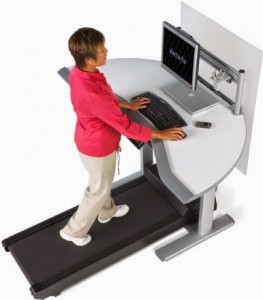
How Many Steps Daily on a Treadmill Desk Negate the Sitting Disease?

Are the number of steps on the treadmill desk more important than the amount of time spent on it to offset the “sitting disease”? (more…)
Why You Shouldn’t Use a Treadmill Desk for Weight Loss