
Once again a report of a missing autistic adult describes her as having “the mind of a 10-year-old.”
That’s important information as far as the search efforts.
The problem is the way it’s written, which is typical of these news reports that are always popping up in the results for “autism Google news.”
In this case, the narrative is as follows: “Memphis Police said Ingram has been diagnosed with autism and has the mind of a 10-year-old.”
The way this is worded can be interpreted to mean that autism causes intellectual impairment.
If such an individual is autistic and also has the mind of a child, then there are TWO distinct conditions that this person has, and they are not related: autism and intellectual disability.
The story should instead read:
“…has been diagnosed with autism and also an intellectual disability, the latter yielding the mind of a 10-year-old.”
This way, it’s clear that the autism isn’t the intellectual deficit, and the intellectual deficit isn’t the autism. Instead we have two separate conditions that just happen to be co-occurring.
Clarifying this in a brief news story does not require a master’s in English.
This misleading journalism is rather common. I see it all the time:
“…has autism and the mind of an 8-year-old.”
Many readers will see this as two separate, unrelated conditions. However, many will also see it as a bundle.
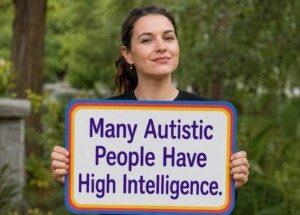
This is why, even today, there are people who believe that Autistics aren’t very bright, or if they are smart, they’re a minority and the high intellect is limited to math, how trains work or memorizing massive amounts of trivia.
Poor journalism contributes to this myth. Ideally, a report of a missing person with autism, who also is intellectually disabled, would read: “Randy is autistic and in addition, has an intellectual disability with the mind of a 10-year-old.”
This can be tweaked, of course, such as, “Randy has the mind of a 10-year-old due to an intellectual disability, and also has autism.”
This kind of wording eliminates the possibility that readers will associate autism with an intellectual handicap.
Many autistic people are in lines of work that require well-above average intelligence: teaching, medical, psychology/mental health counseling, engineering, IT, computer science, architecture, law, writing, music composition, entrepreneurship, sales leadership, YouTube educating and so much more.
